How Regulatory and Documentation Practices Support Peptide Trials
Peptide research depends on more than scientific discovery—it requires strong regulatory oversight and accurate documentation to ensure reliable results. This article explains how compliance, traceability, quality systems, and proper recordkeeping support the integrity of peptide trials. From source verification and chain-of-custody records to Good Clinical Practice (GCP) standards, these processes help researchers maintain data quality, protect participants, and strengthen confidence in study outcomes. A useful overview for anyone interested in peptide research and clinical trial best practices.
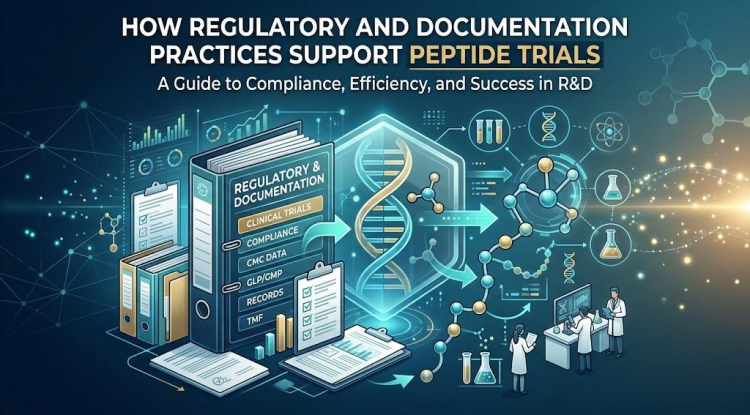
Peptide research has expanded quickly in the United States because peptides can help scientists study signaling pathways, receptor binding, metabolism, and tissue response with a level of precision that is difficult to achieve with larger biologics. At the same time, this field depends on strict oversight. A peptide trial is only as credible as the systems that govern how materials are sourced, how records are kept, and how results are documented. When those systems are weak, the science becomes harder to trust and the trial may lose regulatory value.


That is why research teams often begin by confirming that their materials and records meet basic quality expectations before any study starts. In practice, that can mean verifying supplier documentation, lot traceability, storage conditions, and chain-of-custody records for research-grade peptides. These early steps do not guarantee success, but they do help researchers reduce avoidable risk and create a defensible study framework.
For American audiences, this topic matters because peptide studies may intersect with FDA expectations, institutional review processes, laboratory quality systems, and sponsor obligations. Whether a trial is exploratory, preclinical, or part of a larger clinical development program, regulatory compliance and documentation are not paperwork afterthoughts. They are core scientific tools that support safety, reproducibility, and accountability.
Key points
- Regulatory oversight helps ensure peptide studies are designed and conducted responsibly.
- Documentation creates traceability, supports data integrity, and makes audits manageable.
- Source verification, lot tracking, and storage records are essential to study reliability.
- Good Clinical Practice and laboratory quality systems improve consistency across teams.
- Clear records protect both the scientific value of the trial and the people involved in it.
Why Regulatory Structure Matters in Peptide Trials
Regulatory structure gives peptide trials a framework for decision-making. In the U.S., this framework may include FDA guidance, Institutional Review Board review, informed consent requirements, sponsor oversight, and internal quality controls. Even when a study is early-stage or nonclinical, the same basic principle applies: research must be conducted in a way that can be reviewed, repeated, and defended.
Peptides often present special questions because they may be synthesized, modified for stability, or studied in very specific biological contexts. That means the trial team must be clear about intended use, material identity, purity expectations, and handling conditions. Regulators and reviewers are less concerned with marketing language and more focused on whether the study design protects subjects, preserves data quality, and follows established procedures.
FDA expectations and study credibility
In the United States, the FDA does not simply care whether a study produced a result. It also cares whether the result came from a process that can be trusted. That includes proper protocols, adverse event reporting where applicable, monitoring, source documentation, and accurate final records. If a peptide trial is part of a clinical development pathway, the sponsor must be able to show that the product and the study were managed under appropriate controls.
Regulatory compliance also helps avoid confusion between research use and commercial use. This distinction matters because peptides used in research settings should not be treated as interchangeable with materials intended for human administration outside approved study conditions. A clear regulatory boundary protects participants, investigators, and institutions.
Documentation as the Backbone of Trial Integrity
Documentation does more than satisfy an auditor. It tells the story of the study. If a trial record is incomplete, it becomes difficult to determine what happened, when it happened, and who was responsible. In peptide research, this is especially important because small differences in handling, concentration, or storage can affect outcomes.
Strong documentation practices support the entire research lifecycle. They help with planning, execution, monitoring, analysis, and reporting. They also allow teams to identify deviations quickly and correct them before they compromise the study.
Essential records for peptide trials
- Protocol documents: Define objectives, endpoints, inclusion criteria, exclusion criteria, dosing, and procedures.
- Material sourcing records: Identify supplier, lot number, certificate of analysis, and receipt date.
- Chain-of-custody logs: Show who handled the material and when it changed hands.
- Storage and temperature logs: Confirm that peptides were stored under required conditions.
- Laboratory notebooks or electronic records: Capture observations, measurements, and changes.
- Deviation reports: Document any departure from protocol and how it was addressed.
- Final reports: Summarize results, limitations, and conclusions in a transparent way.
These records should be timely, legible, and complete. Backfilling notes after the fact can introduce errors and undermine confidence in the data. Good documentation habits make it easier for teams to spot trends, compare batches, and support reproducibility across study sites.
Source Verification and Material Traceability
One of the most important parts of peptide trial support is knowing exactly what material was used. Traceability starts with the source and continues through receipt, storage, preparation, and disposal. Researchers should be able to answer basic questions at any point: Where did the peptide come from? Was it the correct sequence? Was it tested for identity and purity? Was it handled according to the protocol?
Certificates of analysis, batch records, and receiving logs are not just administrative files. They are evidence that the material met the study’s expectations. If there is ever a question about a result, those documents help investigators determine whether the issue came from the peptide itself, the handling process, or another variable in the trial.
Why traceability reduces risk
Traceability reduces the chance of mix-ups and helps researchers identify the root cause of unexpected findings. It also supports transparency if the study is reviewed by an IRB, sponsor, journal editor, or regulatory authority. Without traceability, even a well-run experiment can be difficult to defend.
For example, if a peptide is reconstituted incorrectly or stored outside the approved temperature range, the study team needs a record that shows what occurred and whether the affected material was removed from use. That kind of clarity protects the integrity of the data and helps prevent invalid conclusions.
Good Clinical Practice and Quality Systems
When peptide research moves into human studies, Good Clinical Practice becomes especially important. GCP provides a set of ethical and scientific standards for designing, conducting, recording, and reporting trials involving people. It emphasizes participant safety, informed consent, data accuracy, and accountability.
In parallel, many research organizations rely on internal quality systems to support consistent operations. These may include standard operating procedures, staff training records, document control procedures, corrective action plans, and periodic audits. Together, GCP and quality systems help ensure that peptide trials are not dependent on memory or informal habits.
Practical benefits of quality systems
- They reduce variation between team members and study sites.
- They make training expectations clear for new staff.
- They help detect errors before results are locked in.
- They support standardized responses to deviations or complaints.
- They improve readiness for inspections and sponsor reviews.
In a fast-moving research environment, standardization may feel burdensome. However, it is often the difference between a study that can be replicated and one that cannot. Consistent systems protect both scientific quality and institutional credibility.
Data Integrity and the Role of Audit Readiness
Data integrity means the information collected during a trial is accurate, complete, consistent, and trustworthy throughout its life cycle. This concept is central to peptide trials because many studies involve precise measurements and small sample sets. If data are altered, misplaced, or incompletely recorded, the entire interpretation may be compromised.
Audit readiness is a practical extension of data integrity. A team that keeps organized records can answer questions from auditors, sponsors, and regulators with confidence. That does not mean the trial is perfect. It means the team can show how decisions were made and where evidence is stored.
What auditors often look for
Auditors often review whether the study followed its protocol, whether records match reported results, whether deviations were documented, and whether personnel were trained for their tasks. They may also examine source documentation, consent records, calibration logs, and storage controls. Strong documentation makes these reviews much smoother.
Ethical Oversight and Participant Protection
Regulatory and documentation practices also serve an ethical purpose. In human peptide trials, participants have the right to understand what the study involves, what risks may exist, and how their information will be used. Informed consent documents, IRB approvals, and adverse event records all help protect that right.
Ethical oversight is especially important when a trial involves compounds that are still being studied for safety or biological effect. Researchers must be careful not to overstate benefits or understate uncertainties. Clear documentation helps ensure that promises made during recruitment are consistent with the actual protocol and with the study’s evolving findings.
Building a Practical Documentation Culture
The best documentation systems are not built only for inspections. They are built into daily workflow. That means staff understand what must be recorded, when it must be recorded, and where it must be stored. It also means leadership treats documentation as part of the scientific process rather than a clerical chore.
Practical steps include using standardized forms, training personnel on recordkeeping expectations, reviewing logs regularly, and assigning responsibility for document control. Electronic systems can help, but only if they are validated, secure, and used consistently.
Teams should also create a habit of reviewing lessons learned after each study phase. If a storage log was unclear or a protocol amendment was delayed, those issues should be addressed before the next trial begins. Continuous improvement is one of the strongest signs of a mature research program.
Conclusion
Regulatory and documentation practices are not secondary concerns in peptide trials. They are foundational elements that shape how a study is designed, conducted, reviewed, and understood. From source verification to final reporting, each record contributes to a larger system of trust. For U.S. researchers, sponsors, and institutions, that system supports compliance, protects participants, and strengthens the scientific value of the work.
When peptide trials are supported by clear procedures and complete records, the results are easier to interpret and easier to defend. That is true whether the study is exploratory or part of a broader development effort. In the end, careful documentation and regulatory discipline do not slow research down. They make it possible to move forward with greater confidence.
What's Your Reaction?