7 ERP Implementation Services for Tin Container Manufacturers
Explore the 7 ERP Implementation Services for Tin Container Manufacturers to streamline production, improve inventory control, reduce costs, boost efficiency
The global tin container market is experiencing the significant growth, with reaching around the $855.75 million by year 2034 at a CAGR 3.6%. And most of the tin container manufacturers address the concerns of the daily reality of operational issues. Production managers often switches between the spreadsheets to track, monitor the various departments including the inventory, finance teams


For those manufacturers still managing operations with the disconnected systems and the regular manual processes, According to the research shows that 97% of business organizations shows the improved business processes after implementing the ERP systems in their company, and from the Gartner studies estimates that more than 70% of implementations fall short of their original business objectives
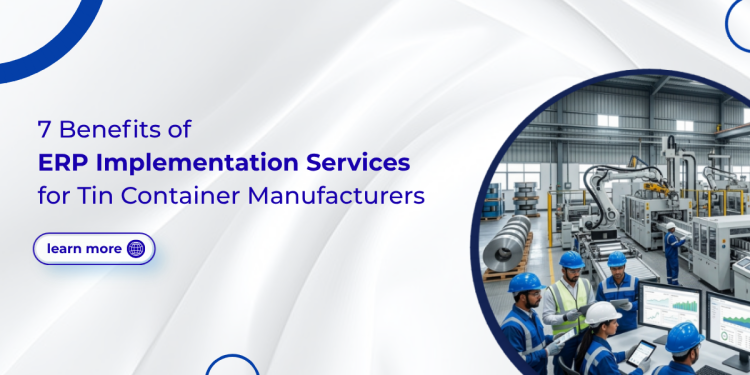
Why Tin Container Manufacturers Need Specialized ERP Implementation
Tin container manufacturing have the unique challenges. Raw material costs for tinplate are volatile. Production involves multiple stages beginning from the coil cutting and printing to forming and sealing the each requiring coordination.
An ERP system designed for general manufacturing simply cannot possess these requirements. Professional ERP implementation services connects the gap, configuring systems to manage the specific workflows, optimizing the expenses, and required in tin container production. Here are the key seven measurable advantages these services deliver.
1. Real-Time Inventory Control:
Removing the Stockouts and Overstock Situations
Manual inventory tracking creates a dangerous lag between physical stock movement and system records. This disconnect often results in production delays when materials appear available but are actually allocated elsewhere—or excessive inventory that ties up working capital.
A properly implemented ERP system provides real-time visibility across all inventory locations. When a coil of tinplate arrives at the receiving dock, it is immediately recorded and available for production planning. Research confirms that real-time tracking reduces guesswork in procurement and production scheduling.
The Financial Impact of Accurate Inventory Data
Royal Can Industries, a leading packaging can manufacturer, implemented SAP ERP to eliminate excess and shortage stock issues. The result was improved inventory accuracy and detailed visibility into costs by product and process, enabling a 5% overall cost reduction. For a mid-sized tin container manufacturer with $20 million in annual revenue, this could represent $1 million in savings
2. Precise Product Costing Analysis
Understanding True Production Costs
Tin container manufacturers often lack visibility into the true cost of each product line. Material costs, machine setup times, labor hours, and overhead allocations are poorly tracked across disconnected systems. This creates a dangerous situation where unprofitable products are subsidizing profitable ones without management's knowledge. ERP implementation services configure cost-accounting modules that track expenses at the production order level.
Data-Driven Decisions for pricing
Accurate costing enables clear pricing decisions. When customers request customizable tins, manufacturers can quote based on various factors like material consumption, production time, and finishing requirements. From a study found that AI-ERP integration enhanced the forecast accuracy to 89% while reducing conversion expenses by 9.4%.
3. Streamlined Production Planning
Optimizing Machine Utilization
Tin container production involves within the various specialized process that includes the slitting lines, press machines, welding units, and coating lines each with specific throughout characteristics. An ERP system with proper planning optimizes the schedules based on capacity, availability of the material, and delivery commitments. The system suggests the optimal sequence to minimize changeover time, customer requirements.
Reducing Lead Times
Improved scheduling directly impacts customer satisfaction. Royal Can Industries reduced its month-end closing lead time by 90% and trace-back lead time by 99% following SAP ERP implementation. This speed advantage translates to faster response to customer inquiries and shorter delivery windows
4. Enhanced Quality Management
Meeting Regulatory Requirements
Tin containers used for food and pharmaceutical applications must meet the strict regulatory standards. ERP systems track each batch through the production, recording material lot numbers, processing according to the various parameters, and quality checks. If a quality issue raises , manufacturers can precisely identify those affected products, enabling recalls rather than broad, expensive ones
5. Financial Management
Accurate Financial Reporting
Finance teams dedicate countless hours on the data works across the spreadsheets and legacy systems. An integrated ERP creates a single source for financial reporting. According to recent studies, Forrester Consulting research, ERP users experienced a 213% ROI, benefiting the $2.4 M approx. against costs of $756,397 over 3 + years.
6. Scalability for Business
Supporting Expansion Without Operational Breakdown
As tin container manufacturers grow, adding new production lines, opening new facilities, or serving new markets, manual processes become unsustainable. ERP systems designed with scalability accommodate increased transaction volumes, additional users, and new business units without requiring system replacement.
Facilitating Acquisitions
Manufacturers pursuing acquisition strategies need systems that integrate newly acquired operations quickly. ERP implementation services establish standardized processes that simplify integration, enabling faster realization of acquisition synergies
Data-Driven Decisions
Manufacturers often make key decisions based on intuition rather than data. ERP systems provides the analytics dashboards and insights, and enable the data-driven decisions.
Identifying Opportunities
Analytics capabilities within ERP systems reveal hidden improvement opportunities. Which production lines consistently exceed cost targets? Which suppliers deliver the best material quality? Which customer orders generate the highest margins? Answers to these questions drive continuous improvement
Overcoming Implementation Challenges
Despite with these clear advantages, ERP implementation carries risks. According to the Panorama Consulting studies shos that the 67% of respondents rate their implementations are successful, 31% achieved only partial success.
- Expert configuration tailored to tin container manufacturing processes
- Change management to help employees embrace new workflows
- Data migration ensuring accurate transfer from legacy systems
- Training building user competence and confidence
- Ongoing support resolving issues before they impact operations
- Conclusion: From Survival to Strategic Advantage
With the plenty of growth opportunities, the tin container market, driven by demand for sustainable and packaging solutions. Manufacturers that are still continuing the manual processes and disconnected systems will struggle to compete in today's dynamics. Those who invest in professional ERP implementation services can achieve the operational growth needed to capitalize on market trends
Bharat Clouds is an Professional ERP Managed Services provider in Chennai offers the ERP Implementation Services for Tin Container Manufacturers, understanding the business requirements and objectives, Bharat Clouds delivers the tailored ERP Services and solutions to the Tin Manufacturers and all sizes of Manufacturing industry. Partner with Bharat Clouds for tailored ERP Implementation Services that helps tin container manufacturers improve efficiency and simplify the daily operations .
What's Your Reaction?