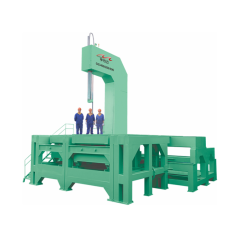
What Makes a Heavy Duty Vertical Band Saw Machine Stable?
When a band saw is used for thick plate, large profiles, or dense alloys, cutting stability depends on more than blade speed and motor power. A Heavy Duty Vertical Band Saw Machine needs a rigid frame, stable wheel arrangement, accurate blade guides, and suitable speed control to keep the blade tracking consistently under load. These mechanical details become increasingly important as material thickness and cutting resistance increase.

Heavy cutting places considerably more stress on a band saw structure than occasional work with thin material. When the blade enters a thick workpiece, cutting forces can create vibration and lateral movement. If the frame flexes under this load, the movement can transfer directly to the blade and affect the accuracy of the cut.


A Heavy Duty Vertical Band Saw Machine therefore relies heavily on frame rigidity. Welded steel construction can provide the mass and structural stiffness needed to maintain the relative position of the wheels, guides, and worktable. This becomes particularly relevant when the machine is used continuously rather than for occasional light-duty cutting.
The wheel arrangement also affects blade stability. Two-wheel systems are common in many band saw configurations, while three-wheel structures can provide a longer blade path and additional support for certain heavy cutting applications. The choice depends on the machine's overall geometry, blade dimensions, and the type of material being processed.
Blade guides are another important part of the cutting system. Their role is to keep the blade aligned as it enters and passes through the workpiece. When the guides have excessive clearance or become misaligned, the blade can move laterally under cutting pressure. On thick stock, even a relatively small deviation can become visible as an angled or uneven cut surface.
Adjustable guide positions are useful when material heights vary. The guides can be positioned closer to the workpiece so that the unsupported section of the blade remains controlled during cutting. Regular inspection is also important because wear, contamination, or gradual movement can affect the original alignment.
Cutting speed needs to correspond with the material as well. Softer materials can generally tolerate different blade speeds from dense alloys that generate greater cutting resistance. Variable-speed control allows the operating speed to be adjusted according to material characteristics instead of applying one speed to every job.
The overall cutting result is therefore influenced by several connected mechanical elements. Frame stiffness helps control vibration, wheel configuration determines the blade path, guide assemblies maintain alignment, and speed control allows the cutting process to respond to different materials.
A Heavy Duty Vertical Band Saw Machine is consequently designed around structural stability as much as cutting capacity. When thick or dense workpieces become a regular part of production, the relationship between the frame, blade, guides, wheels, and drive system becomes increasingly important for maintaining consistent cutting performance.
What's Your Reaction?