How Much Does a Loyalty Program Cost to Run?
What a DTC loyalty program actually costs: platform fees, reward liability, breakage, and the margin maths that says whether it is paying for itself.
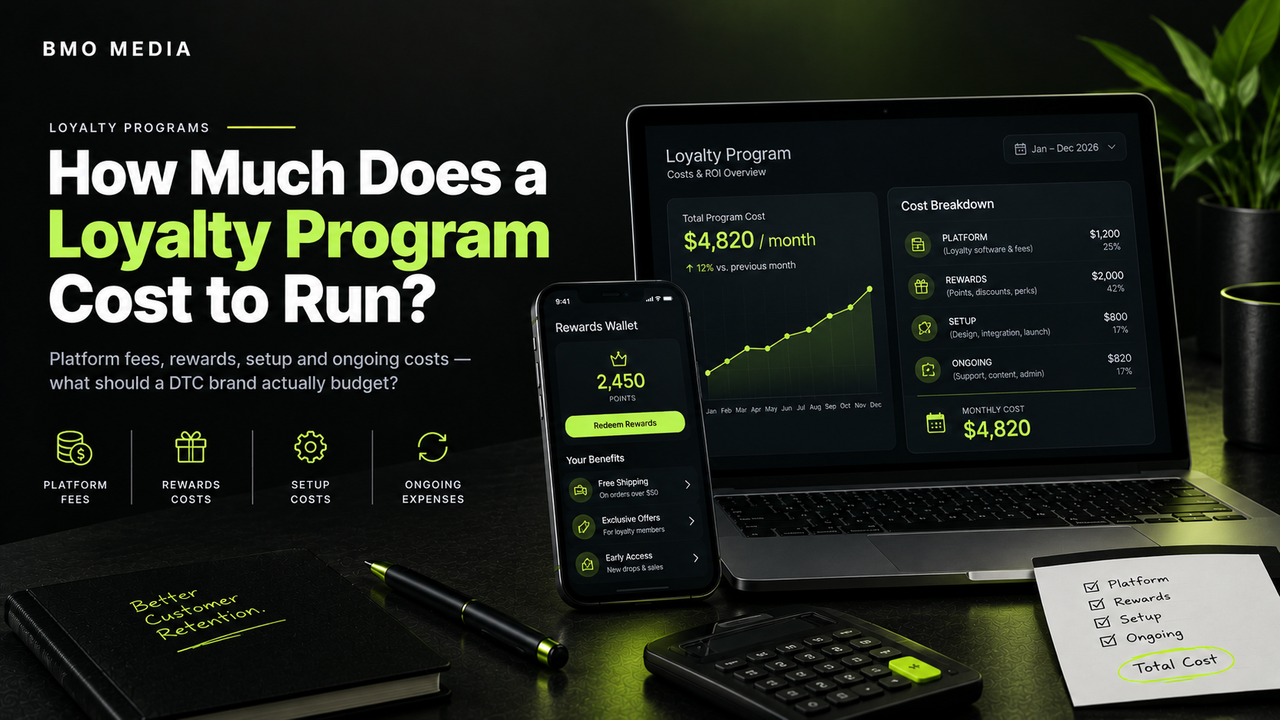
Most loyalty pricing conversations stop at the software subscription, which is usually the smallest of the three costs.


The real bill has three lines: the platform, the reward liability, and the margin you give away to people who would have bought anyway.
Line One: The Platform
For a DTC brand on Shopify, a loyalty platform typically prices on order volume or active members, and the cost scales with the business rather than staying flat.
It is a real cost, but it is also the easiest one to forecast. That is exactly why it tends to dominate the conversation when it should not.
What matters more than the sticker price is what the platform integrates with.
A loyalty programme that cannot pass tier and points data into the tools sending your email and SMS is a programme you cannot properly market. You may eventually end up paying for an additional integration just to move the data where it needs to go.
Check the integration architecture before you compare subscription prices.
Line Two: Reward Liability
Every point you issue is a promise to discount a future order.
Accountants treat unredeemed points as a liability, and the proportion of issued points that go unclaimed is known as breakage.
Antavo's Global Customer Loyalty Report 2026 found that 26.2% of loyalty points go unspent and 11.9% expire outright, representing as much as $10 billion a year in savings that US consumers never claim Antavo points breakage release, 3 February 2026.
Breakage reduces programme cost, which makes it tempting to build it into the economics.
Do not.
The same research found that 41.1% of consumers had left a loyalty programme because they were frustrated by expiring points. Breakage you intentionally engineer can quickly become churn you paid to create.
Model reward liability at full redemption.
If the programme only works financially when a quarter of your promises are never redeemed, the programme does not really work.
Line Three: The Margin You Did Not Need to Give
This is often the most expensive cost, and it never appears on an invoice.
Imagine a customer who already buys four times a year at full price. They join your loyalty programme, continue buying four times a year, but now receive 10% off each purchase.
You have given away 10% of four orders while changing nothing about their behaviour.
Multiply that across your highest-value customers and a programme can become net negative even while the loyalty platform dashboard reports strong member revenue.
The defence is cohorting.
Compare the repeat rate and annual spend of loyalty members against a matched group of non-members with similar previous purchase behaviour over the same period.
Do not compare members against all customers. That almost always makes the programme look better because your strongest customers are usually the first to join.
What the Programme Has to Return
Antavo reported that 92.7% of programme owners saw a positive return, with an average ROI of 5.3 times Antavo GCLR 2026 release, 3 February 2026.
The same report found marketers allocating an average of 51.5% of total marketing budget to loyalty and CRM. That shows how much confidence sits behind the category, but also how much exposure a poorly measured programme can create.
Bond's 2026 loyalty research found that 73% of consumers spend more as a result of programme membership, at roughly $500 more per member per year Bond Loyalty Report, 3 June 2026.
That is the upside case.
But it is an average across mature loyalty programmes, not a guaranteed forecast for a programme launching next quarter.
The Version That Costs Least
Start with non-discount rewards.
Early access, free shipping for members, service benefits, points for reviews, and referral incentives can create perceived value without immediately reducing product margin.
LoyaltyLion's March 2026 research found that 42% of consumers joined their most recent loyalty programme for early access to sales, a benefit with near-zero marginal cost LoyaltyLion, Loyalty in 2026.
Add a points-to-currency reward only after you understand what a member is worth. You can estimate that using our free CLV calculator.
We build the cost model before launching the programme as part of our loyalty and referral program services.
The full return model is covered in the loyalty program ROI playbook, while the economics of status levels and reward thresholds are covered in tiered loyalty programs.
What's Your Reaction?