Deodorized Cocoa Butter: How It Is Made, Its Uses and Why Quality Matters
Deodorized Cocoa Butter: Learn how it is made, its key uses, and why quality matters for food, cosmetics, and personal care products with Konsonetas.
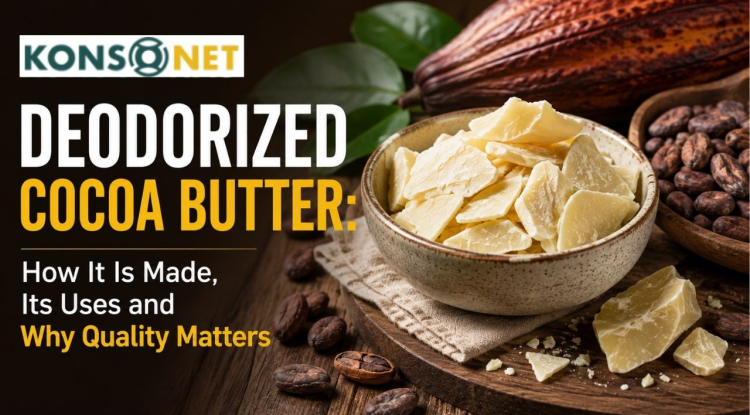
Cocoa butter is valued for much more than its association with chocolate. Its melting behaviour, texture, mouthfeel and functionality make it an important ingredient across confectionery, bakery and other food formulations. However, natural cocoa butter can carry a noticeable cocoa aroma and flavour, which is not always desirable in every recipe.


Deodorized cocoa butter addresses this challenge by undergoing controlled processing designed to reduce volatile compounds responsible for strong or unwanted odours and flavours. The result is a more neutral sensory profile while retaining many of the functional characteristics that make cocoa butter useful.
For food manufacturers and ingredient buyers, understanding how deodorization works is important because processing quality can influence sensory performance, consistency and formulation behaviour. This is particularly relevant when sourcing bulk cocoa ingredients for chocolate, confectionery and food production in Lithuania and other European markets.
What Is Deodorized Cocoa Butter?
Deodorized cocoa butter is cocoa butter that has been processed under controlled conditions to reduce unwanted or pronounced volatile odours and flavours. The purpose is generally to create a more neutral-tasting and neutral-smelling cocoa fat that can perform its intended functional role without strongly affecting the sensory profile of the finished product.
Cocoa butter itself is the fat obtained during cocoa processing. Cocoa beans are processed into cocoa products, and the fat fraction can be separated from cocoa solids. The resulting cocoa butter naturally has characteristics influenced by factors such as bean origin, processing and handling.
Deodorization adds another processing stage. Rather than treating the process as a way of making cocoa butter universally "better", it is more accurate to view it as a way of tailoring the ingredient for particular applications.
A manufacturer producing a product where a strong cocoa note is desirable may prefer a cocoa butter with more of its natural sensory character. Another manufacturer may need a neutral fat profile so that flavours such as vanilla, fruit, coffee or other ingredients remain prominent. In the latter case, deodorized cocoa butter can be a useful option.
Why Is Cocoa Butter Deodorized?
The main reason cocoa butter is deodorized is to reduce unwanted or excessive aroma and flavour components.
Natural cocoa butter can contain volatile compounds that contribute to its characteristic sensory profile. Their presence is not necessarily a quality problem. In fact, the natural cocoa character can be desirable in some chocolate and confectionery formulations. The question is whether that profile matches the product being developed.
Deodorization can therefore help manufacturers:
-
Reduce pronounced or unwanted odours
-
Create a more neutral flavour profile
-
Improve sensory consistency between batches
-
Allow other flavours to remain more prominent
-
Use cocoa fat for its functional properties without adding a strong cocoa note
This distinction is important. Deodorization is primarily related to sensory characteristics and ingredient functionality. It should not automatically be interpreted as simply "purifying" cocoa butter.
For product developers, the right choice depends on the recipe, processing method and desired finished-product characteristics. A deodorized grade can be valuable where sensory neutrality is important, while a less-deodorized cocoa butter may be preferable where natural cocoa characteristics are part of the product identity.
How Is Deodorized Cocoa Butter Made?
The general production route can be simplified as:
Cocoa beans → cocoa processing → cocoa butter separation → controlled deodorization → filtration and handling → packaging
The first stage involves producing cocoa butter through conventional cocoa processing. Cocoa beans are processed to separate the fat-rich cocoa fraction from the solids. Once cocoa butter has been obtained, it can undergo additional processing depending on the intended specification.
Industrial deodorization commonly uses controlled heat, steam and carefully managed processing conditions to remove volatile compounds responsible for unwanted odours and flavours. The process is designed to separate these volatile components while maintaining the useful properties of the cocoa fat.
The exact approach varies between producers. Equipment design, raw material characteristics, product specification and the desired sensory profile can all influence processing conditions. For this reason, there is no single universal deodorization process that applies identically to every food-grade cocoa butter.
After deodorization, the product may undergo further filtration, handling and quality checks before being packaged. The final ingredient should be evaluated against its agreed specification rather than judged solely by whether it has been deodorized.
For ingredient buyers, this is one reason supplier documentation matters. A technical specification and Certificate of Analysis can provide useful information about the characteristics of an individual product and batch.
How Does Deodorization Affect Cocoa Butter?
The most noticeable effect of deodorization is usually on aroma and flavour.
Natural cocoa butter can have a recognizable cocoa character. Controlled deodorization reduces volatile compounds that contribute to this sensory profile, producing a more neutral ingredient. This can make formulation easier when the manufacturer wants other flavours to dominate.
The effect on colour and other physical characteristics depends on the processing approach and the starting material. Deodorization should not be assumed to produce identical changes in every batch or product grade.
Functional properties also matter. Cocoa butter is valued for its melting behaviour and contribution to texture and mouthfeel. A properly specified deodorized product is intended to retain the characteristics required for its application while providing a more controlled sensory profile.
For chocolate and confectionery manufacturers, this balance is particularly important. A change in aroma may be desirable, but the ingredient must still perform appropriately during processing and in the finished product.
This is why buying decisions should focus on the complete product specification rather than the word "deodorized" alone.
Common Uses of Deodorized Cocoa Butter
Deodorized cocoa butter can be used in food applications where cocoa butter's functional properties are useful but a strong cocoa aroma is not required.
Chocolate and Confectionery
Chocolate manufacturing is one of the most obvious applications for cocoa butter because the ingredient contributes to texture, melting behaviour and mouthfeel.
Deodorized cocoa butter can be useful in formulations where manufacturers want controlled cocoa-fat functionality without introducing a pronounced additional cocoa aroma. The suitability of a particular grade depends on the recipe, processing conditions and sensory target.
For products with a strong chocolate identity, the choice between deodorized and more naturally aromatic cocoa butter should be based on the desired final flavour rather than assuming one grade is always superior.
Bakery and Food Products
Bakery products can contain several flavour components, including chocolate, vanilla, fruit, nuts, spices and fillings. In some formulations, a neutral fat profile helps maintain the intended flavour balance.
Deodorized cocoa butter may therefore be considered where its melting characteristics and texture are useful while a pronounced cocoa note would be distracting.
Its suitability depends on the formulation and the manufacturer's technical requirements. Food developers should evaluate the ingredient in the actual recipe rather than relying only on its general application category.
Fillings, Creams and Coatings
Cocoa butter can contribute to the structure and mouthfeel of fillings, creams and coatings. Its melting behaviour can be particularly relevant when developing products intended to provide a specific eating experience.
A deodorized grade may be appropriate when the manufacturer wants the functional contribution of cocoa fat without significantly influencing the flavour of the filling or coating.
The right specification can depend on factors such as processing, texture requirements, flavour system and the intended storage conditions of the finished product.
Other Food Ingredient Applications
Beyond these familiar categories, deodorized cocoa butter may be considered for other food formulations where a food-grade cocoa fat with a relatively neutral sensory profile is appropriate.
The important principle is application fit. Product developers should look at the ingredient's complete specification, not simply its application label, before introducing it into a commercial formulation.
Why Quality Matters in Deodorized Cocoa Butter
Quality is important because cocoa butter is a functional ingredient, not simply a source of fat. Differences in raw materials, processing and handling can influence how the ingredient behaves during manufacturing.
For food manufacturers, relevant quality considerations may include purity, moisture, free fatty acid levels where applicable, odour, taste, colour, melting profile, stability and batch consistency.
There is no single numerical specification that is appropriate for every application. Acceptable values depend on the product grade, intended use and agreed technical requirements.
Purity and Food-Grade Suitability
Food manufacturers need ingredients that meet the requirements established for their intended application. A supplier should be able to provide appropriate product information and documentation for evaluation.
Sensory Characteristics
Odour and taste are particularly important for deodorized cocoa butter because sensory neutrality is one of the reasons the ingredient is processed. Buyers should understand the expected sensory profile and verify that it aligns with their formulation.
Melting and Functional Behaviour
Cocoa butter's melting characteristics influence texture, mouthfeel and processing. A product that meets a sensory requirement but does not perform as expected in the manufacturing process may not be suitable for a particular application.
Batch Consistency
Consistent ingredient performance helps manufacturers maintain consistent finished products. Batch-to-batch variation can affect processing and sensory results, which is why agreed specifications and appropriate quality documentation are valuable.
How to Choose Deodorized Cocoa Butter for Food Manufacturing
Choosing a cocoa butter supplier should begin with the intended application rather than price alone.
First, define what the ingredient needs to do in the formulation. Consider the required sensory profile, texture, melting behaviour and processing conditions. This helps narrow the appropriate product specification.
Next, review the supplier's technical documentation. A Certificate of Analysis can help buyers assess relevant batch characteristics, while a technical specification provides a broader reference for the expected product profile.
Packaging and storage should also be considered, particularly for businesses purchasing cocoa ingredients in bulk. The packaging format needs to protect the ingredient during handling, storage and transport.
For procurement teams, communication is another practical consideration. A reliable ingredient sourcing process depends on clear information about specifications, batch documentation, packaging, shelf-life management and supply planning.
For businesses sourcing cocoa ingredients in Lithuania, these considerations can be especially useful when evaluating suppliers serving European food manufacturing operations. A supplier should be assessed according to the buyer's technical and commercial requirements rather than based on marketing claims alone.
Storage and Handling of Deodorized Cocoa Butter
Correct storage helps preserve the quality of cocoa butter after production and during the period before use.
Deodorized cocoa butter should be protected from moisture, contamination and strong external odours. Packaging should remain intact, and the ingredient should be handled according to the supplier's storage instructions.
Unnecessary temperature fluctuations should also be avoided because cocoa butter is sensitive to changes in its physical state. Storage practices should be aligned with the specific product specification rather than applying one universal temperature rule to every cocoa butter grade.
Shelf-life management is equally important. Manufacturers should monitor production dates, batch information and recommended shelf life so that ingredients are used within the supplier's specified period.
Good warehouse practices are therefore part of ingredient quality management. Even a well-produced food-grade cocoa butter can be affected by poor handling, damaged packaging or unsuitable storage conditions.
Sourcing Deodorized Cocoa Butter in Lithuania
Lithuanian food manufacturers, chocolate and confectionery producers, bakeries, importers and ingredient buyers may need cocoa ingredients that combine suitable technical characteristics with dependable documentation and practical supply arrangements.
When sourcing deodorized cocoa butter, buyers should evaluate the product specification, food-grade documentation, packaging format, batch consistency and storage requirements. It is also useful to clarify technical questions before placing larger orders, particularly when the ingredient will be incorporated into a new formulation.
Supplier communication can make the procurement process more efficient because buyers can confirm whether a particular grade matches their intended application before production begins.
Businesses researching cocoa ingredients and food ingredient sourcing can also explore Konsonetas as a relevant supplier resource. The important point is to evaluate any cocoa butter product against the specific technical and manufacturing requirements of the intended application rather than relying on a generic description.
Conclusion
Deodorized cocoa butter is cocoa butter that has undergone controlled processing to reduce volatile compounds associated with stronger odours and flavours. Its more neutral sensory profile can make it useful when manufacturers want the functional characteristics of cocoa fat without adding a pronounced cocoa note.
Its applications can include chocolate and confectionery, bakery products, fillings, creams, coatings and other food formulations, depending on the product specification. Quality remains essential because purity, sensory characteristics, melting behaviour, stability and batch consistency can all influence manufacturing results.
For ingredient buyers in Lithuania, careful evaluation of specifications, documentation, storage requirements and supplier communication can help ensure that the selected cocoa butter is appropriate for the intended formulation. The best purchasing decision is ultimately the one that matches the ingredient's technical characteristics with the needs of the finished product.
FAQs
1. What is deodorized cocoa butter?
Deodorized cocoa butter is cocoa butter that has undergone controlled processing to reduce volatile compounds responsible for strong or unwanted odours and flavours. The resulting ingredient generally has a more neutral sensory profile while retaining the functional properties expected from cocoa butter. Its suitability depends on the intended food application and the specific product specification.
2. Why is cocoa butter deodorized?
Cocoa butter is deodorized mainly to reduce pronounced or unwanted cocoa-related aroma and flavour. This can be useful when manufacturers want cocoa butter for its melting, texture and mouthfeel properties but do not want it to strongly influence the flavour of the finished product. Deodorization is therefore primarily a sensory and formulation consideration.
3. How is deodorized cocoa butter made?
The general process begins with cocoa butter obtained during cocoa processing. The fat is then subjected to controlled deodorization, commonly involving heat and steam, to remove volatile compounds associated with unwanted odours and flavours. Processing conditions vary according to the producer, equipment and product specification. The finished ingredient may then undergo filtration, quality checks and packaging.
4. Does deodorization remove the cocoa flavour?
Deodorization reduces volatile compounds responsible for cocoa-related aroma and flavour, producing a more neutral sensory profile. It does not mean that every trace of cocoa character is necessarily eliminated. The final sensory result depends on the starting material and processing conditions. Manufacturers should therefore assess the actual product specification and sensory characteristics when choosing a grade.
5. What is deodorized cocoa butter used for?
Deodorized cocoa butter can be used in chocolate and confectionery, bakery products, fillings, creams and coatings, as well as other food formulations where cocoa butter's functional properties are useful. It can be particularly suitable when a manufacturer wants a relatively neutral flavour and aroma. The correct application depends on the product's technical and sensory requirements.
6. What should buyers look for in high-quality cocoa butter?
Buyers should consider purity, moisture, relevant free fatty acid specifications, odour, taste, colour, melting profile, stability, food-grade suitability and batch consistency. They should also review the technical specification and Certificate of Analysis where applicable. Requirements vary by application, so buyers should compare the product against their own formulation and processing needs rather than relying on generic quality claims.
7. How should deodorized cocoa butter be stored?
Deodorized cocoa butter should be protected from moisture, contamination and strong external odours, with packaging kept intact. Storage should follow the supplier's product-specific instructions, including any guidance concerning temperature and shelf life. Avoiding unnecessary temperature fluctuations and maintaining good stock rotation can also help preserve ingredient quality until the cocoa butter is used.
What's Your Reaction?