The Complete Guide to Workplace Fire Safety
A workplace AED program helps organizations respond quickly to sudden cardiac arrest by keeping defibrillators accessible, maintained, and ready for use. Regular inspections, employee CPR/AED training, proper signage, consumable replacement, and documented readiness checks can strengthen emergency preparedness and workplace safety. A managed service provider can further simplify program administration and help maintain equipment across multiple facilities.

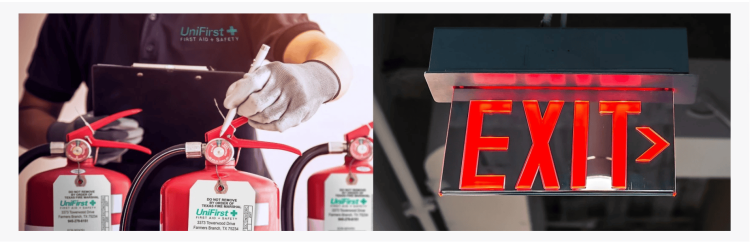
The safety of employees, visitors, property, and the business as a whole are all at stake when there is a fire in the workplace. A fire can start at any moment, and there are plenty of hazardous factors in the workplace that can make it challenging to put out a developing fire.


Of course, alarms, evacuation plans, exits, emergency responders, and other fire-safety measures can help in case of a fire. However, portable fire extinguishers can also be a viable option to control small blazes.
Yet, the presence of fire extinguishers in the workplace is not enough for fire-safety preparedness. Another crucial step is fire extinguisher training, which teaches employees about fire extinguishers, fire classifications, and fire safety in the workplace in general.
Fire-safety education can help familiarize employees with fire hazards and fire-fighting equipment before they have to deal with a fire. Fortunately, UniFirst First Aid + Safety offers fire extinguisher and fire-safety training programs for the workplace. Our professionals can inform your employees of everything they need to know about fire safety in the workplace.
Workplace Fire Safety: Fire Hazards and Fire Extinguisher Basics
Every workplace faces different fire hazards. Offices and commercial spaces include paper, cardboard, wooden furniture, computers, and other electrical appliances. Warehouses may present different flammable materials in the items they store or transport. Kitchens pose cooking oil and cooking gas fire hazards. Industrial facilities may have chemicals, flammable objects, and metalworking fluids or other hazardous materials.
It is essential to identify potential fire hazards in the workplace to learn how to prevent them. However, fire-safety measures should also be present. In fact, fire-safety is a set of measures that should be considered in day-to-day operations in the workplace, and not only when a fire breaks out.
Employees can make a difference when it comes to fire prevention. They should be aware of the possible fire hazards in the workplace and their responsibilities.
Promoting fire prevention culture in the workplace can lead to better fire-safety and employee engagement. For instance, employees should be encouraged to keep the workspace clean and clutter-free, put flammable objects away, and ensure all fire exits and access to them are open and not blocked.
Workplace Fire Safety: The Importance of Fire Prevention
Fire prevention is the best way to ensure fire-safety in the workplace. Employees can support fire prevention through several key fire-safety measures. For example, they should keep their workspace clean and organized to avoid electrical short circuits and spontaneous combustion.
Also, employees should store flammable objects in safe places, report malfunctioning electrical appliances, keep fire exits and access to them open, follow specific safety measures when handling flammable objects, get rid of flammable waste, report any abnormal heat, malfunctioning equipment, or other fire hazards, and keep fire-fighting equipment and fire-safety devices accessible.
Fire prevention in the workplace empowers employees to take action and be responsible instead of waiting for the fire department to arrive or the manager to give orders. Following fire prevention measures can also help to control fire risks in the workplace.
Fire Classification: Understanding Different Types of Fire
Flammable materials in the workplace can be sorted into classes according to the type of fire they present. Fire extinguishers are also sorted into classes A, B, C, D, and K, depending on the type of flammable materials they are designed to put out.
|
Fire Class |
Description |
Common Workplace Locations / Examples |
|
Class A Fires |
Involve ordinary combustibles such as paper, cardboard, wood, and cloth. |
Offices, warehouses, stores, schools, and other workplaces |
|
Class B Fires |
Involve flammable liquids, including fuels and other combustible liquids. |
Warehouses, gas stations, and facilities that store or handle flammable liquids |
|
Class C Fires |
Involve energized electrical equipment and devices. |
Computers, machinery, electrical panels, and other electrically powered equipment |
|
Class D Fires |
Involve flammable or combustible metals. |
Industrial facilities and metalworking environments |
|
Class K Fires |
Involve cooking oils and fats. |
Commercial kitchens, restaurants, cafeterias, and food-service facilities |
Fire Extinguisher Operation: How to Operate Fire Extinguishers in the Workplace
The standard way to operate a portable fire extinguisher is known as the PASS method. It stands for Pull, Aim, Squeeze, and Sweep. The method is simple and informative for firefighters of any level:
PASS Method
-
Pull the safety pin
-
Aim the extinguisher at the fire
-
Squeeze the handle
-
Sweep the extinguisher side to side.
Of course, the operation of a fire extinguisher is only a small part of the emergency response. Moreover, the firefighter should assess the situation and the available options before deciding to use a fire extinguisher or not. Although the use of a fire extinguisher can be useful, it is important to keep in mind that a fire can be out of control quickly after it starts.
Emergency Response: Fire-Fighting or Evacuation in the Workplace
Operating fire extinguishers is just one aspect of fire emergency response. In fact, employees should not risk using a fire extinguisher if the fire is too big to control or if using the extinguisher would endanger them in any way.
Before using a fire extinguisher, employees should assess the fire size, type, and hazards, the availability of fire-fighting equipment, an exit strategy and a safe zone to retreat to, and several other factors. Employees should always remember that their safety is their primary concern. In case of a fire emergency, if the circumstances are not favorable, or if the firefighter is not confident about the situation, it is better to evacuate the building and call for professional help.
Emergency Response: Fire Emergencies, Communication and Evacuation Procedures
Fire extinguishers are only a part of an emergency response plan. In fact, a firefighting plan in the workplace should include communication and evacuation procedures, evacuation routes and assembly points, emergency contact information, alarm calls, emergency responders, and other instructions.
In case of a fire emergency, employees should know whom to communicate with and how to get help. It is also essential for every employee to know the evacuation plan, the nearest exits, and the designated assembly point.
All these measures are necessary because a fire emergency requires a systematic approach and not impulsive actions. Communication and an evacuation plan will guide the employees through the fire emergency step by step, helping them to stay calm and not risk their safety by making impulsive decisions.
Fire Safety Education: Empowering Professional Employees with Fire-Safety Knowledge
Fire-safety education is not just an informative session for the employees. It is a way to train professionals to understand fire hazards and fire-safety equipment and be responsible and prepared when dealing with a fire.
Of course, fire-safety education covers fire classifications, fire extinguishers, fire prevention measures, fire extinguisher operation, emergency response, and evacuation procedures. Moreover, it is essential for employees to know the limitations of fire extinguishers and understand when it is too late to use them. With this knowledge, employees can better assess the circumstances of the fire emergency and make the right decision.
Fire extinguisher training is only a small part of fire-safety education. In fact, employees should also know the fire hazards in the workplace, emergency response procedures, and evacuation plans. Organizations that want to ensure fire-safety through employees’ awareness and preparedness can turn to UniFirst First Aid + Safety for professional fire-safety education and training.
Fire-Safety Culture: Building a Fire-Safety Culture in the Workplace
Fire-safety education will only be useful if employees take their responsibilities seriously. It is not enough to inform the employees of fire hazards and fire-safety measures – to build a fire-safety culture in the workplace, the organization has to ensure that the employees care about fire prevention and emergency response.
Managers and other leaders can encourage employees to report potential fire hazards, such as leaving flammable objects around or not keeping the workplace clean. Moreover, they should ensure that fire exits and access to them are not blocked, that fire extinguishers are available, and that employees know how to reach them.
Fire-safety education is a way to introduce fire-safety measures, identify fire hazards, and build a fire-safety culture in the workplace. The more employees care about fire prevention and emergency response, the fewer fires there will be in the workplace.
Conclusion
Fire-safety in the workplace is an essential skill that requires knowledge of fire extinguishers in the workplace, fire classifications, fire-safety measures, fire prevention, emergency response, and evacuation procedures.
Fire-safety education ensures that employees understand fire hazards in the workplace and can respond appropriately in case of a fire emergency. Moreover, it helps employees make the right choice and not risk their lives by attempting to put out a fire that is too big or dangerous.
Organizations that are serious about fire safety and want to ensure employees understand fire extinguisher use and limitations can rely on the professional fire-safety education programs offered by UniFirst First Aid + Safety.
Contact Us today to learn more about fire-safety education and fire extinguisher training programs for your employees.
FAQs
Do employees need fire extinguisher training if extinguishers are already installed?
Having extinguishers in the workplace is not enough to ensure fire safety. Fire-safety education helps employees become familiar with firefighting equipment and the fire-safety measures in the workplace. It also trains them on fire classifications, fire prevention, fire emergency response, and evacuation procedures.
How often should employees receive fire extinguisher training?
Depending on the fire hazards in the workplace, OSHA, other regulations, and the company’s safety policies, the frequency of fire-safety education can vary.
What type of extinguisher is used for electrical fires?
Depending on the workplace, employees should be familiar with fire classifications and fire extinguishers to know how to respond to different types of fires. In case of an electrical fire, professionals should follow the established fire emergency procedure.
Can an employee use a fire extinguisher without professional training?
As part of the fire emergency response, an employee should assess the situation before deciding whether to use a fire extinguisher or not. Fire-safety education helps employees understand fire classifications, fire extinguishers, fire prevention, fire emergency response procedures, and the evacuation plan. That way, they know what to do in case of a fire emergency without putting themselves at risk.
What should an employee do if an extinguisher does not stop a fire?
If an extinguisher does not stop a fire, the firefighter should stop trying to put it out, evacuate the building, and follow the evacuation procedures.
What's Your Reaction?