Mad Honey for Sale – Exploring the Origin of Himalayan Mad Honey
Learn about the origin of Himalayan mad honey, including its floral source, mountain regions, traditional harvesting, quality factors, and what buyers should check.
If you are searching for


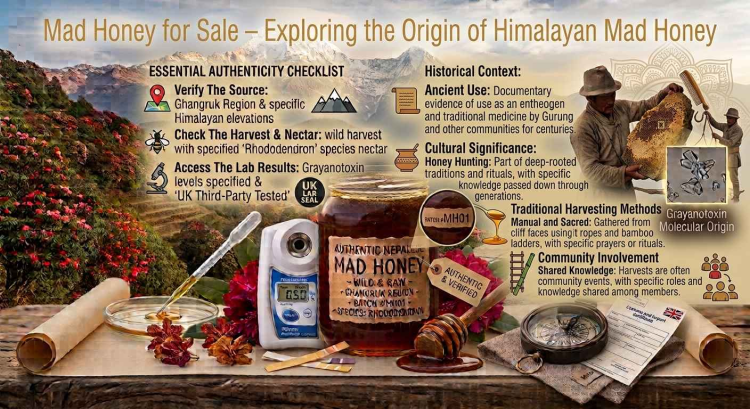
, understanding the origin of Himalayan mad honey can help you make a more informed buying decision. This specialty honey is closely associated with mountainous regions where bees collect nectar from certain rhododendron flowers. Before purchasing, it is useful to learn about its geographical source, floral origin, traditional harvesting methods, natural characteristics, and the information a trustworthy supplier should provide.
Himalayan mad honey has attracted attention because of its distinctive origin and natural composition. Unlike ordinary honey produced from a wide range of common flowers, certain Himalayan varieties are associated with nectar from rhododendron species that can contribute naturally occurring grayanotoxins to the honey.
What Is Himalayan Mad Honey?
Mad honey is a type of honey associated with bees collecting nectar from certain rhododendron flowers.
Some rhododendron species contain naturally occurring compounds called grayanotoxins. When bees collect nectar from suitable flowers, these compounds can be present in the resulting honey.
Himalayan mad honey is traditionally associated with mountainous areas, especially regions of Nepal where appropriate rhododendron species grow naturally.
The honey's characteristics can vary depending on its floral source, altitude, season, weather, bee activity, harvesting practices, and storage conditions.
Where Does Himalayan Mad Honey Come From?
The Himalayas stretch across several countries, including Nepal, India, Bhutan, Pakistan, and parts of China.
However, not every honey produced in the Himalayan region is mad honey.
The specific botanical source is important. Honey associated with rhododendron nectar is generally connected with areas where suitable rhododendron species grow and where local bees can access their flowers during the flowering season.
Nepal is particularly known for traditional mad honey harvesting in mountainous areas.
The Role of Nepal's Mountainous Environment
Nepal's mountainous landscape provides a distinctive environment for traditional honey production.
Different elevations contain different vegetation, climates, and flowering periods. In areas where suitable rhododendron species grow, bees can collect nectar during the flowering season.
Traditional beekeepers have developed methods for working in difficult mountain environments, often using locally adapted practices passed through generations.
This connection between landscape, plants, bees, and local communities is an important part of the story behind Himalayan specialty honey.
Rhododendron Flowers and Honey Production
Rhododendron is an important part of the botanical story behind mad honey.
There are many rhododendron species, and their distribution varies by region and elevation.
Certain species contain grayanotoxins. When bees collect nectar from flowers containing these compounds, the resulting honey can have a different composition from ordinary honey.
This is why botanical source matters when discussing Himalayan mad honey.
It is important not to assume that every honey collected near rhododendron plants will automatically contain the same compounds or have identical characteristics.
How Bees Contribute to the Process
Bees play a central role in producing all natural honey.
During flowering periods, bees visit flowers and collect nectar. The nectar is carried back to the hive, where bees process it through natural enzymatic activity and evaporation.
Eventually, the honey is stored in honeycomb cells.
In regions where bees have access to suitable rhododendron flowers, the nectar from these plants can contribute to the composition of the resulting honey.
Weather, flowering conditions, bee species, and availability of other plants can influence the final product.
Traditional Harvesting in the Himalayas
Traditional honey harvesting in mountainous areas can be very different from commercial honey production.
Some local communities have practiced beekeeping and honey collection for generations.
Depending on the location, harvesting may involve traditional hives, locally developed equipment, or methods adapted to steep mountain terrain.
The exact practices vary between communities and regions.
For buyers, understanding this traditional background can provide useful context, but it should not be confused with scientific proof of authenticity.
Why the Harvesting Season Matters
The flowering season is an important part of honey production.
Rhododendron flowers bloom during particular periods, and bees can only collect their nectar when the flowers are available.
Weather conditions can influence flowering and bee activity from one year to another.
This means that the characteristics of honey can change between harvests.
A supplier who provides useful information about the harvesting season can help buyers understand why batches may differ naturally.
Altitude and Local Vegetation
The Himalayan landscape changes considerably with altitude.
Temperature, vegetation, rainfall, and flowering patterns can differ between lower and higher elevations.
These environmental differences can influence the plants available to bees and therefore affect the characteristics of honey.
However, altitude alone does not prove that honey is genuine mad honey.
A trustworthy supplier should provide information about the general geographical source and botanical background rather than relying on altitude as a marketing claim.
Why Himalayan Honey Can Taste Different
Natural honey can have a wide range of flavors.
Himalayan specialty honey may have floral, earthy, herbal, woody, or slightly bitter characteristics depending on its botanical source.
The flavor can also be influenced by harvesting conditions and storage.
Different batches should not necessarily taste identical.
For this reason, flavor can help describe the honey but cannot independently prove its geographical or botanical origin.
Color and Texture Can Vary Naturally
Buyers sometimes expect authentic Himalayan mad honey to have one specific color or texture.
In reality, natural honey can range from light golden to amber and darker shades.
Texture can also vary. Honey may be liquid, thick, or naturally crystallized.
These characteristics can be influenced by floral source, temperature, moisture, storage conditions, and natural sugar composition.
Therefore, appearance should be treated as one characteristic rather than a definitive authenticity test.
How to Research the Origin Before Buying
When buying Himalayan specialty honey online, start with the supplier's information.
Look for details about:
- Country of origin
- General harvesting region
- Botanical source
- Harvesting season
- Local sourcing
- Beekeeping practices
- Batch information
- Packaging
- Supplier identity
A seller that provides clear information gives buyers a better basis for evaluating the product.
If important information is missing, consider contacting the supplier before ordering.
Check the Product Label
The label is another useful source of information.
Depending on the market and applicable regulations, look for:
- Product name
- Net quantity
- Country of origin
- Date information
- Batch or lot details
- Storage instructions
- Supplier or importer information
For UK consumers, food labeling should be clear, accurate, understandable, and not misleading.
If the information on the website conflicts with the physical label, ask the supplier for clarification.
Look Beyond Marketing Claims
Words such as “wild,” “pure,” “authentic,” “raw,” and “Himalayan” can sound convincing, but marketing terminology does not independently establish origin.
Instead, look for specific information.
For example, a useful description may explain the country, general region, botanical source, harvesting season, and packaging process.
Specific information is generally more useful than broad promotional language.
Can Color Prove the Origin?
No single color can prove the geographical or botanical origin of honey.
Natural honey varies in appearance, and different harvests can produce different shades.
A darker product is not automatically genuine, and a lighter product is not automatically fake.
Buyers should therefore avoid making purchasing decisions based only on photographs.
Can Home Tests Prove Authenticity?
Many websites and social media posts recommend simple tests involving water, matches, paper, bread, or spoons.
These methods are not reliable scientific tests for identifying the botanical or geographical origin of specialty honey.
Honey's physical behavior can change because of temperature, moisture, and natural composition.
For a more informed evaluation, focus on sourcing information, labeling, supplier transparency, batch details, and relevant quality documentation.
Consider Laboratory Information
Laboratory testing can provide information that appearance and taste cannot reliably establish.
Depending on the analysis, testing may examine characteristics such as moisture, sugar composition, contaminants, or other quality indicators.
If a supplier provides a laboratory report, check whether it clearly relates to the product or batch being sold.
A generic document without a clear connection to the product may provide limited reassurance.
Understand the Role of Grayanotoxins
The presence of naturally occurring grayanotoxins is one of the characteristics associated with certain rhododendron-derived honey.
These compounds can affect the nervous system and cardiovascular system. Their concentration can vary between batches.
Potential adverse effects from excessive exposure may include dizziness, nausea, vomiting, weakness, sweating, and changes in heart rate or blood pressure.
Consumers should understand these potential safety considerations before consuming rhododendron-derived honey.
Anyone taking medication or dealing with an existing health concern should consider speaking with a qualified healthcare professional before consuming honey that may contain biologically active compounds.
How Traditional Knowledge Adds Context
The history of Himalayan honey is connected with local communities and traditional beekeeping practices.
In mountainous areas, honey collection can involve knowledge of seasonal flowering, bee behavior, hive locations, and local vegetation.
This traditional knowledge helps explain how specialty honey has been collected and produced over time.
However, traditional methods and cultural history should complement—not replace—modern product information and appropriate quality controls.
What to Look for in a Supplier
A transparent supplier should provide useful information about the product.
Before ordering, look for:
- Clear business information
- Contact details
- Product origin
- Botanical information
- Ingredients
- Batch details
- Packaging information
- Shipping policies
- Relevant quality documentation
A professional website is helpful, but website appearance alone does not prove authenticity.
Questions to Ask Before Buying
If you are uncertain about a product, ask the seller:
Where was the honey harvested?
What country and general region does it come from?
What is the botanical source?
When was the honey harvested?
Is batch information available?
Is relevant laboratory or quality documentation available?
How is the product packaged?
Where will it be dispatched from?
Clear answers can help you understand the product before placing an order.
Warning Signs to Watch For
Be cautious when a seller:
- Provides no meaningful origin information
- Uses only vague Himalayan claims
- Has incomplete labeling
- Makes guaranteed health claims
- Uses home tests as proof of authenticity
- Refuses reasonable questions about sourcing
- Provides no clear business information
- Gives unclear information about packaging or shipping
One concern does not automatically mean the product is fake, but several concerns together are a reason to investigate further.
A Simple Origin Checklist
Before buying Himalayan specialty honey, check:
Geographical origin: Is the country and general region clear?
Botanical source: Does the seller explain the floral source?
Harvest: Is useful seasonal information provided?
Ingredients: Is the product composition clear?
Label: Is the required information present?
Supplier: Can you identify the business?
Batch: Is traceability information available?
Quality: Is relevant documentation available?
Packaging: Is the honey securely packaged?
Safety: Do you understand the potential characteristics and risks associated with rhododendron-derived honey?
Final Thoughts
The origin of Himalayan mad honey is closely connected with mountain environments, local vegetation, bees, seasonal flowering, and traditional honey harvesting. Understanding these factors can help buyers appreciate why different batches may have different characteristics.
However, origin should not be judged from color, flavor, texture, or marketing claims alone. When buying online, focus on clear sourcing information, botanical details, labeling, supplier transparency, batch information, packaging, and relevant quality documentation.
It is also important to understand the potential presence of grayanotoxins in rhododendron-derived honey and the associated safety considerations before consumption.
By researching the origin and supplier carefully, buyers can make more informed decisions when choosing Himalayan specialty honey online.
What's Your Reaction?