Kundali Matching, Guna Milan and Horoscope Kundali Matching for Marriage
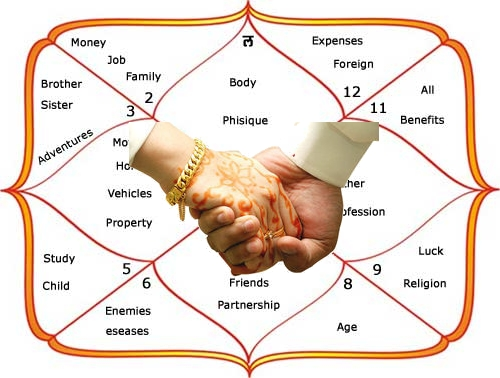
Kundali matching is a traditional Vedic astrology practice used to compare the birth charts of two individuals before marriage. It commonly includes Guna Milan, Nakshatra and Rashi comparison, and analysis of selected planetary and house positions. Accurate birth date, birth time, and birthplace are generally important for preparing and comparing the charts. The Ashta Koota system provides a traditional framework of 36 points, while broader Jyotish analysis may consider several additional factors. Online astrology calculators can assist with preliminary calculations, although results may vary according to settings and birth information. Astrology is a traditional belief system and is not scientifically established as a predictor of relationship success.


What Is Kundali Matching and How Does It Work?
kundali matching is the traditional practice of comparing two birth charts according to Vedic astrology principles. A Kundali, or birth chart, is prepared using the date, time, and place of birth and traditionally represents planetary positions, Rashis, houses, and Nakshatras. In marriage analysis, the Moon's Rashi and Nakshatra have particular importance because they are used in several Ashta Koota calculations.
The process generally starts by collecting the birth details of both individuals and generating their respective charts. These charts may then be compared through Guna Milan and broader Jyotish principles. Depending on the tradition followed, analysis may include the seventh house, its lord, Venus, Jupiter, Moon, Navamsa, Dashas, and Manglik considerations. Such factors are interpreted within traditional astrology and should not be presented as scientifically proven indicators of marital outcomes.
What Is Guna Milan in Vedic Astrology?
Guna Milan is a traditional compatibility assessment based on eight categories known as Kootas. These eight Kootas collectively form the Ashta Koota system and provide a maximum of 36 points. The method generally uses the Moon signs and Nakshatras of two individuals to calculate the traditional compatibility score.
The eight Kootas and their traditional maximum points are:
-
Varna: 1 point
-
Vashya: 2 points
-
Tara: 3 points
-
Yoni: 4 points
-
Graha Maitri: 5 points
-
Gana: 6 points
-
Bhakoot: 7 points
-
Nadi: 8 points
Varna traditionally concerns broad compatibility classifications, while Vashya relates to mutual influence. Tara considers Nakshatra-based factors, and Yoni is traditionally associated with behavioural and physical compatibility. Graha Maitri examines planetary friendship, Gana relates to temperament, Bhakoot considers Moon sign relationships, and Nadi carries the highest traditional point value.
How Does Horoscope Kundali Matching Help With Marriage Compatibility?
Horoscope kundali matching for marriage is traditionally used to compare selected astrological characteristics of two prospective partners. General horoscope matching may consider zodiac signs, Moon signs, or Nakshatras, whereas personalised Kundali matching uses the individual birth details of both people. This makes personalised matching more specific than a general horoscope comparison.
Traditional Jyotish may also examine the seventh house, its lord, Venus, Jupiter, Moon, Navamsa, Dashas, and Manglik considerations. These factors can provide additional context beyond the Guna Milan score. However, astrology is a traditional belief system and does not offer scientifically established predictions about relationship quality. Couples should also consider communication, shared values, financial planning, family expectations, and long-term goals.
What Are the 36 Gunas in Kundali Matching?
The 36 Gunas represent the maximum points available across the eight Ashta Koota categories. The traditional distribution gives Varna 1 point, Vashya 2, Tara 3, Yoni 4, Graha Maitri 5, Gana 6, Bhakoot 7, and Nadi 8. These values together create the traditional maximum of 36 points.
In many traditional practices, 18 out of 36 is commonly used as a minimum benchmark. However, this benchmark is not an absolute rule and is not scientifically validated. A score below 18 does not automatically indicate that a marriage will fail, while a higher score cannot guarantee a happy or stable relationship. The score is better understood as one traditional compatibility indicator rather than a complete assessment.
How Is Kundali Matching Performed Using Drik Panchang?
Drik Panchang Kundali matching refers to using Kundali and astrology calculation resources available through Drik Panchang. Drik Panchang is an astrology and Panchang reference platform that provides tools based on traditional Hindu calendar and Jyotish concepts. Users generally enter the birth date, birth time, and birthplace of both individuals to generate relevant charts and compatibility calculations.
Different online astrology tools may produce different results because of variations in birth time accuracy, birthplace, time zone, Ayanamsha, calculation method, chart system, or rounding and software settings. Users should verify their birth information before interpreting a result. A calculation from Drik Panchang or another online tool should be understood as a traditional astrological calculation and not as a scientifically validated guarantee of marriage success or failure.
What Is the Difference Between Kundali Matching and Guna Milan?
Kundali matching is the broader process of comparing two birth charts, while Guna Milan is one specific scoring method within the Ashta Koota system. Horoscope matching is a broader expression that may refer to comparing selected astrological characteristics, while birth chart compatibility can involve a more detailed examination of planets, houses, Rashis, Nakshatras, Navamsa, and Dashas.
The distinction is useful because a Guna score does not represent every feature of two complete birth charts. Two couples may receive a similar score while having different planetary placements or seventh-house conditions. Traditional practitioners may therefore consider Guna Milan alongside other chart factors. A complete birth chart analysis can provide more context than relying only on the numerical score.
Which Factors Are Considered Beyond the Guna Milan Score?
Traditional Jyotish practitioners may examine the seventh house, seventh-house lord, Venus, Jupiter, Moon, Navamsa, Dashas, planetary aspects, and Manglik considerations beyond Ashta Koota scoring. These factors can be interpreted differently depending on the particular school of Vedic astrology. They are part of traditional astrological practice rather than scientifically established relationship measurements.
Practical compatibility should also be considered independently. Couples can discuss financial responsibilities, career priorities, family expectations, communication patterns, household duties, lifestyle preferences, personal boundaries, and future plans. Astrology cannot reliably measure these practical areas. A high Guna score cannot guarantee compatibility, and a lower score cannot prove that a relationship is unsuitable.
Why Are Accurate Birth Details Important for Matching?
Accurate birth details are generally important for generating traditional Kundalis. The basic information required for both individuals includes:
-
Date of birth
-
Birth time
-
Birthplace
Birth time can affect the Ascendant and house positions, while birthplace is relevant to location-based calculations. Rashi and Nakshatra calculations may also depend on precise birth information. If the recorded birth time is uncertain, some elements of the resulting chart may likewise be uncertain.
When comparing results from multiple online calculators, users should also check the time zone, Ayanamsha, chart system, and calculation method. Differences in these settings can sometimes produce different outputs. Verifying the original birth details and calculation settings can help users understand why two tools may not display identical results.
How Should Couples Interpret an Online Kundali Result?
An online Kundali result should be treated as a traditional reference rather than a final judgment about marriage suitability. For example, a score of 27 out of 36 does not scientifically establish that a couple will have a successful marriage. Likewise, a score of 15 does not prove that their relationship will fail. The number reflects the traditional rules applied to the entered birth information.
Couples can consider the result alongside practical discussions about married life. Communication, financial expectations, career plans, family responsibilities, personal values, lifestyle preferences, and future goals should be discussed openly. People who value Vedic astrology may include Kundali matching as one perspective, while also recognizing that major relationship decisions should not be based solely on an astrological score.
How Can Couples Use Traditional Matching Responsibly?
A responsible approach treats Kundali matching as one source of traditional guidance rather than an unquestionable decision-making system. For someone using Ask Astro or another astrology service, the useful starting point is to provide accurate birth information and understand what the calculation actually measures. A traditional result can then be considered alongside personal discussions and informed judgment.
Couples should avoid fear-based interpretations involving unavoidable marriage failure, divorce, illness, infertility, financial loss, or other serious outcomes based solely on a Kundali score. Differences in Guna Milan results can be discussed in context rather than treated as fixed predictions. This balanced approach respects the cultural role of Jyotish while keeping practical relationship factors at the centre of marriage decisions.
Conclusion
Kundali matching is a traditional Vedic astrology practice used to compare the birth charts of two prospective partners.
Guna Milan applies the eight Ashta Koota categories and provides a maximum traditional score of 36 points.
The commonly used 18-point benchmark is a traditional reference rather than a scientifically established measure of marital compatibility.
Broader Jyotish analysis may consider the seventh house, planets, Navamsa, Dashas, and Manglik considerations.
Online calculators can assist with traditional calculations when accurate birth details and consistent settings are used.
Different calculation methods can produce variations, making verification of birth information important before interpretation.
Astrology can provide a traditional perspective, while communication, mutual respect, shared values, and practical compatibility should remain central to marriage decisions.
What's Your Reaction?