Bringing the Universe Indoors: Simple and Fun Astronomy Projects for Kids
Discover engaging indoor astronomy projects for kids. Boost critical thinking and early STEM skills with hands-on, home-based space activities.
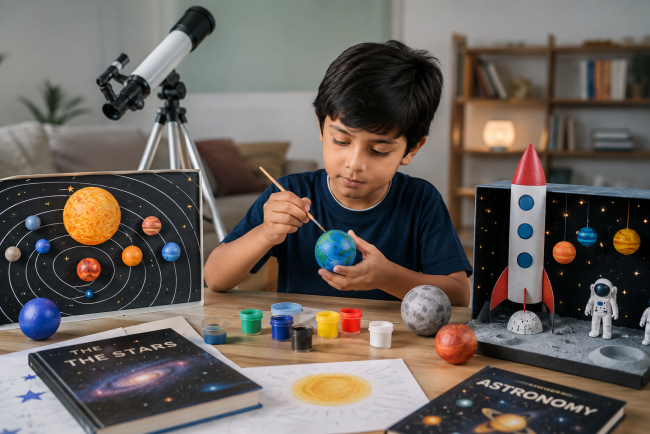
In an increasingly tech-driven economy, fostering early interest in Science, Technology, Engineering, and Math (STEM) is one of the most effective ways to nurture future innovators and problem-solvers. While stargazing is traditionally viewed as an outdoor nighttime activity, you do not need clear skies or expensive observatories to introduce young minds to space science. Interactive, hands-on indoor activities offer an accessible, year-round entryway into foundational astrophysics and orbital mechanics.


For parents, educators, and leaders looking to cultivate analytical thinking in the next generation, engaging astronomy projects for kids provide a perfect balance of education and creativity. Here are three practical, low-cost indoor space projects that transform complex scientific concepts into tangible learning experiences.
1. The Shoe-Box Planetarium Projector
Understanding stellar navigation and constellation patterns can be challenging through textbooks alone. Building a tabletop planetarium allows children to project night-sky formations directly onto their bedroom walls.
How to Build It:
-
Materials Needed: An empty shoebox, a small LED flashlight, black cardstock, and a pushpin.
-
The Process: Cut a large window on one end of the shoebox. On a piece of black cardstock cut to fit the opening, trace major constellations such as Orion or Ursa Major and use the pushpin to pierce holes for each star. Secure the cardstock over the box window, place the flashlight inside facing the cut-out, and turn off the room lights.
The Learning Value:
This project demonstrates how light travels in straight lines and introduces children to star mapping and spatial geometry, reinforcing critical observational skills.
2. A Scale Model Solar System
Space is vast, and the sheer distances between planets are difficult for young learners to conceptualize. Creating a physical scale model brings planetary proportions down to a manageable human scale.
The Learning Value:
By arranging these objects down a long hallway using proportional distances, kids gain a true visual appreciation for astronomical units and spatial ratios, turning abstract numbers into an intuitive mental map.
3. Simulating Lunar Craters with Impact Tests
The Moon’s surface tells a history of meteorite collisions. Kids can replicate this process in the kitchen to observe physics and surface mechanics in real time.
How to Build It:
-
Materials Needed: A shallow baking pan, white flour, cocoa powder, and various small rocks or marbles.
-
The Process: Fill the tray with flour to represent the lunar crust, and dust a fine layer of cocoa powder over top. Have children drop different weights of marbles from varying heights into the tray.
The Learning Value:
When the objects strike, the dark cocoa layer disperses to expose the white flour below, perfectly mimicking impact craters and ejecta ray patterns. This experiment illustrates potential energy transfer, gravity, and kinetic impact mechanics.
Conclusion
Executing simple astronomy projects for kids inside the home does more than pass the time on a rainy afternoon. It builds foundational analytical habits, curiosity, and scientific literacy.
When young learners master these practical concepts, structured academic paths can further accelerate their passion. Enrolling children in specialized astronomy courses for students helps transition informal curiosity into structured technical knowledge. By integrating engaging astronomy projects for kids into early learning, we help inspire the researchers, engineers, and visionary executives of tomorrow.
What's Your Reaction?