Custom Generative AI Development: Everything You Need to Know
Build custom generative AI tailored to your data and workflows. Step-by-step process, real costs ($50K pilots to $300K+), ROI examples from JPMorgan + healthcare, vs off-the-shelf tools. Start small, own your models, cut ops 30-50%.

I've seen hype cycles burn out fast. Custom generative AI development stands apart. Teams aren't messing with chatbots for fun anymore. They need models tied to their own data to cut through real business bottlenecks—like endless support tickets or manual contract reviews.


Generic AI handles basic tasks fine. But it blanks on your supply chain quirks or compliance rules. Custom work turns that weakness into a strength.
What Custom Generative AI Development Really Means
This means adapting AI models to your data and workflows. Forget public GPT-4 versions. Yours runs in your secure environment, using proprietary info.
Gartner updated their forecast this year: by 2028, 60% of enterprise GenAI will be domain-specific models. Off-the-shelf tools miss the mark in high-stakes fields like finance or healthcare where one wrong output costs big.
Custom AI vs Ready-Made Tools
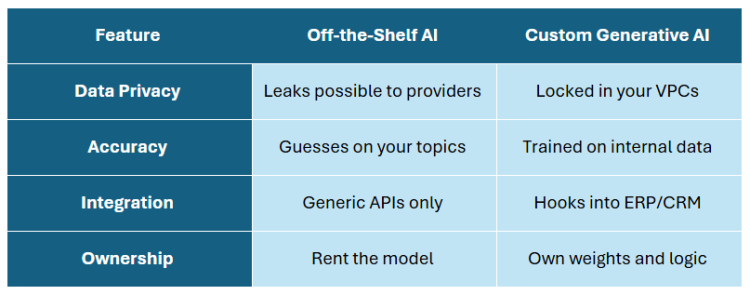
Decision-makers ask me all the time: why not just pay for ChatGPT Enterprise? Data control, niche accuracy, and scale costs seal the deal.
How to Build Custom AI: Step by Step
We run projects through a tight lifecycle focused on payoff, not experiments.
Pick a pain point first. One client had legal spending 40 hours weekly on contracts. We set KPIs: cut that to 10 hours.
Data prep decides it all. Strip duplicates, anonymize PII for GDPR/SOC2, convert PDFs and logs to clean formats. Skip this, and your model flops.
Choose fine-tuning on Llama 3.1 or Mistral with your dataset. Or RAG for pulling live facts from your docs.
Experts review outputs—human-in-the-loop. McKinsey data shows this boosts workflow gains by 35%.
Deploy on AWS Bedrock or Azure with drift monitoring. Models degrade if data shifts; catch it early.
Real Use Cases That Deliver
JPMorgan fine-tuned models for risk reports last year—saved analysts 20 hours weekly on fraud summaries.
Healthcare firms summarize patient histories. One Midwest hospital cut doctor note time from 2 hours to 30 minutes daily.
Retail like Nike generates 10,000 personalized descriptions weekly, boosting conversion 12%.
Engineering teams at GitLab use custom agents for code reviews, catching 40% more vulns pre-deploy.
Common Hurdles and Fixes
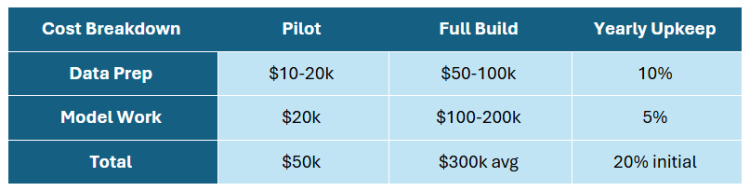
Costs hit hard upfront. CloudZero pegged mid-sized AI bills at $100k monthly in 2025. Start with a $50k pilot on one workflow—prove ROI first.
Legacy systems clash with APIs. Middleware like Kafka fixes that.
AI hallucinations? Guardrails plus RAG limit it to verified sources.
ROI hits quick: 30-50% ops savings or 2x faster product launches.
Strategies for 2026 Adoption
Make AI training mandatory—Deloitte says top firms do this, hitting ROI 3x faster.
Move to agents, not chatbots. Think systems that update Jira or query databases.
Build model-agnostic. LangGraph frameworks let you swap providers without rebuilds.
Next Steps
Custom generative AI development creates a moat generics can't touch. Grab data from one team, run a pilot, measure the win. Keep humans checking outputs.
Ready to scope yours? Start with that bottleneck workflow today.
FAQs
How long for a custom generative AI development pilot?
6-12 weeks to live results.
Biggest cost driver?
Data prep—rush it and redo everything.
RAG or fine-tuning first?
RAG for facts, fine-tuning for your voice and rules.
What's Your Reaction?