Bootcamp Workouts 101: What to Expect Before You Join One
Thinking about joining a boot camp workout? This guide explains what boot camp workouts involve, how classes are structured, who they're best suited for, and how to choose the right program. Learn about the benefits, common workout formats, safety tips, beginner modifications, and what to expect during your first class so you can start with confidence.
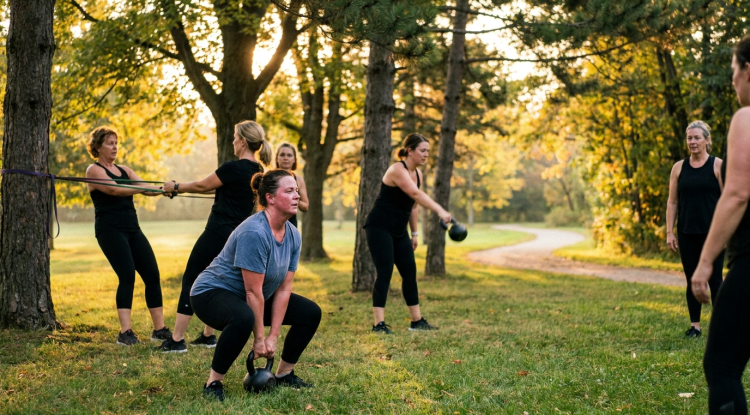
Group fitness classes have exploded in popularity over the past decade, and few formats are as recognizable — or as intimidating to newcomers — as the boot camp. The name conjures images of drill sergeants and workouts designed to make you regret signing up. The reality is usually far more approachable, and far more effective, than the stereotype suggests.


This guide breaks down what boot camp workouts actually involve, who they're best suited for, and how to evaluate whether a particular class is the right fit for your goals and fitness level.
What Is a Boot Camp Workout, Really?
A fitness boot camp is a style of group training that blends elements of high-intensity interval training (HIIT), strength conditioning, and circuit training into a single session. Rather than following one format exclusively, most boot camps rotate participants through a series of stations or exercise blocks, combining cardio bursts with resistance-based movements like squats, push-ups, kettlebell swings, and bodyweight exercises.
The structure typically follows one of a few common patterns:
Circuit-based format: Participants move through a set number of stations, performing an exercise at each for a fixed time or rep count before rotating to the next. This keeps heart rate elevated while working different muscle groups in sequence.
Interval-based format: Short, intense bursts of effort (often 20-60 seconds) are followed by brief recovery periods, repeated across multiple rounds. This is the HIIT-based approach, prized for its efficiency.
Hybrid format: Many classes combine both approaches, opening with a cardio-focused warm-up, moving into strength circuits, and finishing with a core or conditioning finisher.
What ties these formats together is the group setting itself. Unlike solo gym workouts, boot camps are led by an instructor who cues the group through each exercise, demonstrates proper form, and keeps the energy and pace moving. This structure is a large part of what makes the format appealing to people who struggle with motivation or don't know where to start when training alone.
Who Boot Camps Are Best Suited For
Boot camp classes tend to work particularly well for people who:
· Want a full-body, functional fitness workout without having to plan it themselves
· Thrive on structure and enjoy having an instructor guide the pacing
· Are motivated by training alongside others rather than working out solo
· Have some baseline fitness or movement experience, even if it's minimal
· Want to build cardiovascular endurance and strength simultaneously in time-efficient sessions
Because these classes are designed for groups of mixed ability, most instructors build in modifications for different fitness levels — more on that below.
The Real Benefits (and Who Should Be Cautious)
Why People Stick With It
The appeal of group fitness training goes beyond the workout itself. Three benefits come up consistently in research and anecdotal reporting on group exercise formats:
Efficiency. Because boot camps blend cardio and strength work, participants often get more done in 45-60 minutes than they would in separate cardio and weights sessions. This makes the format attractive to people with limited time to train.
Community and social accountability. Exercise psychology has long recognized the role of social support in exercise adherence. Showing up to a class where others expect you, and where an instructor knows your name, creates a layer of accountability that's harder to replicate training alone. This is one of the most commonly cited reasons people stick with boot camp-style programs over time, compared to unstructured solo workouts.
Variety. Because station and interval formats rotate frequently, boot camps tend to feel less monotonous than repeating the same machine-based routine. This variety can also translate into more well-rounded functional fitness, since sessions typically train pushing, pulling, hinging, squatting, and core stability patterns across a single class.
Who Should Approach With Caution
Boot camps aren't the right entry point for everyone, and it's worth being honest about that before signing up.
People with a significant or recent injury history should consult a physician or physiotherapist before joining a high-intensity group class, since the pace of a boot camp can make it difficult to fully customize movements around a specific limitation without one-on-one guidance.
Absolute beginners with no exercise background may find the pace and volume of a typical class overwhelming at first. This doesn't mean boot camps are off-limits — many are genuinely beginner-friendly workouts — but it does mean beginners should look specifically for classes that advertise scalable intensity and beginner accommodations (discussed further below).
Anyone with uncontrolled cardiovascular conditions should get medical clearance first, since interval-style training pushes heart rate into higher zones by design.
How to Modify Intensity Safely
The good news is that intensity in a boot camp setting is almost always adjustable. A few strategies:
· Reduce range of motion or add rest. A full squat can become a partial squat; a 40-second work interval can become 20 seconds with extra recovery.
· Use lighter loads or bodyweight only. Most exercises have a scaled version — a modified push-up on the knees, for example, or a kettlebell swap for a lighter dumbbell.
· Communicate with the instructor before class starts. A brief heads-up about an old injury or a return from time off allows the instructor to suggest modifications proactively rather than you having to guess mid-session.
· Listen to perceived exertion, not the group's pace. A well-run class allows for individual pacing even within a group format — you're not required to match the person next to you.
How to Find the Right Boot Camp Near You
If you've typed "boot camp near me" into a search bar, the sheer number of results can make it hard to know what actually separates a well-run class from one that's poorly structured or unsafe. A few criteria are worth prioritizing over convenience or price alone.
Questions to Ask Before Joining
· What certifications does the instructor hold, and do they have training in exercise modification for injuries or beginners?
· What does a typical class structure look like — warm-up, main set, cool-down?
· Is there a beginner or introductory session available before jumping into a regular class?
· How large are the classes, and does the instructor provide individual form correction during the session?
· Is equipment provided, or do participants need to bring their own?
Red Flags to Watch For
· No warm-up or cool-down built into the session structure
· An instructor who doesn't circulate to correct form or check in with participants
· Pressure to keep pace with the group regardless of ability or injury status
· No modifications offered for any exercises
· Overcrowded classes where individual attention isn't realistically possible
What a First Class Typically Looks Like
A well-structured introductory class usually opens with a dynamic warm-up (light cardio and mobility work), followed by a walkthrough of the main exercises and any equipment involved. The instructor should explain proper form for each movement before the pace picks up, and should check in with newcomers specifically during the first session. Expect some muscle soreness in the days following — this is a normal response to unfamiliar exercise stress, particularly eccentric loading, and typically resolves within 48-72 hours as the body adapts.
The Bottom Line
Boot camp-style training offers a genuinely effective combination of cardiovascular conditioning, strength work, and social accountability in a time-efficient package. It's not the right starting point for everyone — those with injuries or no exercise background should ease in carefully and seek out classes built for scalability — but for many people, the structure and community of group fitness training solve the two biggest obstacles to consistency: knowing what to do, and having a reason to show up. Approach your first class with realistic expectations, ask the right questions beforehand, and you'll be in a strong position to judge whether the format is a fit for your long-term fitness goals.
What's Your Reaction?