Automotive Wire Market to Reach $46.6B by 2032 Driven by EV Growth, ADAS, and Vehicle Connectivity
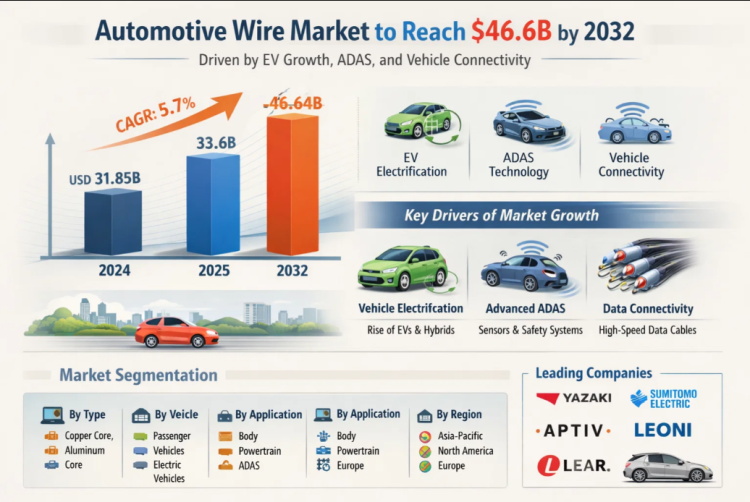
Global Automotive Wire Market, valued at a robust USD 31,850 million in 2024, is on a trajectory of significant expansion and is projected to grow from USD 33,600 million in 2025 to a substantial USD 46,640 million by 2032. This growth represents a compound annual growth rate (CAGR) of 5.7%, as detailed in a comprehensive new report published by Semiconductor Insight. This study underscores the foundational role of these critical components in ensuring the reliability, safety, and performance of modern vehicles, particularly as the industry accelerates its transition towards electrification and connectivity.


Automotive wires are the vital arteries of a vehicle's electrical system, responsible for transmitting power and data to virtually every electronic component. Their importance is magnified in today's automotive landscape, where features like advanced driver-assistance systems (ADAS), sophisticated infotainment units, and electric powertrains are becoming standard. The demand for more complex and higher-performance wiring harnesses is rising in lockstep with the increasing electronic content per vehicle, making this market a critical barometer for the health and direction of the global automotive industry. As vehicles evolve into sophisticated electronic platforms on wheels, the requirements for automotive wires in terms of data transmission speed, power handling capacity, durability, and lightweight properties are becoming more stringent, driving continuous innovation in the sector.
Download FREE Sample Report:
Automotive Wire Market - View in Detailed Research Report
Vehicle Electrification and Connectivity: The Primary Growth Engines
The report identifies the global push towards vehicle electrification and autonomy as the paramount driver for automotive wire demand. The electrification trend, in particular, is a game-changer. While conventional internal combustion engine vehicles contain an average of 1,500-2,000 meters of wiring, a modern electric vehicle (EV) or hybrid electric vehicle (HEV) can require significantly more, sometimes upwards of 5,000 meters. This dramatic increase is driven by the need for high-voltage cables for the powertrain and battery systems, intricate data networks for battery management systems (BMS), and a growing suite of electronic features. Furthermore, the market for connected and autonomous vehicles relies heavily on robust data transmission wires, including high-speed coaxial cables and fiber optics, to facilitate the massive data exchange required for sensors, cameras, and vehicle-to-everything (V2X) communication.
"The massive concentration of automotive manufacturing and the rapid adoption of electric vehicles in the Asia-Pacific region, which accounts for over half of the global automotive wire consumption, is a key factor in the market's momentum," the report states. With global investments in EV production and infrastructure exceeding hundreds of billions of dollars, coupled with stringent new government emissions regulations worldwide, the demand for advanced, lightweight, and high-performance wiring solutions is set to intensify. The industry is particularly focused on developing wires that can withstand higher temperatures in EV applications, reduce overall vehicle weight to extend range, and support gigabit-speed data transfer for autonomous driving functions.
Read Full Report: https://semiconductorinsight.com/report/automotive-wire-market/
Market Segmentation: Cooper Core Wires and Body Applications Dominate
The report provides a detailed segmentation analysis, offering a clear view of the market structure and key growth segments, illustrating the diverse applications and material demands within the automotive sector.
Segment Analysis:
By Type
-
Cooper Core
-
Aluminum Core
-
Others
By Application
-
Body
-
Chassis
-
Engine
-
HVAC
-
Speed Sensors
-
Other
By End User
-
OEMs (Original Equipment Manufacturers)
-
Aftermarket
-
Specialty Vehicle Manufacturers
By Vehicle Type
-
Passenger Vehicles
-
Commercial Vehicles
-
Electric Vehicles (EVs)
By Insulation Material
-
Polyvinyl Chloride (PVC)
-
Cross-Linked Polyethylene (XLPE)
-
Fluoropolymers (e.g., PTFE)
Competitive Landscape: Key Players and Strategic Focus
The global Automotive Wire market is a highly consolidated landscape, dominated by a select group of multinational giants. Yazaki, Sumitomo Electric, Delphi (now part of Aptiv), LEONI, and Lear collectively command a significant share of the global market, estimated at approximately 70%. This concentration is driven by the capital-intensive nature of production, stringent automotive quality standards, and the necessity for global supply networks to serve major Original Equipment Manufacturers (OEMs) worldwide. These leading players have established strong, long-term relationships with automotive manufacturers, providing comprehensive wiring harness systems that integrate thousands of individual wires. Their competitive strategies heavily rely on continuous innovation in materials for weight reduction and high-temperature resistance, automation in manufacturing to control costs, and strategic geographic presence to be near key automotive production hubs, particularly in China, which is the largest single market.
Beyond the top-tier players, a number of other significant companies compete by focusing on technological niches, regional strength, or specialized applications. Companies like Furukawa Electric and Fujikura are key competitors with strong technological prowess in advanced materials. Regional leaders, such as China-based Yura, Beijing Force, and Shanghai Shenglong, have captured substantial market share within the Asia-Pacific region, benefiting from the massive local automotive industry. Other notable players, including Coficab, PKC Group (acquired by Motherson Sumi Systems), Kyungshin, Coroplast, and General Cable, compete effectively by specializing in specific vehicle segments, offering cost-competitive solutions, or focusing on aftermarket sales. This secondary tier ensures a dynamic competitive environment, driving innovation and providing alternatives for automakers seeking diversification in their supply chains.
List of Key Automotive Wire Companies Profiled
-
Yazaki
-
Delphi Technologies (Aptiv)
-
Lear Corporation
-
Yura Corporation
-
Coficab Group
-
PKC Group (Motherson Sumi Systems)
-
Kyungshin Corporation
-
Beijing Force
-
Coroplast Fritz Müller GmbH & Co. KG
-
General Cable Technologies Corporation
-
Shanghai Shenglong
These companies are focusing on material science advancements, such as developing thinner, lighter wires with higher temperature ratings, and expanding their manufacturing footprint in high-growth regions like Asia-Pacific and Eastern Europe to capitalize on the shifting geography of automotive production.
Emerging Opportunities in High-Voltage Systems and Lightweighting
Beyond the overarching trends, the report outlines significant emerging opportunities driven by specific technological needs. The transition to 800-volt and higher vehicle architectures in the electric vehicle segment presents a major growth frontier, demanding entirely new classes of high-voltage wiring that offer superior insulation and electromagnetic shielding. Concurrently, the relentless industry-wide focus on lightweighting creates a strong push for aluminum core wires and other lightweight materials to replace heavier copper, directly contributing to improved fuel efficiency and extended EV driving range. Furthermore, the integration of advanced data architectures like Automotive Ethernet is creating demand for specialized cables capable of handling high bandwidth with minimal signal loss, essential for the real-time data processing required by autonomous driving systems.
Report Scope and Availability
The market research report offers a comprehensive analysis of the global and regional Automotive Wire markets from 2025–2032. It provides detailed segmentation, market size forecasts, competitive intelligence, technology trends, and an evaluation of key market dynamics, including the impact of raw material price fluctuations and evolving regulatory standards.
For a detailed analysis of market drivers, restraints, opportunities, and the competitive strategies of key players, access the complete report.
Get Full Report Here:
Automotive Wire Market, Global Business Strategies 2025-2032 - View in Detailed Research Report
About Semiconductor Insight
Semiconductor Insight is a leading provider of market intelligence and strategic consulting for the global semiconductor and high-technology industries. Our in-depth reports and analysis offer actionable insights to help businesses navigate complex market dynamics, identify growth opportunities, and make informed decisions. We are committed to delivering high-quality, data-driven research to our clients worldwide.
???? Website: https://semiconductorinsight.com/
???? International: +91 8087 99 2013
???? LinkedIn: Follow Us
Regional Analysis: Automotive Wire Market
Asia-Pacific
The Asia-Pacific region dominates the global automotive wire market, driven by its position as the world's largest automotive manufacturing hub. Countries like China, Japan, South Korea, and India are at the forefront of both vehicle production and sales, creating immense, sustained demand for automotive wiring harnesses and related components. The market dynamics are fueled by rapid urbanization, rising disposable incomes, and aggressive government policies supporting electric vehicle (EV) adoption and local manufacturing. This region is also a critical center for innovation, with local manufacturers heavily investing in the development of high-voltage wires for electric vehicles and lightweight materials to improve fuel efficiency. The presence of major global automotive OEMs and a dense network of tier-1 and tier-2 suppliers ensures a robust and complex supply chain for automotive wires. Intense competition among domestic and international players fosters continuous advancements in product quality and cost-effectiveness, securing the region's leadership in the global automotive wire market for the foreseeable future.
Manufacturing and Supply Chain Dominance
The concentration of automotive assembly plants across China, Japan, and South Korea creates an unparalleled ecosystem for automotive wire demand. This integrated supply chain, supported by extensive raw material availability and a skilled workforce, ensures efficient production and logistical advantages, making the region a pivotal global supplier.
Electric Vehicle Proliferation
Government mandates and consumer shift towards sustainability are accelerating EV production. This directly boosts demand for specialized high-voltage automotive wires and intricate wiring systems. Asia-Pacific leads in EV battery and component manufacturing, creating a synergistic growth path for advanced automotive wire technologies.
Technological Innovation and R&D
Significant investments in research and development are focused on creating more durable, lightweight, and heat-resistant wires to meet the demands of next-generation vehicles, including autonomous and connected cars. This focus on innovation ensures the region remains at the cutting edge of automotive wire specifications.
Cost-Competitive Production
Competitive labor costs and large-scale manufacturing capabilities allow Asian producers to offer automotive wires at highly competitive prices. This cost advantage is a key factor for global OEMs sourcing components, further solidifying the region's critical role in the international automotive wire market landscape.
North America
The North American automotive wire market is characterized by high demand for premium and technologically advanced vehicles, particularly in the United States and Canada. The region's strong emphasis on safety regulations, vehicle electrification, and the integration of advanced driver-assistance systems (ADAS) fuels the need for sophisticated and reliable wiring systems. The shift towards electric vehicles, supported by federal and state-level incentives, is a significant driver, increasing requirements for high-voltage cables and complex wiring architectures. The presence of leading automotive OEMs and a mature automotive aftermarket ensures steady demand for both original equipment and replacement automotive wires. Strategic partnerships between wire manufacturers and technology companies are common, focusing on developing next-generation solutions for the evolving automotive landscape.
Europe
Europe represents a highly sophisticated and regulated market for automotive wires, driven by stringent environmental standards and a strong push towards electrification. The European Union's ambitious CO2 emission targets are accelerating the transition to electric vehicles, directly impacting demand for specialized high-performance wiring harnesses. Germany, as the automotive heartland, along with France and Italy, hosts major OEMs and Tier-1 suppliers that are leaders in automotive innovation. The market demands high-quality, durable wires that can withstand rigorous safety and performance standards. There is a significant focus on lightweight materials to enhance electric vehicle efficiency, making the European automotive wire market a key hub for advanced material research and application.
South America
The South American automotive wire market is emerging, with growth primarily centered in Brazil and Argentina. The market is influenced by the recovery and modernization of the regional automotive industry. Demand is driven by the replacement market and gradual increases in vehicle production. Economic fluctuations can impact market stability, but there is a growing focus on adopting more advanced vehicle technologies, which will gradually increase the sophistication of wiring requirements. Local manufacturing is pivotal, with an emphasis on cost-effective solutions that meet regional safety standards, positioning the market for steady, long-term growth as the automotive sector evolves.
Middle East & Africa
The Middle East & Africa region presents a diverse automotive wire market landscape. The Gulf Cooperation Council (GCC) countries have a strong market for luxury and high-performance vehicles, creating demand for premium wiring systems. In contrast, other parts of the region are characterized by a significant used car market and growing automotive manufacturing in countries like South Africa. The overall market growth is tied to economic diversification efforts and infrastructure development, which spur commercial vehicle sales. The hot climatic conditions specific to the region necessitate automotive wires with enhanced heat resistance and durability, presenting unique requirements for manufacturers operating in this market.
What's Your Reaction?










![[ Latest Report ] Multi Access Edge Computing Market is anticipated to grow at Good CAGR](https://likelylike.com/assets/img/bg_slider.png)