Challenges in Achieving AI-Powered Learning ROI (How to Solve Them)
Struggling with AI-powered learning ROI? Discover key challenges and proven solutions to optimize and maximize business impact from AI learning programs.
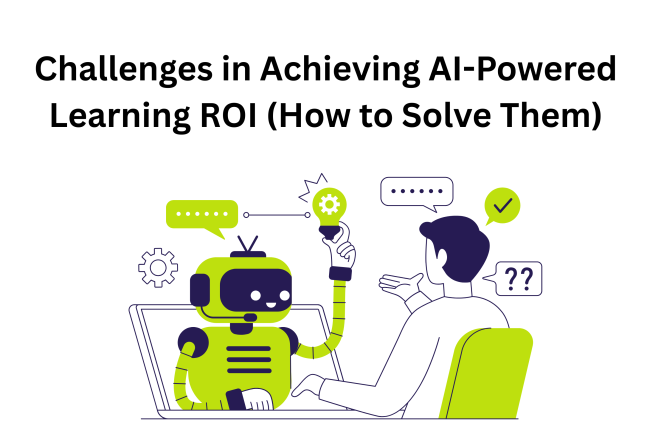
AI-driven learning is frequently portrayed as a game-changer for contemporary organisations. Although the promise is compelling, many companies find it difficult to achieve quantifiable returns. Achieving AI-powered learning ROI for CEOs and decision-makers requires more than just embracing the technology; it also requires smart implementation and overcoming typical obstacles.


Why It's Hard to Get ROI from AI-Powered Learning
On paper, AI learning platforms provide data insights, automation, and personalisation. In actuality, a lot of businesses are unable to link these competencies to observable business results. AI-powered learning ROI is more difficult to monitor and optimise when there is a gap in execution, measurement, and alignment with business objectives.
Here are some challenges and their solutions:
Challenge 1: Lack of Clear Business Alignment
The Problem
The lack of well-defined goals is one of the main reasons businesses don't experience a significant return from AI-powered learning ROI. Training initiatives are frequently started without being connected to quantifiable business results.
The Solution
Aligning learning initiatives with strategic objectives should come first. Every AI learning endeavour should be connected to a particular KPI, whether the goal is to increase productivity, decrease onboarding time, or improve sales performance. This guarantees that your ROI estimates are based on actual impact.
Challenge 2: Poor Data Tracking and Measurement
The Problem
AI platforms produce large volumes of data, but in the absence of appropriate tracking mechanisms, this data turns into noise. Measuring the appropriate KPIs is a challenge for many organisations.
The Solution
Pay attention to important metrics like increased productivity, time savings, less errors, and skill development. Before implementation, set a baseline and compare it to performance after training. Validating the AI-powered learning ROI requires accurate tracking.
Challenge 3: High Initial Investment Concerns
The Problem
ROI may appear dubious, particularly in the early phases, due to the upfront costs of AI learning tools, integration, and content creation.
The Solution
Adopt a gradual implementation strategy. Start with a pilot program aimed at a particular use case or team. This enables you to show off rapid successes and gain confidence prior to scaling. The AI-powered learning improves with time as the total advantages surpass the early expenses.
Challenge 4: Low Employee Adoption
The Problem
If workers don't actively interact with the AI learning system, even the most sophisticated one will fail. Effectiveness may be hampered by a lack of drive and resistance to change.
The Solution
Encourage adoption with user-friendly experiences, leadership support, and transparent information. One of AI's greatest advantages is personalisation, which should be used to make learning interesting and relevant. The ROI of AI-powered learning is directly impacted by increased adoption.
Challenge 5: Difficulty in Converting Outcomes into Value
The Problem
Improvements such as faster work completion or improved abilities are frequently difficult for organisations to convert into financial terms.
The Solution
Whenever possible, give results a monetary value. Calculate time saved in terms of personnel costs, for instance, or connect increased revenue with improved performance.
This stage makes the ROI of AI-powered learning more tangible and simpler to communicate to stakeholders.
Best Practices to Maximize ROI
To continuously increase the ROI of AI-powered learning, companies should:
-
Continue to evaluate and improve educational initiatives
-
Utilise AI insights to improve training methods
-
Get rid of poorly performing content
-
Review ROI data regularly.
Instead of focusing on short-term profits, a data-driven, iterative approach guarantees long-term success.
Conclusion
While there are obstacles to achieving a robust ROI from AI-powered learning, none of them are insurmountable. Businesses can transform AI learning into a potent growth and efficiency engine with the correct approach, well-defined objectives, and regular measurement.
Moving past adoption and concentrating on execution is crucial for leaders. When implemented properly, AI-powered learning improves company performance in addition to staff training.
What's Your Reaction?