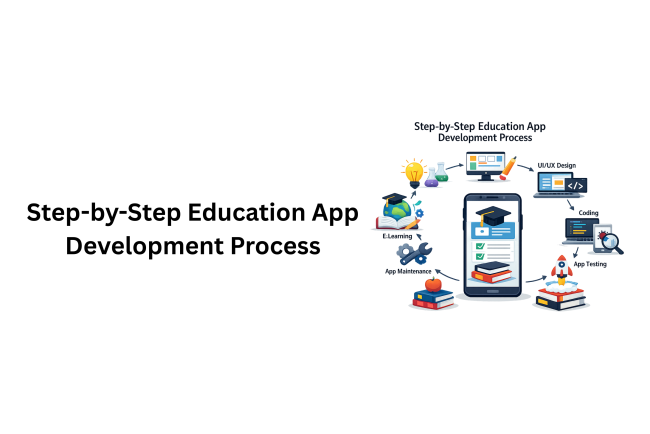
Step-by-Step Education App Development Process
Education apps are often discussed as products. In reality, for businesses and enterprises, they function more like systems. They support training, onboarding, compliance, and long-term skill development. That’s why building one requires more than technical execution.
Education apps are often discussed as products. In reality, for businesses and enterprises, they function more like systems. They support training, onboarding, compliance, and long-term skill development. That’s why building one requires more than technical execution.


A reliable education app development process focuses on clarity before speed. Teams that rush into development usually circle back later to fix structural problems that could have been avoided early.
What follows is a practical, step-by-step look at how education apps are actually built when long-term usage and scale matter.
Starting With the Problem, Not the App
Most education apps fail before development even begins. The reason is simple: the problem isn’t clearly defined.
Before anything else, teams need alignment around what the app is meant to solve. Is it employee training? External learning? Certification? Internal knowledge sharing?
This step also clarifies who the real users are. In enterprise environments, the buyer and the learner are rarely the same person. Ignoring that gap often leads to poor adoption later.
A broader explanation of how features, process, and cost connect can be found here.
Research That Reflects Real Usage
Once objectives are clear, research begins. This isn’t about copying competitors. It’s about understanding how people already learn.
User interviews, internal feedback, and workflow observation usually reveal friction points. Sometimes it’s time constraints. Sometimes it’s access issues. Sometimes it’s content overload.
Good research narrows focus. Instead of building everything, teams learn what actually needs to be built first.
Deciding What Not to Build
Feature planning sounds straightforward. It rarely is.
This stage involves tough decisions. Not every feature belongs in version one. In fact, most shouldn’t.
Enterprise education apps typically start with:
-
Structured learning paths
-
Progress visibility
-
Basic assessments
-
Admin-level reporting
Everything else is evaluated later, based on real usage. This is where experienced educational app development services help prevent over-engineering.
Design That Prioritizes Clarity
Education app design is not about visual flair. It’s about reducing friction.
Learners should know where they are, what’s next, and how much effort remains. Admins should find reports without searching. Instructors should manage content without technical support.
Good UX often goes unnoticed. That’s usually a sign it’s working.
Choosing Technology With Scale in Mind
Technology decisions tend to get locked in early, so this step matters more than it seems.
The stack must support:
-
Growing user numbers
-
Data security
-
Content expansion
-
Integration with existing systems
Enterprises rarely want isolated platforms. Education apps often need to connect with HR tools, analytics systems, or internal dashboards.
Building in Phases, Not All at Once
Development usually starts after designs are validated. But the best teams don’t build everything together.
They build in phases. Core functionality first. Supporting features next. Enhancements later.
This approach allows regular reviews, early testing, and course correction without resetting the entire project.
Testing Beyond Just Functionality
Testing isn’t only about bugs.
Education apps need to be tested for usability, performance, and behavior under load. An app that works fine for 50 users may struggle with 5,000.
Security testing also matters here. Learning platforms handle sensitive user data, and enterprises expect that to be protected.
Launching With a Plan, Not Just a Date
A launch isn’t the end of development. It’s the start of real feedback.
Many enterprise education apps roll out in stages. A pilot group first. Then broader teams. This allows issues to surface early, without impacting everyone at once.
Support documentation and onboarding resources are just as important as the app itself at this stage.
Learning From Usage After Launch
Once users are active, the app starts telling its own story.
Analytics reveal what works and what doesn’t. Some features get used heavily. Others are ignored. These signals guide future updates.
Education apps that evolve based on data tend to stay relevant longer.
Long-Term Support and Scaling
Education apps are not one-time builds.
They require updates, performance tuning, security reviews, and feature improvements over time. As organizations grow, the app must grow with them.
This is where long-term educational app development services add real value, not just during development but throughout the product’s lifecycle.
Closing Note
A step-by-step education app development process isn’t about slowing things down. It’s about avoiding mistakes that cost far more later.
When businesses invest time in planning, research, and iteration, the result isn’t just an app. It’s a learning system that actually works in the real world.
What's Your Reaction?