How AI Identifies Skill Gaps with Speed and Accuracy
Learn how AI skill intelligence quickly detects workforce skill gaps with data-driven accuracy, helping businesses plan hiring, training, and growth better.
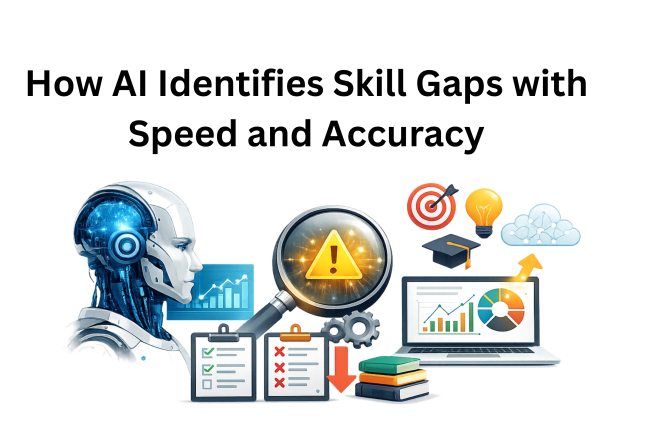
To determine talents, the majority of businesses still rely on manager reviews, certificates, and recurring surveys. These techniques produce blind spots even if they are well-known.


They are subjective, sluggish, and frequently lacking. Workers may exaggerate or underestimate their abilities. Managers may use their own judgement or recollections. Additionally, it may take months to collect this data from huge teams.
That delay is costly for a large-scale firm. Instead of being founded on facts, decisions about hiring, training, and promotions end up being educated assumptions.
What Makes AI Different?
AI skill intelligence adopts a radically different methodology. It watches what employees really do rather than asking them what they know.
Project results, performance statistics, learning history, certifications, collaboration patterns, and even task completion speed are just a few of the signals that AI can simultaneously analyse. It generates a precise and up-to-date talent profile for every person and team by integrating these inputs.
As a result, insight is obtained more quickly and accurately than using manual procedures.
How AI Identifies Skill Gaps Quickly
Continuous Data Collection
AI systems collect data automatically while operating in the background. Surveys and distinct testing cycles are not required.
Identification of Patterns
Trends that people might overlook are detected by machine learning. For instance, it can detect teams lacking growing technical capabilities or losing competency in a vital tool.
Dashboards in Real Time
Leaders have instant access to information about the strengths and weaknesses of various jobs, departments, and locations. They can take action on the same day rather than waiting for quarterly reports.
Predictive Knowledge
AI predicts future gaps in addition to highlighting existing ones. It calculates the skills needed and identifies shortages early on if new projects or technologies are planned.
Workforce planning becomes a competitive advantage thanks to this proactive capabilities.
Accuracy That Builds Trust
While speed is important, precision is more important. Bad decisions are the result of bad data.
AI skill intelligence lessens subjectivity and prejudice by depending on quantifiable performance indicators rather than subjective judgements. Fairer promotions, more astute hiring practices, and focused training expenditures result from this.
Additionally, it fits with Google's credibility and quality standards, which emphasise that reliable, experience-based insights produce superior results. The same holds true for workforce planning: data-driven judgements routinely trump gut feelings.
Business Impact Leaders Can See
Businesses can react more quickly when skill shortfalls are discovered early. Training becomes targeted rather than general. Because it is easier to identify latent talent, internal mobility improves. Since companies nurture talent internally, hiring expenses go down.
Above all, instead of rushing to catch up, teams remain ready for change.
Conclusion
Businesses today cannot grasp dynamic talents with static tests. They require visibility that is as fast-paced as their company.
That clarity is provided by AI skill intelligence, which can quickly, accurately, and scalably identify deficiencies. It turns talent management from a reactive endeavour into a competitive advantage for CEOs and company executives.
And that advantage is crucial in a market where success is determined by agility.
What's Your Reaction?