Top Challenges of AI Implementation in eCommerce
Explore key AI in eCommerce challenges and how to solve them. Learn to overcome data, cost, and adoption issues to scale AI successfully.
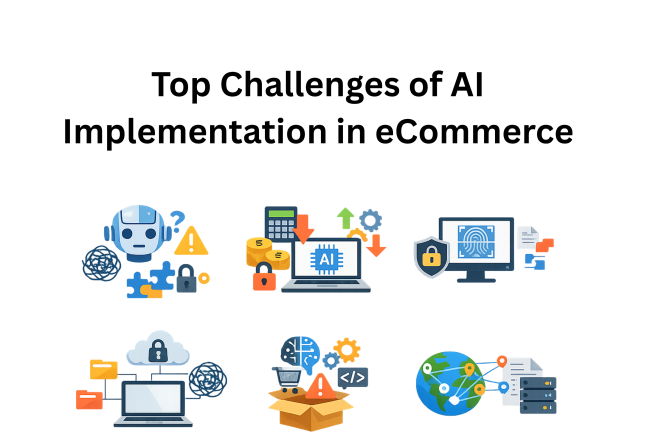
AI is everywhere in e-commerce conversations right now. But once teams move past the initial excitement, the reality starts to look different. Implementing AI in e-commerce is not just about plugging in tools. It’s about changing how decisions are made across the business.


And that’s where things begin to slow down.
Most enterprises don’t struggle with the idea of AI. They struggle with making it work in real conditions. Let’s look at where e-commerce AI actually becomes difficult to execute.
1. Data Isn’t Ready
On paper, most businesses have plenty of data. In practice, it’s messy.
Customer behavior, order history, inventory, and marketing data often live in different systems. They don’t sync well. Some of it is outdated. Some of it is incomplete.
When this kind of data feeds into AI systems, the output becomes unreliable. That’s why many AI for online stores projects fail before they even start delivering value.
2. No Clear Outcome, Just “We Need AI”
This happens more often than teams admit.
AI gets pushed as a priority, but without clarity on what it should improve. Conversion? Retention? Supply chain efficiency? No one defines it properly.
So the system runs, dashboards get built, but impact remains unclear. For AI in e-commerce to work, it has to solve a specific business problem, not a vague ambition.
3. Existing Systems Don’t Cooperate
Most e-commerce setups are already complex.
There’s a backend system, a storefront, payment integrations, logistics tools, and more. Adding AI into this mix isn’t always smooth.
If systems don’t talk to each other properly, AI ends up working in isolation. And isolated intelligence doesn’t help much. This is a common roadblock in scaling e-commerce AI across operations.
4. Costs Add Up Faster Than Expected
AI isn’t just a one-time setup. There’s data cleaning, model training, testing, deployment, and then continuous monitoring. It’s ongoing work. And that means ongoing cost.
For many businesses, the hesitation isn’t about adopting AI for online stores. It’s about not being sure when the returns will justify the investment.
5. Teams Don’t Always Align
AI sits at the intersection of tech and business. But these teams don’t always speak the same language. Developers focus on models and systems. Business teams focus on outcomes.
When alignment is missing, projects drag. Features get built but don’t solve the right problems. This slows down real adoption of AI in e-commerce.
6. Privacy and Trust Become Real Concerns
Customers are more aware now. They notice how their data is being used. Personalization works, but only to a point. If it feels intrusive, it backfires. Add to that regulatory pressure, and things get more sensitive.
Businesses need to be careful with how they use AI. Because trust, once lost, is hard to rebuild. This is one of the more overlooked challenges in e-commerce AI adoption.
7. Over-Automation Without Control
Automation sounds efficient. But too much of it can create problems. AI can misjudge demand. It can recommend the wrong products. It can even set prices incorrectly if left unchecked.
That’s why AI for online stores needs oversight. Human intervention still matters, especially in critical decisions.
8. Pilot Projects That Never Scale
A lot of companies run small AI experiments. Some of them even work. But taking that success across the organization is where things break. Different teams use different data. Systems don’t align. Priorities shift.
So AI remains limited to one function instead of becoming part of the core system. This is why AI in e-commerce often feels underwhelming at scale.
Where It Usually Goes Off Track
The pattern is quite consistent. AI is treated like an add-on instead of something that should be built into the foundation. Without integration, alignment, and clarity, even good tools fail to deliver.
If you want a broader view of how this transformation is actually playing out, this breakdown of AI in e-commerce transforming online stores connects the dots more clearly.
A More Practical Way to Approach It
There’s no shortcut, but there is a better way to approach it. Start small, but start with purpose. Fix your data before adding intelligence. Make sure systems are connected. And don’t remove human judgment completely.
Many businesses are now taking a structured route with eCommerce development services to avoid patchwork implementations.
And for brands building mobile-first experiences, integrating AI through mobile application development ensures consistency across user touchpoints.
Final Thought
AI can absolutely change how online stores operate. But the gap between potential and execution is still wide. The businesses that are getting it right are not rushing. They are building slowly, aligning teams, and focusing on outcomes.
That’s really the shift. From experimenting with e-commerce AI to making it part of how the business runs every day.
What's Your Reaction?