Predictive Maintenance for Defense Equipment Market Growth Analysis, Dynamics, Key Players and Innovations, Outlook and Forecast 2026-2034
The Predictive Maintenance for Defense Equipment Market is growing rapidly due to rising defense modernization, AI-powered maintenance systems, IoT integration, and increasing demand for operational readiness across military platforms worldwide.
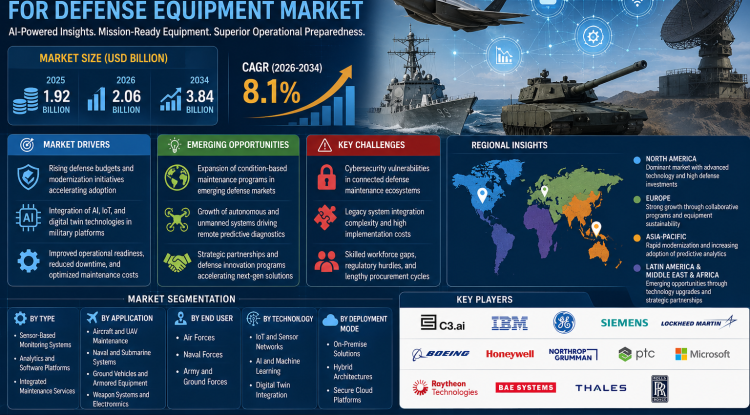
According to a new report from Intel Market Research, the global Predictive Maintenance for Defense Equipment Market was valued at USD 1.92 billion in 2025 and is projected to grow from USD 2.06 billion in 2026 to USD 3.84 billion by 2034, exhibiting a robust CAGR of 8.1% during the forecast period. This growth is propelled by rising defense budgets, increasing adoption of AI and IoT technologies in military platforms, and the strategic imperative to enhance operational readiness of mission-critical assets.


What is Predictive Maintenance for Defense Equipment?
Predictive maintenance for defense equipment refers to the deployment of advanced analytics, machine learning algorithms, and real-time condition monitoring systems that assess equipment health to anticipate failures before they occur. This technology supports mission-critical military assets such as aircraft, naval vessels, ground vehicles, missile systems, and radar platforms by analyzing vibration data, temperature patterns, and telemetry signals to ensure operational readiness. Because modern defense systems involve intricate mechanical and electronic subsystems, predictive models help reduce unexpected downtime, optimize maintenance cycles, and extend asset lifespan. The ecosystem includes solutions such as sensor-based monitoring platforms, integrated diagnostic toolkits, AI-driven maintenance software, and digital twin systems.
This report provides a deep insight into the global Predictive Maintenance for Defense Equipment market covering all its essential aspects-from a macro overview of the market to micro details such as market size, competitive landscape, development trends, niche markets, key drivers and challenges, SWOT analysis, and value chain analysis.
The analysis helps the reader understand competition within the industry and strategies for enhancing profitability. Furthermore, it provides a framework for evaluating and accessing the position of a business organization. The report also focuses on the competitive landscape of the Global Predictive Maintenance for Defense Equipment Market, introducing market share, performance, product positioning, and operational insights of major players. This helps industry professionals identify key competitors and understand the competition pattern.
In short, this report is a must-read for industry players, investors, researchers, consultants, business strategists, and all those planning to foray into the Predictive Maintenance for Defense Equipment market.
???? Download Sample Report: Predictive Maintenance for Defense Equipment Market - View in Detailed Research Report
Key Market Drivers
1. Rising Defense Budgets and Modernization Initiatives Accelerating Adoption
Global defense establishments are increasingly channeling resources toward technology-driven asset management strategies, with predictive maintenance for defense equipment emerging as a cornerstone of military modernization programs. Nations across North America, Europe, and the Asia-Pacific region have recognized that unplanned equipment downtime poses critical operational risks, prompting armed forces to invest in condition-based monitoring and advanced diagnostics. The shift from reactive and scheduled maintenance toward data-driven predictive models is being institutionalized within defense procurement frameworks, reflecting a structural change in how military organizations approach equipment lifecycle management.
2. Integration of AI, IoT, and Digital Twin Technologies in Military Platforms
The convergence of artificial intelligence, the Internet of Things, and digital twin technology is fundamentally transforming maintenance operations across military fleets, aircraft, naval vessels, and ground combat systems. Embedded sensors continuously stream real-time performance data from critical defense assets, enabling AI-powered analytics platforms to detect anomalies, predict component failures, and recommend corrective actions well before a breakdown occurs. Defense contractors and original equipment manufacturers are actively integrating these capabilities into new platforms and retrofitting legacy systems, creating sustained demand within the predictive maintenance for defense equipment market.
➤ The U.S. Department of Defense has identified predictive maintenance as a priority investment area under its broader digital transformation agenda, with the Army, Navy, and Air Force each running dedicated condition-based maintenance plus (CBM+) programs aimed at maximizing fleet readiness while reducing total ownership costs.
Operational readiness requirements are also a significant driver. Military commands operate under strict mission availability targets, and equipment failures during deployment can have severe strategic consequences. Predictive maintenance frameworks help defense organizations maintain higher asset availability rates, directly supporting mission success. As defense forces continue to operate complex, multi-domain platforms, the criticality of maintaining equipment performance in real time further reinforces sustained investment in predictive maintenance solutions across the sector.
Market Challenges
-
Cybersecurity Vulnerabilities in Connected Defense Maintenance Ecosystems – One of the most significant challenges confronting the predictive maintenance for defense equipment market is the cybersecurity risk inherent in connecting mission-critical military assets to networked monitoring systems. IoT-enabled sensors, cloud analytics platforms, and digital communication channels introduce potential attack vectors that adversarial state and non-state actors could exploit.
-
Legacy System Integration Complexity – A large proportion of active defense equipment worldwide operates on aging platforms that were not designed with digital connectivity or sensor integration in mind. Retrofitting these legacy systems requires significant engineering effort and customization.
-
Skilled Workforce and Data Literacy Gaps – Effective deployment requires personnel who can interpret complex sensor data and manage AI-driven analytics tools. Many defense organizations face shortages of personnel with the requisite data science and systems engineering skills.
-
Stringent Regulatory Frameworks and Lengthy Defense Procurement Cycles – Defense procurement processes are highly regulated, leading to prolonged sales cycles, extensive qualification processes, and complex compliance requirements.
Emerging Opportunities
The global defense landscape is becoming increasingly favorable for advanced maintenance technologies. Growing emphasis on operational efficiency, modernization of emerging defense markets, and strategic industry collaborations are accelerating market expansion, especially in Asia-Pacific, Middle East, and Latin America. Key growth enablers include:
-
Expansion of Condition-Based Maintenance programs across emerging defense markets
-
Growth of autonomous and unmanned systems driving demand for remote predictive diagnostics
-
Public-private partnerships and defense innovation programs accelerating commercialization of next-generation solutions
Collectively, these factors are expected to enhance operational capabilities, stimulate innovation, and drive broader adoption of predictive maintenance technologies across new platforms and geographies.
???? Download Sample PDF: Predictive Maintenance for Defense Equipment Market - View in Detailed Research Report
Regional Market Insights
-
North America: North America stands as the dominant force in the Predictive Maintenance for Defense Equipment Market, driven by extensive defense budgets, technological superiority, and close collaboration between armed forces and defense contractors. The region leads in the integration of advanced sensors, AI, and digital twins for critical assets.
-
Europe: Europe demonstrates robust growth fueled by collaborative defense programs, emphasis on equipment sustainability, and initiatives to improve interoperability among allied forces.
-
Asia-Pacific: The Asia-Pacific region is emerging as a dynamic player, characterized by rapid military modernization, growing indigenous capabilities, and increasing adoption of predictive analytics for naval and air fleets.
-
Latin America and Middle East & Africa: These regions present significant opportunities through targeted upgrades to military inventories, strategic investments in border security, and partnerships with international technology providers.
Market Segmentation
By Type
-
Sensor-Based Monitoring Systems
-
Analytics and Software Platforms
-
Integrated Maintenance Services
By Application
-
Aircraft and UAV Maintenance
-
Naval and Submarine Systems
-
Ground Vehicles and Armored Equipment
-
Weapon Systems and Electronics
By End User
-
Air Forces
-
Naval Forces
-
Army and Ground Forces
By Technology
-
IoT and Sensor Networks
-
AI and Machine Learning
-
Digital Twin Integration
By Deployment Mode
-
On-Premise Solutions
-
Hybrid Architectures
-
Secure Cloud Platforms
By Region
-
North America
-
Europe
-
Asia-Pacific
-
Latin America
-
Middle East & Africa
???? Get Full Report: Predictive Maintenance for Defense Equipment Market - View Detailed Research Report
Competitive Landscape
The Predictive Maintenance for Defense Equipment Market is characterized by a mix of established technology giants, specialized AI solution providers, and major defense contractors. Leading players leverage advanced AI, IoT sensors, and digital twin technologies to deliver real-time equipment health monitoring for military assets.
The report provides in-depth competitive profiling of key players, including:
-
C3.ai, Inc.
-
IBM Corporation
-
General Electric Company
-
Siemens AG
-
Lockheed Martin Corporation
-
The Boeing Company
-
Honeywell International Inc.
-
Northrop Grumman Corporation
-
PTC Inc.
-
Microsoft Corporation
-
Raytheon Technologies Corporation
-
BAE Systems plc
-
Thales Group
-
Rolls-Royce Holdings plc
Report Deliverables
-
Global and regional market forecasts from 2025 to 2034
-
Strategic insights into technology developments, integration trends, and defense programs
-
Market share analysis and competitive assessments
-
Evaluation of cybersecurity considerations and regulatory dynamics
-
Comprehensive segmentation by type, application, end user, technology, deployment, and geography
???? Get Full Report: Predictive Maintenance for Defense Equipment Market - View Detailed Research Report
???? Download Sample Report: Predictive Maintenance for Defense Equipment Market - View in Detailed Research Report
About Intel Market Research
Intel Market Research is a leading provider of strategic intelligence, offering actionable insights in biotechnology, pharmaceuticals, and healthcare infrastructure. Our research capabilities include:
-
Real-time competitive benchmarking
-
Global clinical trial pipeline monitoring
-
Country-specific regulatory and pricing analysis
-
Over 500+ healthcare reports annually
Trusted by Fortune 500 companies, our insights empower decision-makers to drive innovation with confidence.
???? Website: https://www.intelmarketresearch.com
???? Asia-Pacific: +91 9169164321
???? LinkedIn: Follow Us
What's Your Reaction?