How to Learn AI While Working - A Step-by-Step Weekly Schedule
Master artificial intelligence without quitting your day job. Discover a practical, weekly schedule designed for busy executives and business leaders.
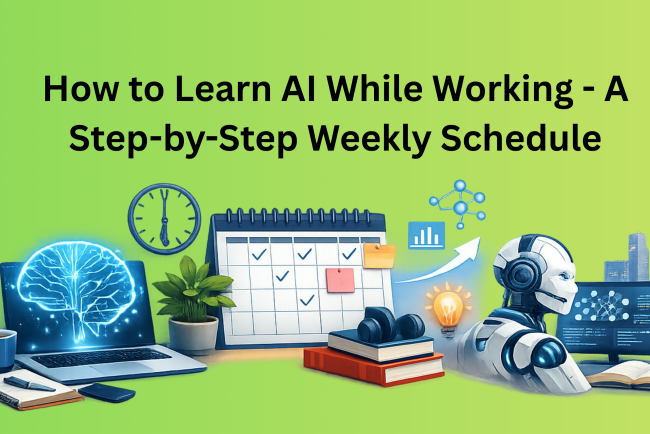
You don't need to be informed that artificial intelligence (AI) is changing the industry if you are a CEO or other business executive. You are already aware of it. You may be unaware of how to get the time to truly comprehend it. It seems hard to fit learning neural networks into your to-do list with board meetings, quarterly evaluations, and operational fires.


The good news? You are not required to return to school full-time. This is a realistic, highly structured weekly timetable that will help you learn AI while working so you can confidently lead your organization into the automation future.
Why AI Is Important for Business Leaders (EEAT Perspective)
Modern executives require more than a cursory understanding of buzzwords to make strategic and procurement decisions. Strategic micro-learning is necessary to balance this learning curve with a demanding career.
The 5-Hour Weekly AI Schedule for Busy Executives
You may develop a solid foundation in AI in a matter of months by devoting just one hour every day, Monday through Friday.
Monday: Foundations & Big-Picture Concepts
Time commitment: 1 hour (Early morning or during commute)
Focus: Understand the core terminology.
Action item: Don't start with code. Start with concepts. Learn the structural differences between Machine Learning (ML), Deep Learning, and Generative AI.
Tuesday: Case Studies & Industry Applications
Time commitment: 1 hour (Lunch break or mid-afternoon)
Focus: See AI in action within your specific vertical.
Take action: Read case studies or whitepapers from Gartner, Harvard Business Review, or McKinsey. Examine how rivals are using AI for customer service automation, predictive analytics, and supply chain optimization.
Wednesday: Practical Prompt Engineering & Equipment
Time commitment: One hour at the end of the workday
Focus: Real-world implementation.
Action item: Ask more than just basic questions. Use tools like Google Gemini, Claude, or ChatGPT Plus to experiment with advanced prompt engineering techniques for an hour. Learn how to enter data schemas into these models to generate fictitious market reports or internal policy drafts.
Thursday: Security, Governance, and Ethics
One hour of time commitment
Risk management is the main focus.
Action item: As a leader, compliance and security are more important than adoption when it comes to AI. Spend Thursdays learning about algorithmic bias mitigation techniques, data privacy legislation (such as the EU AI Act or GDPR), and AI ethics.
Friday: Strategy for Business Integration and Reflection
One hour of time commitment
Focus: Bridging the gap between knowledge and execution.
Action item: Examine the lessons you gained this week and apply them directly to your company. Consider this: Where in my company is the low-hanging fruit where AI may reduce operating time by 20%? Create an outline for a trial project.
Tips for High-Powered Professionals on Micro-Learning
-
Examine Your Audio: Listen to top-notch AI podcasts (like Hard Fork or The AI Podcast) to transform your regular workout or commute into a classroom.
-
Use Executive Summaries: AI can be learned through AI. Use a method to condense lengthy study papers into five essential executive takeaways.
-
Assign to Learn: Give your technical staff a biweekly AI Show and Tell to demonstrate how they are using new technologies.
Conclusion
Becoming an AI-literate leader is the aim of studying AI while working, not becoming a data scientist. You can make sure your company leads innovation instead of falling behind by devoting just five dedicated hours every week.
What's Your Reaction?