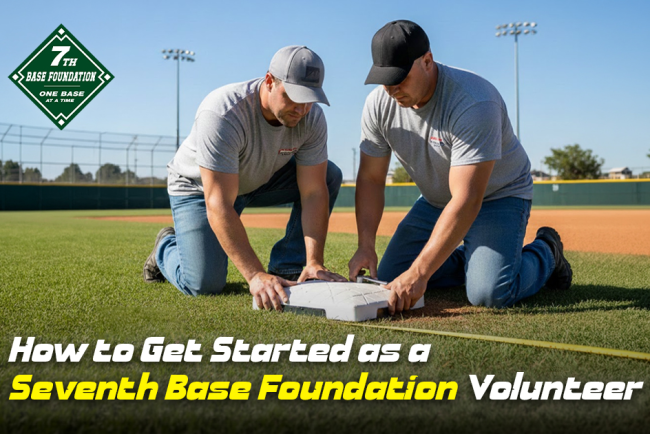
How to Get Started as a Seventh Base Foundation Volunteer
A practical guide to volunteering with the Seventh Base Foundation — the four ways you can help, what each involves, and how to sign up.
Most volunteer pages are vague on purpose. They say "get involved" and hope you'll figure out the rest.


This one isn't going to do that. Here's exactly what volunteering with the Seventh Base Foundation involves, what each role actually asks of you, and how to sign up.
Why we need volunteers specifically
Our biggest obstacle isn't skepticism about breakaway bases. It's obscurity.
Leagues can't apply for help they've never heard of. Donors can't fund a cause they don't know exists. Board members can't prioritize a safety issue nobody has mentioned to them.
Closing that gap is fundamentally a person-to-person job. It happens at tournaments, in league board meetings, in group chats, and in conversations between coaches who know each other. No amount of organizational effort substitutes for someone local saying "you should look into this."
That's the work. It's less glamorous than it sounds and more effective than it looks.
What you get out of it
Three things, plainly:
A direct impact on youth safety in sports. Not abstract advocacy — physical equipment on specific fields.
A cause focused on preventing injuries before they happen. Most sports safety work responds to injuries. This work stops them from occurring. That's a rarer thing to be part of than it should be.
A network. You join a growing group of passionate supporters and sports enthusiasts — parents, former players, coaches, and people who simply think kids should be safe on a ball field.
The four ways you can help
Fundraising and outreach
Helping us connect with local leagues, donors, and sponsors.
In practice: identifying youth programs in your area whose fields need work, reaching out to league presidents and parks departments, approaching local businesses about sponsorship, or organizing a small fundraiser through a team, school, or workplace.
Our tiers make asks concrete — $100 funds one breakaway base, $200 a double first base, $600 an entire field — which is far easier to pitch than an open-ended request.
Good fit if: you're comfortable starting conversations, you know people in local youth sports, or you've done any fundraising before.
Community events
Representing the foundation at games, tournaments, and awareness events.
In practice: staffing a table at a tournament, talking with parents and coaches, handing out materials, answering the questions that always come up (does the base come loose? is this expensive? how do we apply?).
Weekend tournaments are especially valuable, because they concentrate hundreds of families and dozens of coaches in one place.
Good fit if: you enjoy talking to people, you're already at fields on weekends, or you want visible, social volunteering rather than desk work.
Field assessments
Assisting in evaluating the safety of local baseball and softball fields.
In practice: visiting fields in your area, documenting base type and condition with photographs, noting whether bases are bolted to sunken posts or use a breakaway system, and flagging wear, damage, and exposed anchors.
This is genuinely useful data. It tells us where need is concentrated, and it gives local leagues the documentation they need to make their own case — to their board, their city, or a sponsor.
Good fit if: you're methodical, you're around fields regularly, or you like concrete tasks with a clear output.
Content and advocacy
Sharing our mission online and spreading the word about breakaway bases.
In practice: posting about base safety, sharing our work on social media, writing about your own experience with youth sports injuries, or simply sending our application page to the league president in your town.
Don't underestimate this one. A single share in a local youth sports group can reach exactly the person who runs the league with the worst fields in the county.
Good fit if: you have a network in youth sports, you write or create content, or you have limited time but real reach.
How to actually start
Becoming a volunteer is deliberately simple. Fill out our short volunteer form on the Become a Volunteer page — it asks for your name, email, and phone number — and our team will reach out with next steps.
That's it. No application essay, no interview process, no minimum commitment.
When we get in touch, it helps if you can tell us:
● Roughly where you're located, since much of the work is regional
● Which of the four areas interests you most
● How much time you realistically have — an hour a month is a real contribution
● Any relevant background: coaching, playing, health care, marketing, event work, local business connections
Be honest about your capacity. We'd much rather have someone reliable for one hour a month than someone who overcommits in March and disappears in May. Youth sports runs on volunteers, and the ones who last are the ones who were realistic at the start.
What the first few months usually look like
New volunteers often expect a rigid program and are surprised by how much is shaped around them. In practice, the first conversation is mostly about matching: where you are, who you already know in local youth sports, and which of the four areas fits your time and temperament.
From there, most people start small — one field documented, one league contacted, one tournament worked, one post shared. What tends to happen next is that one thing leads to another. A coach you spoke with mentions a neighboring league. A field you photographed turns into an application. That compounding is why local volunteers matter so much more than their hours suggest.
There's no requirement to have played the game, coached, or know anything about equipment when you start. The facts that matter can be learned in an afternoon.
If volunteering isn't the right fit
There are other ways to help, and none is lesser.
You can donate — every gift funds equipment directly, and we're a 501(c)(3) so it's tax-deductible.
You can partner with us if you own or run a business.
You can tell one league about us. Seriously — if you do nothing else, send the application page to the program in your town. That single act has a real chance of putting safer bases on a field.
What it adds up to
Volunteering here won't produce a dramatic moment. Nobody will thank you at a ceremony. The kid whose ankle didn't break will never know your name, because nothing happened to them.
What you'll have instead is the knowledge that a field somewhere got safer because you made an introduction, staffed a table, took some photographs, or shared a link — and that every child who slides into that bag for the next several seasons is better off for it.
Take the first step and join our volunteer team today.

What's Your Reaction?