Global LiDAR Technology Market to Reach 15.47 Billion by 2032 Driven by Autonomous Vehicles
The global LiDAR technology market was valued at 2.34 billion in 2024 and is projected to reach 15.47 billion by 2032, growing at a CAGR of 31.7 percent. Rapid adoption in autonomous vehicles, smart infrastructure, robotics, and advancements in solid-state LiDAR systems are driving strong market growth.
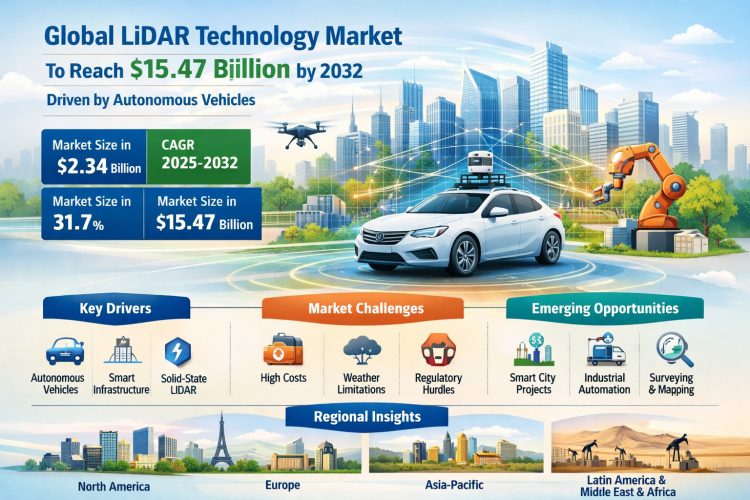


According to a new report from Intel Market Research, the global LiDAR Technology market was valued at USD 2.34 billion in 2024 and is projected to reach USD 15.47 billion by 2032, growing at a remarkable CAGR of 31.7% during the forecast period (2025–2032). This rapid expansion is fueled by the surging adoption of autonomous vehicles, increasing deployment in smart infrastructure projects, and significant technological advancements in solid-state LiDAR systems.
What is LiDAR Technology?
LiDAR (Light Detection and Ranging) is an advanced remote sensing method that uses laser pulses to measure distances and create precise, three-dimensional representations of physical environments. The technology operates by emitting laser light and measuring the time it takes for the reflected signals to return, enabling highly accurate mapping and object detection capabilities. A typical LiDAR system consists of three core components: a laser scanner, a specialized GPS receiver, and an Inertial Measurement Unit (IMU). LiDAR has become an indispensable technology for autonomous driving systems, topographic surveying, urban planning, and environmental monitoring applications.
This comprehensive report delivers deep insights into the global LiDAR Technology market, covering all essential aspects from macro-level market overviews to micro-level details including market size analysis, competitive dynamics, development trends, niche applications, key growth drivers and challenges, SWOT analysis, and value chain assessment.
The analysis provided enables readers to thoroughly understand competitive dynamics within the industry and identify strategies for enhancing market position and profitability. Furthermore, it establishes a robust framework for evaluating and assessing business organizational positioning within the market landscape. The report also meticulously examines the competitive landscape of the Global LiDAR Technology Market, presenting detailed market share analysis, performance metrics, product positioning strategies, and operational insights of major industry players. This comprehensive competitive intelligence helps industry professionals effectively identify key competitors and understand prevailing competition patterns.
This report represents essential reading for industry participants, investors, research professionals, consultants, business strategists, and all stakeholders considering entry into the dynamic LiDAR Technology market.
???? Download Sample Report: LiDAR Technology Market - View in Detailed Research Report
Key Market Drivers
1. Accelerating Autonomous Vehicle Adoption and Safety Regulations
The accelerating development and deployment of autonomous vehicles represents the primary growth catalyst for the LiDAR market. Modern Advanced Driver-Assistance Systems (ADAS) and fully autonomous driving systems require the precise, real-time 3D environmental mapping that LiDAR technology uniquely provides. Regulatory mandates for enhanced vehicle safety features across major automotive markets, combined with automakers' increasing commitment to achieving higher levels of autonomy, have created substantial demand. The automotive LiDAR segment is projected to maintain a growth rate exceeding 30% annually as these systems transition from premium vehicles to mass-market models.
2. Technological Advancements in Solid-State LiDAR Systems
The ongoing technological evolution from mechanical to solid-state LiDAR systems represents a transformative shift in the industry. Solid-state LiDAR (SSL) eliminates moving parts, offering significant advantages in durability, compact form factors, and potential cost reduction at volume production scales. This technological transition is crucial for broader market adoption across consumer automotive applications and other sectors where reliability, size, and cost are critical factors. Major industry players are increasingly focusing their R&D efforts on advancing solid-state technologies to capitalize on these benefits.
Market Challenges
- High System Costs and Manufacturing Scalability – Despite technological progress, the substantial cost of high-performance LiDAR units remains a significant barrier to widespread adoption, particularly in price-sensitive consumer automotive markets. Achieving cost-effective mass production while maintaining performance and reliability standards presents ongoing challenges for manufacturers.
- Performance Limitations in Adverse Weather Conditions – LiDAR system performance can be compromised during heavy precipitation, fog, or snow conditions where laser scattering occurs. Ensuring consistent operational reliability across diverse environmental conditions represents an important area for continued technological development.
- Standardization and Regulatory Hurdles – The absence of universal standards for LiDAR performance metrics, data formats, and safety protocols (particularly concerning laser eye safety) creates integration complexities and can slow market adoption across different industries and geographical regions.
Emerging Opportunities
The global technological landscape is creating increasingly favorable conditions for LiDAR adoption across multiple sectors. Growing infrastructure development initiatives, supportive government policies for smart city projects, and strategic industry collaborations are accelerating market expansion, particularly in Asia-Pacific, Latin America, and the Middle East & Africa. Key growth enablers include:
- Enhanced government infrastructure development programs and surveying initiatives
- Expansion of industrial automation and robotics applications
- Formation of strategic partnerships between technology providers, automotive OEMs, and infrastructure developers
Collectively, these factors are expected to broaden accessibility, stimulate continued innovation, and drive LiDAR technology penetration across new application areas and geographic markets.
???? Download Sample PDF: LiDAR Technology Market - View in Detailed Research Report
Regional Market Insights
- North America: North America maintains market leadership, driven by strong technology innovation ecosystems, substantial venture capital investment, and early adoption across automotive and industrial sectors. The region's mature regulatory environment and established infrastructure for autonomous vehicle testing further support market dominance.
- Europe: Europe represents a highly advanced LiDAR market characterized by stringent automotive safety standards and significant investment in smart city initiatives. Leading automotive manufacturers in Germany, France, and Italy are at the forefront of LiDAR integration for next-generation vehicles.
- Asia-Pacific: The Asia-Pacific region is experiencing the most rapid market growth, fueled by massive infrastructure development, urbanization projects, and substantial investments in autonomous vehicle technology, particularly in China, Japan, and South Korea.
- Latin America and Middle East & Africa: These emerging markets show promising growth potential, driven by increasing applications in natural resource management, agricultural development, and infrastructure projects, though adoption rates are currently lower than in developed regions.
Market Segmentation
By Type
- Mechanical LiDAR
- Solid-State LiDAR
By Application
- Automotive & Transportation
- Robotics & Industrial Automation
- Smart Infrastructure
- Environmental Monitoring
- Agriculture
- Others
By Component
- Laser Scanners
- Navigation & Positioning Systems
- Software & Services
By Region
- North America
- Europe
- Asia-Pacific
- Latin America
- Middle East & Africa
???? Get Full Report: LiDAR Technology Market - View Detailed Research Report
Competitive Landscape
While Hesai Technology and RoboSense currently lead the market with significant shares, numerous technology companies are advancing competitive LiDAR solutions across automotive, industrial, and consumer applications. The competitive environment continues to intensify as established players and innovative startups develop increasingly sophisticated and cost-effective sensing solutions.
The report provides comprehensive competitive profiling of 15+ key market participants, including:
- Hesai Technology
- RoboSense
- Velodyne Lidar
- Continental AG
- Valeo
- Luminar Technologies
- Innoviz Technologies
- Ouster
- Quanergy Systems
- Aeva Technologies
- Cepton
- LeddarTech
- Baraja
- Trimble Inc.
- Teledyne Optech
- Other prominent players developing advanced LiDAR solutions
Report Deliverables
- Global and regional market forecasts from 2025 to 2032
- Strategic insights into technology developments, product innovations, and regulatory landscape
- Market share analysis and comprehensive SWOT assessments
- Pricing trend analysis and cost structure evaluation
- Detailed segmentation by type, application, component, and geography
???? Get Full Report: LiDAR Technology Market - View Detailed Research Report
???? Download Sample Report: LiDAR Technology Market - View in Detailed Research Report
About Intel Market Research
Intel Market Research is a leading provider of strategic intelligence, offering actionable insights in emerging technologies, advanced manufacturing, and industrial automation. Our research capabilities include:
- Real-time competitive benchmarking
- Global technology adoption monitoring
- Country-specific regulatory and market analysis
- Over 500+ technology and industrial reports annually
Trusted by Fortune 500 companies, our insights empower decision-makers to drive innovation with confidence.
???? Website: https://www.intelmarketresearch.com
???? International: +1 (332) 2424 294
???? Asia-Pacific: +91 9169164321
???? LinkedIn: Follow Us
What's Your Reaction?