Diablo II Resurrected Guide: Face the Lord of Terror with U4GM
For some members of the community, obtaining specific equipment is central to this process. Discussions about whether to buy D2R Items exist alongside the traditional approach of earning equipment through gameplay, but the underlying attraction is character optimization.
There is a particular feeling associated with returning to an old game that once occupied countless evenings. Familiar sounds, locations, enemies, and interface elements can instantly bring back memories. Yet nostalgia alone cannot explain the continued appeal of Diablo II. A game can be remembered fondly and still feel outdated when played years later.


D2R Items demonstrates what happens when a classic has systems strong enough to survive the passage of time. Blizzard Entertainment preserved the game's fundamental structure while rebuilding its presentation for modern hardware. The result is both a historical artifact and a fully playable action RPG for a contemporary audience.
The Atmosphere of Sanctuary
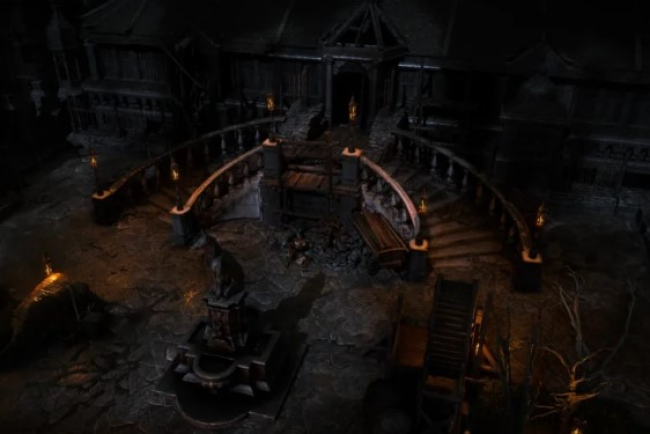
From the opening moments, Diablo II: Resurrected establishes a mood that differs from many modern fantasy games. Sanctuary is not presented as a bright world filled with heroic spectacle. It is bleak, dangerous, and often unsettling.
Villages provide temporary moments of safety, but the surrounding wilderness is filled with demons, corrupted creatures, abandoned ruins, and ominous environments. Each act has its own visual identity, yet they all contribute to the larger sense that the player is moving through a world under supernatural threat.
The remastered graphics make these environments much more detailed while maintaining their grim personality. Stone structures have greater texture, deserts appear more expansive, and hellish areas contain considerably more visual detail.
The ability to switch to legacy graphics is particularly interesting because it allows players to compare both eras instantly. The old presentation still has a distinctive charm, and seeing it beside the remastered version demonstrates how carefully the newer visuals reproduce the original game's structure.
Seven Ways to Become a Hero
Character development remains one of the strongest elements of Diablo II: Resurrected. The game provides seven classes, each with distinct abilities and playstyles.
The Amazon specializes in ranged and spear-based combat. The Barbarian focuses heavily on physical strength and melee attacks. The Paladin combines combat abilities with powerful auras, while the Necromancer uses curses and undead summons to control the battlefield.
The Sorceress offers extensive magical abilities, the Druid combines nature-based magic with shapeshifting, and the Assassin brings traps and martial techniques into battle.
Each class has multiple skill trees, creating substantial build variety. Players are encouraged to think about how individual abilities interact rather than simply selecting every skill that becomes available.
That system creates an important sense of ownership. A character is not simply a collection of statistics generated by the game. The player makes meaningful decisions about how that character develops.
The Addiction of the Loot System
Few elements are more closely associated with Diablo II than loot. Defeating a monster can produce a weapon, armor piece, rune, charm, potion, or other item. Most drops are ordinary, but occasionally the game delivers something that dramatically changes the player's plans.
This unpredictability creates an enduring feedback loop. Players defeat enemies to become stronger, but becoming stronger also allows them to tackle harder content more efficiently, which creates opportunities to find better equipment.
The search for D2R Items can therefore become its own long-term activity. A player might spend considerable time farming a particular boss because that boss has a chance to drop a desired unique item or rune.
Unlike progression systems where the next upgrade is always predetermined, Diablo II frequently leaves players wondering what might appear after the next encounter.
A Better Experience for Modern Players
The original game contained many systems that were accepted as normal in 2000 but can feel inconvenient today. Resurrected addresses several of those frustrations.
The shared stash is particularly important for players who enjoy experimenting with multiple characters. Equipment can be placed in shared storage and accessed by other heroes, making it substantially easier to transfer useful gear.
Automatic gold pickup is another small but meaningful improvement. Players no longer need to manually click every piece of currency scattered across the battlefield.
Controller support also broadens the ways players can interact with the game. Combined with modern console availability and cross-progression, the remaster fits more naturally into contemporary gaming habits.
These changes are valuable because they improve convenience without replacing the underlying mechanics.
Multiplayer and Seasonal Progression
Although Diablo II can be enjoyed alone, multiplayer adds another dimension to the experience. Groups can cooperate against powerful enemies, clear areas more quickly, and share the excitement of particularly valuable loot discoveries.
The seasonal ladder structure also gives experienced players a reason to create new characters and begin the progression cycle again. Starting from modest equipment and gradually developing a powerful build is one of the game's most recognizable experiences.
For some members of the community, obtaining specific equipment is central to this process. Discussions about whether to buy D2R Items exist alongside the traditional approach of earning equipment through gameplay, but the underlying attraction is character optimization.
Preserving a Gaming Landmark
The greatest accomplishment of Diablo II: Resurrected is perhaps its restraint. The developers could have radically changed the progression system, redesigned every class, or attempted to modernize every mechanic. Instead, the remaster largely preserves the original experience.
That decision allows the game to retain its distinctive identity. Its pacing, difficulty, itemization, and character systems remain recognizable, while modern graphics, audio, interfaces, and convenience features reduce the barrier for new players.
The result is a fascinating bridge between generations. Veteran players can revisit familiar adventures with dramatically improved presentation, while newcomers can experience the mechanics that influenced countless games that followed.
Returning to the Darkness
More than twenty years after the original release, Diablo II Resurrected Items proves that compelling game design does not necessarily require constant reinvention. Strong systems can remain engaging when they are built around meaningful choices, satisfying progression, and unpredictable rewards.
The demons may be familiar, the maps may be remembered, and the music may bring back another era of gaming, but the experience still has the ability to draw players forward. There is always another dungeon, another boss, another character build, and another piece of equipment waiting somewhere in the darkness.
What's Your Reaction?