Facebook Ad Frequency Caps: When Capping Helps and When It Costs You
Learn when Facebook ad frequency caps help reduce ad fatigue and when they can hurt performance. Discover how to balance reach, frequency, and creative strategy.
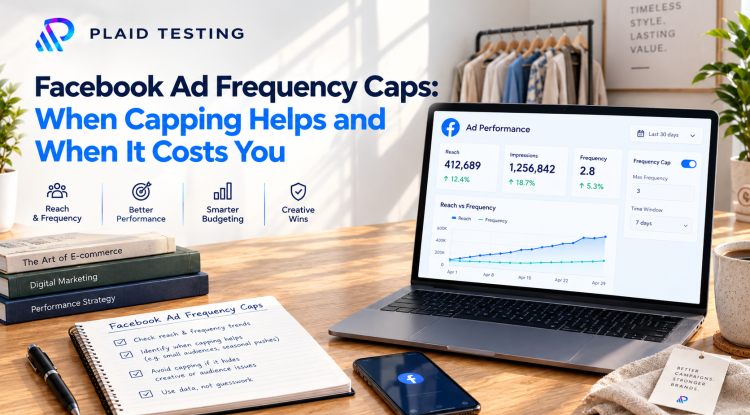
Capping frequency helps when a small, well defined audience is seeing the same asset repeatedly and response is falling. It costs you when the cap substitutes for new creative, because the system then buys less of the inventory that was working. The cap controls exposure, not fatigue.


What a frequency cap actually controls
Frequency is not a setting. It is an output. Divide impressions by people reached over a window and you have it, so it moves whenever budget, audience size or creative volume moves. A cap is a delivery instruction laid over that arithmetic: stop serving a person once they have seen an ad a chosen number of times inside a chosen window.
In reach and frequency buying the instruction is enforced directly. In auction buying most advertisers approximate it through tighter exclusions, wider prospecting pools, and pacing that stops one asset taking the whole budget. An operator who says the account is capped in auction buying usually means the inputs changed, not the ceiling, and the difference changes how you read what happened next.
When capping frequency helps
Small retargeting pools are the clearest case. If the audience is a few weeks of site visitors and the budget was sized against a much larger pool, delivery concentrates on people who already know you, and each extra view is worth less than the last.
Narrow geography behaves the same way. A single metro or a single language market offers a fixed supply of people, so extra budget turns into repetition instead of reach.
Seasonal pushes are missed most often. During heavy trading, prospecting, retargeting, promotional and brand campaigns can all be live at once and eligible to serve the same person. Each looks reasonable on its own report while the person on the other end sees more of you than any report shows.
When a cap costs you more than it saves
The auction serves a person repeatedly because the model predicts value there. A ceiling removes those impressions first, pushing budget toward people the model is less sure about. Delivery looks calmer, average frequency falls, and efficiency often falls with it, which surprises teams who expected protection.
The second cost is diagnostic. Rising frequency against falling response is one of the more reliable signals in an account. Cap it and the signal goes while the problem stays.
Most of what buyers want from a cap is a creative supply problem, which is why our performance creative work, described at plaidtesting.com/services/performance-creative/, starts with concept volume rather than delivery settings. One strong concept and a queue of variations will not become two winners because of a ceiling.
How to read reach and frequency together
Frequency alone says almost nothing. Read it against reach over the same window. Reach still expanding while frequency climbs means you are scaling, and repetition is a side effect of spending more against an audience that keeps widening. Reach flat while frequency climbs means you are buying the same people again, and cost per result usually confirms it.
On a womens fashion brand we ran, a single product accounted for $1.45M of revenue across 10,564 units and 8,517 new customer orders over the eight months.
The asset carrying it ran at a frequency that would have failed most rules of thumb. It kept converting because reach was still widening underneath it, and a blanket ceiling would have throttled the strongest thing in the account.
What to change before you touch the cap
Begin with creative supply: how many genuinely different concepts, rather than variations of one, entered the account last cycle. Audience construction comes next, because overlapping campaigns, missing exclusions and stacked retargeting windows produce most of the repetition blamed on delivery. Pacing follows, since a large budget against a narrow audience concentrates regardless of the settings above it.
Placement deserves its own pass. Repetition in a feed and repetition in short form video are not experienced the same way, and an account average hides both.
If you have worked through that and exposure is still concentrating on a group you can name, a cap is a reasonable tool. Apply it to one campaign, for a stated reason, with a date to review, rather than as standing policy.
Look at reach and frequency together before touching a cap. One without the other is misleading.
Jason Lu leads Plaid Testing. He works with ecommerce brands on the growth infrastructure that has to be in place before media spend can compound.
What's Your Reaction?