Key Elements of Private LLM Development
Explore key elements of Private LLM Development, including data, security, and scalability to build secure, high-performing AI systems for businesses.
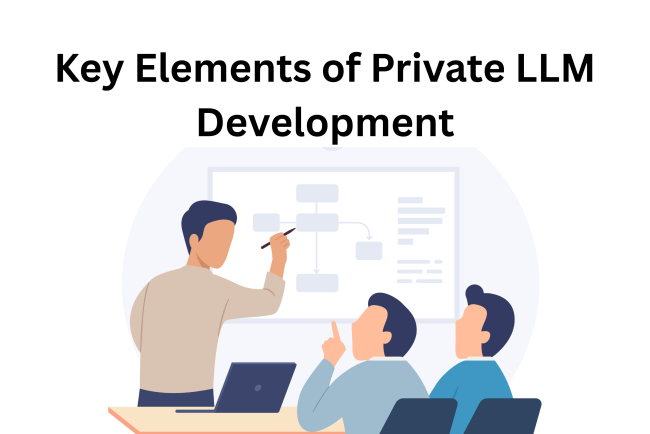
Control, security, and personalization are all essential as businesses deploy AI more quickly. Private LLM Development can help in this situation. Businesses are now creating custom models that fit their internal data, workflows, and compliance needs rather than depending on public AI platforms.


CEOs and decision-makers must comprehend the fundamental components of creating a private LLM. It's a strategic endeavor that directly affects productivity, creativity, and competitive advantage rather than merely being a technical procedure.
Core Elements Of Private LLM Development
1. Clear Business Use Case
Every effective AI project begins with a clear goal. Clarity is essential for automating customer service, improving corporate knowledge management, or boosting analytics.
Even the most sophisticated models may fall short of providing value in the absence of a targeted use case. Companies should pinpoint particular problems and link them to quantifiable results. This guarantees that your investment in private LLM development will yield a measurable return on investment instead of becoming an experimental endeavor with ambiguous advantages.
2. High-Quality Data Infrastructure
The foundation of any LLM is data. This includes proprietary datasets like conversation logs, CRM data, and corporate documents in private installations.
But having data alone is insufficient. It needs to be orderly, tidy, and comply with rules. Inaccurate outputs from poor data quality can influence business decisions.
To ensure that sensitive data is managed securely and responsibly throughout its lifecycle, organizations should also have robust data governance procedures.
3. Model Choice and Personalization
Selecting the appropriate base model is a crucial choice. Depending on their requirements and available resources, businesses can either start from scratch or modify pre-existing open-source models.
The true value is found in customization. Organizations can develop AI systems that comprehend their industry jargon, workflows, and subtleties by training the model on domain-specific data.
Businesses can now more easily obtain Private LLM Development because to effective methods like parameter-efficient fine-tuning, which lower costs without sacrificing performance.
4. Safe Environment for Deployment
One of the main reasons businesses choose private LLMs is security. Ideally, deployment should take place in a controlled setting, either on-site or in a private cloud.
Data encryption, role-based access control, and ongoing monitoring are important factors to take into account. These safeguards guarantee that confidential company data never leaves the ecosystem of the company.
This degree of control is required for sectors like finance and healthcare that handle sensitive data.
5. Performance Optimization and Scalability
Your AI systems need to develop with your company. This entails creating infrastructure that can manage growing user demands and data loads without sacrificing speed.
Cost effectiveness, latency, and response accuracy are all crucial indicators to keep an eye on. Frequent optimization guarantees that even as usage grows, your model will continue to produce high-quality results.
Your LLM becomes a long-term business asset with a scalable system.
6. Constant Observation and Enhancement
Artificial intelligence models are not "set and forget" fixes. Maintaining accuracy and relevance requires constant observation.
To find areas for improvement, organizations should monitor performance indicators and collect user input. Retraining the model on a regular basis with current data guarantees that it adapts to changing business requirements.
A crucial element of successful private LLM development is this continuous process, which aids companies in staying ahead of a quickly evolving market.
Conclusion
Building a private LLM necessitates a strategic approach that is in line with company objectives, not merely technical know-how. Every component is essential to success, from establishing precise use cases to guaranteeing security and scalability.
For CEOs and company executives, investing in private LLM development is about more than just implementing AI; it's about gaining a competitive advantage through safe, tailored, and effective systems. When done well, it becomes a potent force for growth and innovation.
What's Your Reaction?