Do Plants Prefer Small Amounts of Water? | SmartiLiving
Do plants prefer gradual watering or one big drink? Learn how watering frequency, soil moisture, and self-watering systems affect plant health.
Do Plants Prefer Small Amounts of Water Over One Big Drink?


When you water your plants, you might think the goal is simple: give them plenty of water and wait until they need it again.
But plant watering isn't quite that simple.
Some plants can benefit from consistent access to moisture, while others prefer their soil to dry between waterings. This raises an interesting question:
Do plants actually prefer receiving small amounts of water over one large watering session?
The answer depends on the plant, soil, pot, and environment. However, understanding how moisture moves through soil can help you create a better watering routine.
What Happens When You Give a Plant One Big Drink?
Imagine your plant's soil has become completely dry.
You pour a large amount of water into the pot.
At first, the soil absorbs the water. Some moisture moves downward through the soil while excess water may eventually drain through the bottom of the pot.
This can thoroughly rehydrate dry soil, which can be useful when a plant genuinely needs watering.
But there is an important difference between thorough watering and keeping soil constantly saturated.
Plants need water, but their roots also need oxygen.
That's why simply adding more and more water isn't necessarily better.
Plants Don't All Drink Water the Same Way
Different plants have different watering requirements.
For example:
-
Succulents generally prefer drier conditions.
-
Tropical plants often prefer more consistent moisture.
-
Herbs can have moderate watering requirements.
-
Young plants may need closer monitoring.
-
Plants in small pots can dry faster.
-
Plants in large containers may retain moisture for longer.
So there isn't one watering schedule that works for every plant.
Instead of asking, "How much water should every plant get?" it's better to ask:
What moisture conditions does this particular plant prefer?
Why Consistent Moisture Can Matter
Some plants don't respond well to repeated cycles of becoming extremely dry and then receiving a large amount of water.
Depending on the plant, frequent moisture fluctuations can contribute to stress.
A more gradual supply of moisture can sometimes create a more stable environment around the roots.
This is one reason passive watering systems have become popular among plant owners.
Instead of manually adding a large amount of water every time the soil becomes dry, a self-watering system can provide moisture gradually.
What Is Gradual Watering?
Gradual watering means supplying water over a longer period rather than delivering all of it at once.
Think about the difference between:
One large watering → long dry period → another large watering
and:
Gradual moisture → gradual moisture → gradual moisture
The second approach can help maintain a more consistent moisture environment for plants that prefer it.
However, gradual watering isn't automatically better for every plant.
Plants that prefer dry soil may not benefit from continuously moist conditions.
Where Terracotta Comes In
Terracotta is particularly interesting because it is naturally porous.
Unglazed terracotta contains tiny pores that allow moisture to interact with the clay.
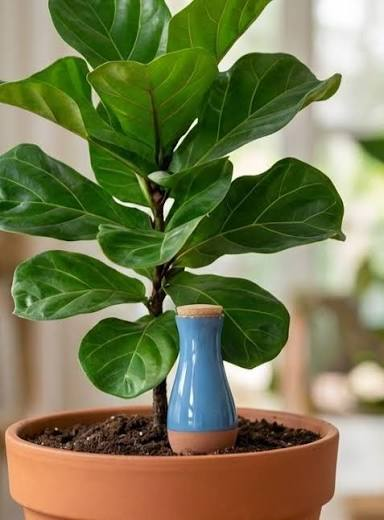
This property can be used in passive watering systems such as terracotta watering spikes.
A water reservoir supplies moisture to the terracotta, and the porous clay interacts with the surrounding soil.
This can create a gradual way of providing moisture without requiring an electronic pump or timer.
How a Terracotta Watering Spike Changes the Process
With traditional watering, you manually pour water onto the soil.
With a terracotta watering spike, water is stored in a reservoir and can gradually interact with the soil through the porous clay.
The basic process looks like this:
Water reservoir → Terracotta → Soil → Plant roots
The rate of moisture movement depends on several conditions, including soil moisture, temperature, humidity, soil structure, and the plant's water requirements.
SmartiLiving offers terracotta watering spikes designed for indoor and outdoor potted plants.
Explore SmartiLiving's Self-Watering System
Does More Water Mean Healthier Plants?
Not necessarily.
This is one of the biggest misunderstandings about plant care.
Water is essential, but too much water can create problems.
When soil remains excessively saturated, air spaces in the soil can become filled with water. Plant roots need oxygen, so constantly waterlogged soil can be unhealthy for many plants.
On the other hand, extremely dry soil can also cause problems.
The goal is to find the right balance.
Think About Moisture, Not Just Water
Instead of thinking:
"My plant needs a lot of water."
Think:
"My plant needs the right moisture conditions."
This small change in thinking can make plant care much easier.
A plant doesn't simply need a certain number of ounces or cups of water.
Its needs depend on:
-
Species
-
Root system
-
Soil
-
Pot size
-
Temperature
-
Humidity
-
Light
-
Season
That's why watering schedules found online should be treated as general guidelines rather than strict rules.
What About Vacation?
This becomes particularly important when you're traveling.
If you normally water your plants every few days, leaving them alone for one or two weeks can create a challenge.
One option is to ask someone to water them.
Another is to prepare a passive watering system.
Terracotta watering spikes can provide a convenient way to supply gradual moisture while you're away.
SmartiLiving states that its terracotta watering spikes can provide hydration for approximately 7–14 days, depending on conditions.
See SmartiLiving's Terracotta Watering Spikes
The actual duration will vary depending on the plant and environment, so testing the setup before your trip is important.
How to Know if Your Plant Is Getting Too Much Water
Watch your plant and soil instead of relying only on a schedule.
Possible signs of excessive moisture can include:
-
Soil remaining wet for unusually long periods
-
Yellowing leaves
-
Drooping despite wet soil
-
Unpleasant-smelling soil
-
Poor plant growth
These symptoms can have multiple causes, so they shouldn't automatically be interpreted as overwatering.
Still, checking the soil before adding more water is a good habit.
How to Know if Your Plant Needs More Water
Depending on the plant, signs of insufficient moisture can include:
-
Wilting
-
Dry soil
-
Drooping leaves
-
Crispy leaf edges
-
Leaves becoming dry or brittle
Again, different plants behave differently.
The best approach is to learn what is normal for your specific plant.
Should You Water Plants Every Day?
For most plants, daily watering isn't automatically necessary.
In fact, watering on a fixed schedule without checking the soil can sometimes cause problems.
Instead, check the plant's environment.
Ask:
Is the soil actually dry?
Does this plant prefer consistently moist soil?
Has the temperature changed?
Is the plant receiving more sunlight than usual?
These questions are more useful than simply following a calendar.
Small Amounts vs. One Big Watering
So, which is better?
One thorough watering
Can be useful when:
-
The soil has become dry
-
The plant needs a deep watering
-
The pot has good drainage
-
The plant prefers a wet-to-dry watering cycle
Gradual watering
Can be useful when:
-
The plant prefers more consistent moisture
-
You're trying to reduce frequent manual watering
-
You're away from home
-
You're caring for container plants
-
You want a passive watering solution
Neither method is universally better.
The right method depends on the plant.
Why Testing Matters
If you decide to use a self-watering system, don't assume that the same setup will work for every plant.
Test it first.
Place the watering system in the pot and observe it for several days.
Check:
-
Soil moisture
-
Water consumption
-
Plant appearance
-
Reservoir level
-
Environmental conditions
This helps you understand how the system behaves before you depend on it.
A Better Way to Think About Plant Watering
Good plant care isn't about giving plants as much water as possible.
It's about creating an environment where the plant has access to the moisture it needs without keeping the roots unnecessarily saturated.
Sometimes that means traditional watering.
Sometimes it means allowing the soil to dry before watering again.
And for some plants and situations, gradual watering can be a convenient option.
Final Thoughts
So, do plants prefer small amounts of water over one big drink?
There isn't a universal answer.
Some plants benefit from thorough watering followed by a drying period, while others perform better when moisture is more consistent.
What matters most is understanding your plant's natural requirements and paying attention to its soil and environment.
For plants that benefit from gradual moisture, terracotta watering systems offer an interesting solution.
By combining a water reservoir with naturally porous clay, products such as terracotta watering spikes can provide a passive way to supply moisture over time.
SmartiLiving uses this simple principle to create self-watering products for indoor and outdoor plant owners.
The goal isn't more water. It's the right water, at the right time, in the right way.
What's Your Reaction?