The Role of Creative Testing in Fashion Brand Scaling
Discover how a creative testing framework helps fashion brands scale with data-driven insights, optimized campaigns, and improved marketing ROI.
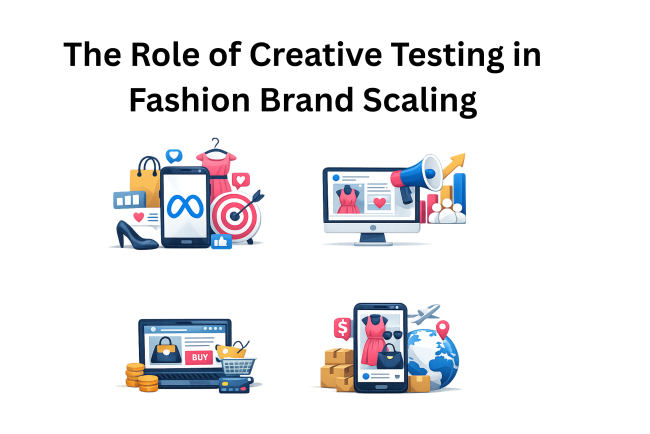
Today, a fashion business needs to scale with accuracy, speed, and data-driven decision-making in addition to strong branding and excellent design. Relying just on intuition is no longer sufficient due to growing competition and constantly shifting consumer preferences. This is the point at which a creative testing framework turns into a potent growth engine.


The capacity to regularly generate high-performing creatives can have a direct impact on revenue, customer acquisition expenses, and long-term brand equity for CEOs and corporate executives. Every innovative choice is guaranteed to contribute to scalable success when testing is done in an organised manner.
What is the Creative Testing Framework?
A methodical approach to testing various creative elements, such as images, ad formats, text, and calls-to-action, to find out what appeals to your audience the most is called a creative testing framework.
Today, a fashion business needs to scale with accuracy, speed, and data-driven decision-making in addition to strong branding and excellent design. Relying just on intuition is no longer sufficient due to growing competition and constantly shifting consumer preferences. This is the point at which an innovative testing framework turns into a potent growth engine.
The ability to consistently generate a performing creative strategy can directly impact revenue, customer acquisition costs, and long-term brand equity for CEOs and corporate executives. Every innovative choice is guaranteed to contribute to scalable success when testing is done in an organised manner.
Why Creative Testing Is Essential for Scaling
1. Enables Data-Driven Growth
Measurable insights take the role of speculation in a well-defined creative testing strategy. Brands can determine whether creatives actually produce results by examining analytics like click-through rates, engagement, and conversions. This results in more effective marketing and more intelligent budget allocation.
2. Keeps Your Brand Relevant
Consumer preferences change as swiftly as fashion trends. Real-time brand adaptation is made possible by ongoing testing. A creative testing methodology guarantees that your brand remains in line with current trends, whether you're experimenting with new visual styles or messaging approaches.
3. Reduces Marketing Risk
Ad expenditure may be squandered if campaigns are scaled without testing. Before making significant investments in ideas, a systematic framework for creative testing aids in their validation. This reduces risk and guarantees that only successful creatives are expanded across all platforms.
4. Improves Customer Insights
Beyond performance numbers, creative testing shows the values of your target audience. Brands may improve their marketing, product positioning, and overall brand strategy by knowing which images and messaging appeal to consumers the most.
Key Components of an Effective Creative Testing Framework
Businesses should concentrate on the following components to create an effective framework for creative testing:
-
Hypothesis-Driven Testing: Begin with specific hypotheses regarding potential outcomes.
-
Controlled Experiments: For precise insights, test one variable at a time.
-
Performance Metrics: Monitor KPIs like engagement, ROAS, and conversion rate.
-
Iterative Optimisation: Continually improve creatives in light of outcomes
These elements produce a repeatable procedure that facilitates scalability and steady progress.
How Creative Testing Fuels Long-Term Growth
A creative testing framework can become an ongoing growth engine when it is incorporated into the main marketing strategy. It enables marketers to swiftly find effective creatives and scale them across social media, search, and display advertising.
This results into greater ROI and steady growth for CEOs. Marketing teams are able to work more quickly, make well-informed judgements, and match creative endeavours with corporate goals. This regularity eventually creates a competitive edge that is hard for rivals to match.
Conclusion
In the fiercely competitive world of fashion, performance is more important than creativity. Brands are able to blend artistic vision with data-driven precision thanks to a strong creative testing framework. It guarantees that every campaign is maximised, every choice is well-informed, and every investment yields returns.
The way forward for corporate executives who want to grow is straightforward: embrace testing, give insights top priority, and let performance drive innovation. This is how contemporary fashion brands translate concepts into quantifiable expansion.
What's Your Reaction?