Best API Testing Tools in 2026: Features, Comparisons, and How to Choose the Right Solution
Discover the best API testing tools in 2026. Compare Postman, Insomnia, Bruno, SoapUI, ReadyAPI, and REST Assured to choose the right solution for your team.
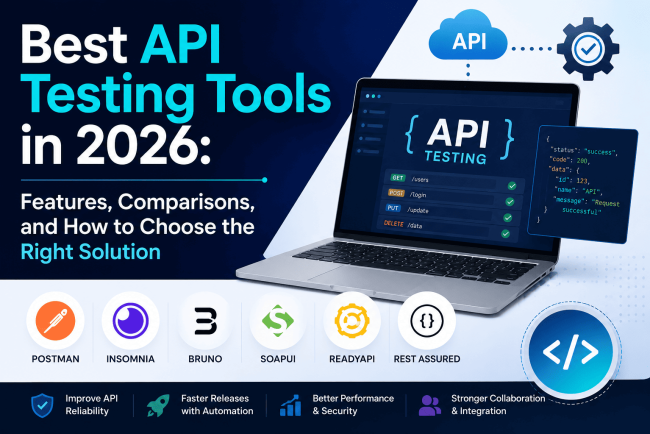
APIs are the foundation of modern applications. Whether you're building a mobile app, SaaS platform, eCommerce website, or enterprise software, APIs handle the communication between systems. As APIs become more complex, testing them effectively is no longer optional.


The right API testing tool can help development and QA teams identify bugs earlier, improve software quality, automate testing workflows, and reduce deployment risks.
In this guide, we'll explore the best API testing tools in 2026, compare their features, and help you choose the right solution for your needs.
What Are API Testing Tools?
API testing tools are software solutions that validate whether an API functions as expected. They allow developers and testers to verify requests, responses, authentication, performance, security, and overall reliability before applications reach production.
Unlike UI testing, API testing focuses on the business logic layer, making it faster, more reliable, and easier to automate.
Benefits of API Testing
- Detect issues early in development
- Improve application reliability
- Automate repetitive testing tasks
- Validate integrations between services
- Support CI/CD workflows
- Enhance API security and performance
As organizations increasingly adopt microservices and cloud-native architectures, API testing has become a critical part of the software development lifecycle.
Top API Testing Tools in 2026
1. Postman
Postman remains one of the most widely used API testing platforms. It offers a user-friendly interface for creating requests, running collections, generating documentation, and automating tests. Many teams use it throughout the entire API lifecycle, from development to monitoring.
Best For:
- Development teams
- API collaboration
- Automated testing workflows
Key Features:
- API collections
- Automated testing
- Mock servers
- Environment management
- Team collaboration
2. Insomnia
Insomnia has become a popular alternative for developers who want a lightweight and flexible API client. It supports REST, GraphQL, and various authentication methods while maintaining a clean interface.
Best For:
- REST API testing
- GraphQL development
- Small to mid-sized teams
Key Features:
- Open-source support
- Git integration
- Environment variables
- Automated request workflows
3. Bruno
Bruno has gained significant attention among developers who prefer a Git-first workflow. Instead of storing collections in the cloud, it saves them as local files that can be version-controlled alongside application code.
Best For:
- Developer-focused teams
- Git-based collaboration
- Privacy-conscious organizations
Key Features:
- Local file storage
- Git integration
- Open-source architecture
- Lightweight performance
4. SoapUI and ReadyAPI
SoapUI has long been a trusted solution for API testing. Its commercial version, ReadyAPI, extends functionality with advanced automation, security testing, and reporting capabilities.
Best For:
- Enterprise environments
- SOAP and REST APIs
- Security-focused testing
Key Features:
- Functional testing
- Security testing
- Load testing
- Advanced reporting
5. REST Assured
REST Assured is a powerful Java-based library designed specifically for API automation testing. It is highly popular among developers building automated test frameworks.
Best For:
- Java teams
- Automated API testing
- CI/CD pipelines
Key Features:
- Java integration
- BDD-style testing
- Detailed assertions
- Automation support
API Testing Tool Comparison
Postman
- Best For: API collaboration and full API lifecycle management
- Automation Support: Yes
- Open Source: No
Insomnia
- Best For: REST API and GraphQL testing
- Automation Support: Yes
- Open Source: Yes
Bruno
- Best For: Git-based API testing workflows
- Automation Support: Yes
- Open Source: Yes
SoapUI
- Best For: Functional API testing for REST and SOAP services
- Automation Support: Yes
- Open Source: Yes
ReadyAPI
- Best For: Enterprise-level API testing and automation
- Automation Support: Yes
- Open Source: No
REST Assured
- Best For: Java-based API automation testing
- Automation Support: Yes
- Open Source: Yes
How to Choose the Right API Testing Tool
There is no single tool that works for every team. The right choice depends on your workflow, budget, and technical requirements.
1. Consider Your Team Size
Small teams often benefit from lightweight tools such as Insomnia or Bruno, while larger organizations may require collaboration features available in Postman or ReadyAPI.
2. Evaluate Automation Requirements
If your goal is continuous testing within CI/CD pipelines, tools such as REST Assured and Postman offer strong automation capabilities.
3. Check Integration Support
Your testing platform should integrate smoothly with:
- GitHub
- GitLab
- Jenkins
- Azure DevOps
- Docker
- Kubernetes
4. Review Security Features
Modern APIs handle sensitive business data. Look for tools that support:
- Authentication testing
- Authorization validation
- Security scanning
- Compliance requirements
API Testing Best Practices
Using the right tool is only part of the process. Following proven testing practices is equally important.
1. Automate Repetitive Tests
Automated testing helps maintain consistency and reduces manual effort.
2. Test Early
Incorporate API testing during development rather than waiting until release stages.
3. Validate Performance
Functional correctness alone is not enough. APIs should also perform reliably under load.
4. Include Security Testing
Verify authentication, access control, rate limiting, and data protection mechanisms.
5. Integrate With CI/CD
Automated API tests should run whenever code changes are introduced. This helps catch issues before deployment.
Final Thoughts
The API testing landscape continues to evolve in 2026. Postman remains a strong all-around solution, while Insomnia and Bruno provide excellent alternatives for developers seeking flexibility and simplicity. Enterprise teams often prefer ReadyAPI for advanced testing capabilities, while REST Assured remains a top choice for Java-based automation.
The best API testing tool is the one that aligns with your team's workflow, technical expertise, and automation goals. By evaluating features, integrations, scalability, and testing requirements, you can choose a platform that improves software quality and accelerates delivery.
Investing in robust API testing today can save countless hours of debugging and prevent costly production issues tomorrow.
What's Your Reaction?