Agrochemical Packaging Market Growth Analysis, Dynamics, Key Players and Innovations, Outlook and Forecast 2026-2034
Agrochemical packaging market grows with sustainable, safe, and smart farming solutions demand.
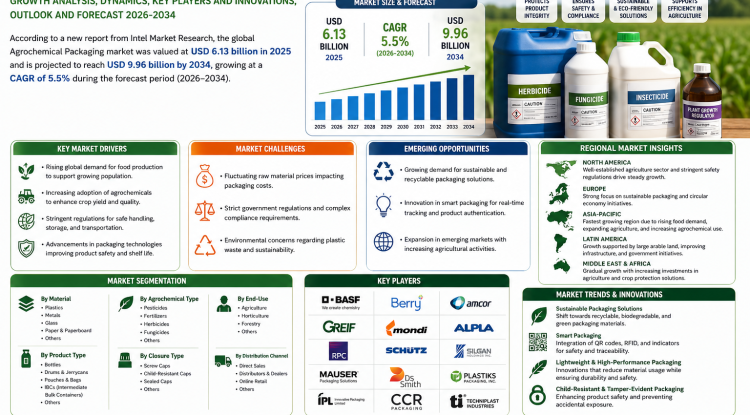
According to a new report from Intel Market Research, the global agrochemical packaging market was valued at USD 6.45 billion in 2025 and is projected to reach USD 10.12 billion by 2034, growing at a robust CAGR of 5.3 % during the forecast period (2026–2034). This expansion is propelled by the accelerating adoption of modern farming practices, heightened regulatory scrutiny on hazardous chemical handling, and continuous innovation in lightweight and sustainable packaging materials.


Agrochemical packaging refers to specialized containers and materials designed to safely store, transport, and dispense agricultural chemicals, including pesticides, herbicides, fertilizers, and fungicides. These packaging solutions are engineered to prevent leakage, contamination, and degradation while ensuring compliance with regulatory standards for hazardous substances. Common formats include rigid plastic bottles, jerricans, intermediate bulk containers (IBCs), flexible pouches, fiber drums, and multi‑layered bags, each tailored to specific chemical properties and application requirements.
???? Download FREE Sample Report:
Agrochemical Packaging Market – View in Detailed Research Report
The demand for agrochemical packaging is driven by the expanding agricultural sector, particularly in emerging economies where modern farming practices are being adopted at scale. While traditional materials like glass and metal remain relevant for certain high‑risk formulations, innovations in lightweight plastics and biodegradable alternatives are gaining traction due to sustainability pressures. Furthermore, stringent regulations governing chemical handling-such as the UN’s Globally Harmonized System (GHS) for classification and labeling-are compelling manufacturers to invest in tamper‑evident and child‑ resistant designs.
Key Market Drivers
Rising Global Food Demand and Crop Protection Needs
The growing world population intensifies the need for higher agricultural output, which directly fuels demand for effective crop‑protection chemicals. Reliable, secure packaging is essential to preserve the potency of pesticides, herbicides, and fungicides throughout the supply chain, thereby supporting yield stability and food security.
Technological Advancements in Agriculture
Precision farming, drone‑based application, and variable‑rate technology require packaging that can deliver exact dosages and resist harsh field conditions. Manufacturers are therefore prioritising high‑barrier materials, ergonomic designs, and smart‑label features that align with the digital transformation of agronomy.
➤ Adoption of precision farming drives demand for specialized packaging.
Additionally, the fragmentation of agricultural activities in emerging economies has created a decentralized market landscape. Smaller, more manageable packaging formats are increasingly preferred by smallholder farmers, widening the overall market base.
Market Challenges
Supply Chain Volatility
Raw‑material costs for plastics and metal components fluctuate due to geopolitical tensions and oil price volatility. These price swings can erode margins for both packaging manufacturers and agrochemical producers, necessitating agile supply‑chain strategies and forward‑looking procurement.
Product Safety Compliance
Maintaining compliance with rigorous safety standards for hazardous‑material handling remains a constant hurdle. Companies must navigate a complex mosaic of international, regional, and local regulations, each demanding specific labeling, testing, and documentation protocols.
Market Complexity
Differing regional regulations regarding packaging waste, recycling mandates, and chemical containment complicate global distribution. Firms often need to customise packaging solutions to satisfy divergent legislative environments, adding operational and cost burdens.
Market Restraints
Stringent Environmental Regulations
Governments worldwide are imposing rigorous rules to minimise the environmental impact of the agrochemical industry. Restrictions on non‑biodegradable polymers and higher recycling‑rate requirements increase production costs and may slow adoption of traditional plastic packaging formats.
Market Opportunities
Adoption of Eco‑Friendly Solutions
The shift toward sustainability presents a significant growth avenue. Developing biodegradable films and containers from recycled content aligns with global sustainability goals and meets the expectations of environmentally conscious growers. Companies that invest early in green technologies can differentiate themselves and capture premium market share.
Segment Analysis
Segment Analysis:
| Segment Category | Sub‑Segments | Key Insights |
| By Type |
|
Liquid Formulations dominate because they offer superior handling flexibility and rapid dissolution characteristics; they align well with diverse application equipment ranging from high‑volume sprayers to precision spot‑treatments; their compatibility with additives enables manufacturers to tailor performance attributes such as viscosity, stability, and compatibility with advanced adjuvants. |
| By Application |
|
Herbicides lead the application segment as growers prioritise weed management for yield protection; packaging designs emphasize airtight sealing to preserve efficacy against moisture and volatilisation; the need for safe field‑level transport drives adoption of robust, lightweight containers that simplify logistics on large acreage. |
| By End User |
|
Large‑scale Farms shape packaging trends by demanding high‑capacity bulk containers that reduce handling steps; they favour ergonomic designs that support mechanised loading and unloading; sustainability concerns encourage selection of recyclable materials that satisfy corporate environmental commitments. |
| By Material |
|
Plastic (HDPE) remains the material of choice because it balances chemical resistance with cost efficiency; its lightweight nature reduces shipping burdens, while its recyclability aligns with emerging regulatory expectations; manufacturers leverage HDPE’s moulding versatility to integrate safety features such as child‑proof caps and tamper‑evident seals. |
| By Regulatory Compliance |
|
Environmentally Friendly Certifications influence packaging strategies as brands aim to differentiate through green credentials; certified recyclable or biodegradable containers enhance market perception among sustainability‑focused growers; regulatory pressure to minimise hazardous waste drives innovation in secondary packaging that simplifies collection and reuse. |
Competitive Landscape
COMPETITIVE LANDSCAPE
Key Industry Players
Agrochemical Packaging Market: Competitive Overview 2024
The agrochemical packaging sector is dominated by a handful of multinational converters that leverage scale, advanced extrusion technology, and extensive distribution networks. Amcor, Berry Global, and Sealed Air command the bulk of the global market share, supplying high‑density polyethylene (HDPE) bottles, flexible pouches, and multilayer laminates to major fertilizer and pesticide manufacturers. Their competitive advantage stems from integrated supply chains, R&D investments in barrier films, and sustainability initiatives that address regulatory pressure on single‑use plastics. Smaller but agile firms such as Greiner and Huhtamäki specialise in niche applications like UV‑resistant sachets and biodegradable sachet solutions, gaining traction in regions with stringent environmental legislation.
Beyond the primary converters, a second tier of specialised players contributes critical value‑added services. Futamura, DS Smith, and Sonoco focus on custom extrusion coating and precision moulding for herbicide concentrates, while Silgan and Nampak provide rigid containers optimised for high‑volume liquid fertilizers. Emerging contenders like Mauser Packaging and AIC (American International Container) are expanding their portfolios through strategic acquisitions and partnerships, targeting growth in emerging markets of Latin America and Southeast Asia where demand for reliable, cost‑effective packaging is accelerating.
List of Key Agrochemical Packaging Companies Profiled
-
Greiner
-
Huhtamäki
-
Sonoco
-
Silgan
-
Nampak
-
Mauser Packaging
-
AIC (American International Container)
-
RPC Group
-
Gerona
-
FuturePak
Market Trends
Agrochemical Packaging Market Trends
Primary Trend: Sustainable & Smart Packaging
The market is undergoing a transformation driven by evolving regulatory landscapes, sustainability imperatives, and the increasing demand for precision‑agriculture solutions. Smart packaging equipped with QR codes, RFID tags, and sensor‑based monitoring is gaining acceptance, enabling real‑time traceability, tamper evidence, and condition monitoring throughout the supply chain. Simultaneously, bio‑based and recyclable materials are moving from niche to mainstream as manufacturers respond to circular‑economy mandates.
Other Trends
Sustainable Packaging Solutions
Farmers and manufacturers alike are seeking alternatives to conventional petroleum‑based plastics. Bio‑derived polymers, compostable films, and recycled‑content HDPE containers are increasingly incorporated into product lines. These solutions not only reduce carbon footprints but also help customers meet local recycling requirements, enhancing brand reputation.
Advanced Barrier Technologies
Innovations in multilayer laminates and nano‑coatings are improving barrier performance against moisture, oxygen, and ultraviolet light. Enhanced barrier properties extend agrochemical shelf life, minimise degradation, and reduce the need for stabiliser additives, thereby lowering overall formulation costs.
Precision‑Agriculture Enablement
Miniaturised, high‑concentration formulations demand packaging that can safely contain high‑potency active ingredients while allowing accurate dose measurement. Integrated dosing caps, graduated dispensers, and single‑use sachets are being developed to support variable‑rate application technologies.
Regional Analysis
Regional Analysis: North America
Smart packaging with QR codes for traceability and tamper‑evident seals is gaining traction. Sustainability concerns are prompting the shift towards recyclable HDPE and bio‑based alternatives.
Bio‑based and compostable polymers are emerging as viable options, driven by regulatory pressure and customer environmental expectations.
Stringent product‑safety, environmental‑impact, and labelling regulations shape packaging design and material selection.
Market players differentiate through customised solutions, technological innovation, and sustainability initiatives.
Europe
The European market is characterised by rigorous environmental legislation that accelerates the adoption of recyclable and biodegradable packaging. Circular‑economy initiatives encourage manufacturers to design for end‑of‑life recyclability, while robust safety standards drive innovation in high‑barrier multilayer solutions.
Asia‑Pacific
Asia‑Pacific represents the fastest‑growing region, propelled by expanding agricultural land, rising per‑capita food demand, and government incentives for modern farming. Cost‑effective packaging that balances affordability with durability is a key success factor, especially for the large‑scale smallholder segment.
South America
Intensive cultivation of soy, corn, and sugarcane creates strong demand for bulk‑capacity containers and durable IBCs. Precision‑agriculture technologies are gaining foothold, prompting a shift towards high‑precision dosing packaging.
Middle East & Africa
Climatic challenges such as high temperatures and humidity drive the need for packaging with superior thermal stability and UV resistance. Government programmes aimed at enhancing food security are stimulating investments in modern agro‑chemical supply chains.
Report Scope
Report Scope
This market research report offers a holistic overview of global and regional markets for the forecast period 2025–2032. It presents accurate and actionable insights based on a blend of primary and secondary research.
Key Coverage Areas:
-
✅ Market Overview
- Global and regional market size (historical & forecast)
- Growth trends and value/volume projections
-
✅ Segmentation Analysis
- By product type or category
- By application or usage area
- By end‑user industry
- By distribution channel (if applicable)
-
✅ Regional Insights
- North America, Europe, Asia‑Pacific, Latin America, Middle East & Africa
- Country‑level data for key markets
-
✅ Competitive Landscape
- Company profiles and market‑share analysis
- Key strategies: M&A, partnerships, expansions
- Product portfolio and pricing strategies
-
✅ Technology & Innovation
- Emerging technologies and R&D trends
- Automation, digitalisation, sustainability initiatives
- Impact of AI, IoT, or other disruptors (where applicable)
-
✅ Market Dynamics
- Key drivers supporting market growth
- Restraints and potential risk factors
- Supply‑chain trends and challenges
-
✅ Opportunities & Recommendations
- High‑growth segments
- Investment hotspots
- Strategic suggestions for stakeholders
-
✅ Stakeholder Insights
- Target audience includes manufacturers, suppliers, distributors, investors, regulators, and policymakers
Frequently Asked Questions
Frequently Asked Questions
???? Download Sample Report: https://www.intelmarketresearch.com/download-free-sample/46011/agrochemical-packaging-market
???? Get Full Report Here:
Agrochemical Packaging Market – View Detailed Research Report
About Intel Market Research
Intel Market Research is a leading provider of strategic intelligence, offering actionable insights in biotechnology, pharmaceuticals, and healthcare infrastructure. Our research capabilities include:
- Real-time competitive benchmarking
- Global clinical trial pipeline monitoring
- Country-specific regulatory and pricing analysis
- Over 500+ healthcare reports annually
Trusted by Fortune 500 companies, our insights empower decision‑makers to drive innovation with confidence.
???? Website: https://www.intelmarketresearch.com
???? Asia‑Pacific: +91 9169164321
???? LinkedIn: Follow Us
What's Your Reaction?