Why AI Narratives Fail Without Leadership Alignment
AI narratives fail without leadership alignment. See how AI narrative development consultants bring clarity, trust, and consistency.
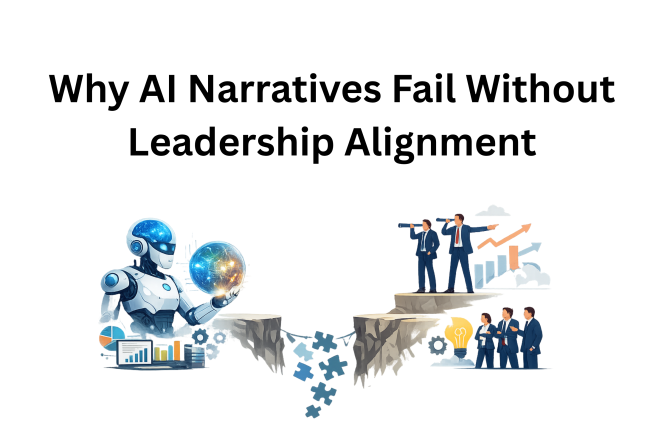
AI isn’t failing because of capability. It’s failing because of a disconnect.


Across enterprises, there’s a visible gap between what AI can do and what organizations are able to credibly communicate. This is where most AI narratives break down. Not at the product layer, but at the leadership layer.
You’ll see strong demos. Solid engineering. Even real use cases. But when it comes to explaining why this matters—internally or externally—the story feels fragmented.
That’s not a messaging issue. It’s an alignment issue.
And this is exactly where AI narrative development consultants and structured AI brand narrative consulting start becoming critical.
The Real Problem: AI Narratives Are Built Bottom-Up
Most companies build their AI story like they build their product.
Feature-first. Capability-heavy. Execution-led.
But narratives don’t work that way.
An AI narrative needs to answer three simple questions:
-
Why does this exist?
-
Why does it matter now?
-
Why should anyone trust it?
Without leadership alignment, these answers vary depending on who you ask.
Product says one thing. Marketing reframes it. Sales simplifies it. Leadership speaks in vision.
The result? A narrative that sounds different in every room.
That inconsistency is what erodes trust.
Why Leadership Alignment Changes Everything
When leadership is aligned, the narrative becomes stable.
Not louder. Not more creative. Just clearer.
Leadership alignment does three things:
1. It Anchors the Narrative in Business Intent
AI is not a story by itself. It’s a lever.
Aligned leadership defines:
-
What role AI plays in the business
-
Where it creates real value
-
Where it does not
This clarity prevents overclaiming. And that matters more than most teams realise.
2. It Removes Internal Contradictions
Misalignment shows up subtly:
-
One team says "AI-first."
-
Another says "AI-assisted."
-
Leadership talks about “human-centered AI."
All three can coexist. But if they’re not intentionally structured, they sound confused.
Strong AI strategic storytelling services don’t just refine language. They reconcile these internal tensions.
3. It Builds External Credibility
Enterprise buyers are skeptical. Not because they don’t understand AI, but because they’ve seen too many inflated claims.
They’re listening for:
-
Consistency
-
Restraint
-
Proof
When leadership alignment is missing, narratives become exaggerated or vague.
When alignment is present, narratives feel grounded.
That’s what builds belief.
Where AI Narratives Typically Fail
You can usually spot the cracks early.
Overclaiming Without Proof
Big promises. Weak evidence. This breaks trust immediately.
Messaging That Changes by Audience
Different decks for investors, customers, and internal teams with no common core.
Product-Led Storytelling
Heavy on features. Light on meaning.
No Clear Position on Risk
AI narratives that avoid talking about limitations often feel incomplete.
Lack of Ownership
No single function owns the narrative. Everyone contributes; no one governs.
This is where AI brand narrative consulting becomes less about messaging and more about structure.
What Leadership-Aligned AI Narratives Look Like
They’re not louder. They’re tighter.
You’ll notice a few things:
Clear Boundaries
They explicitly state what the AI does—and what it doesn’t.
Consistent Language Across Teams
The same idea shows up in product docs, sales decks, and leadership talks.
Measured Confidence
No inflated claims. No buzzwords. Just clarity.
Proof Integrated into Story
Use cases, outcomes, and constraints are part of the narrative—not afterthoughts.
Human Context
AI is positioned as an enabler, not a replacement.
These narratives don’t try to impress. They aim to be understood.
The Role of AI Narrative Development Consultants
This is not about writing better copy.
It’s about building alignment across leadership, product, and GTM.
Experienced AI narrative development consultants typically focus on:
-
Extracting leadership intent
-
Translating technical capability into business meaning
-
Defining narrative boundaries (what to say vs what to avoid)
-
Creating a unified messaging spine across functions
-
Stress-testing claims against real-world scrutiny
This process often surfaces uncomfortable gaps.
But that’s the point.
A strong narrative doesn’t hide misalignment. It resolves it.
A Simple Alignment Framework That Works
You don’t need complexity. You need structure.
Here’s a practical way to approach it:
Step 1: Define AI’s Role in the Business
Is it a differentiator, an efficiency layer, or an enabler?
Be specific.
Step 2: Identify Real Value Creation
Where does AI actually impact:
-
Revenue
-
Cost
-
Speed
-
Decision-making
Avoid hypothetical benefits.
Step 3: Set Claim Boundaries
Decide what you will not say.
This reduces risk and increases credibility.
Step 4: Align Leadership Language
Ensure founders, executives, and GTM leaders use the same core narrative.
Not identical scripts, but aligned meaning.
Step 5: Build Proof Into the Narrative
Case examples. Metrics. Real outcomes.
If proof is missing, the narrative should reflect that honestly.
Why This Matters More Now
AI fatigue is real.
Enterprise buyers are no longer impressed by “AI-powered” claims. They’re filtering aggressively.
They’re asking:
-
Does this solve a real problem?
-
Can this scale?
-
Is this reliable?
Without leadership alignment, most narratives fail these filters.
With alignment, even modest capabilities can feel credible and valuable.
That’s the shift.
Practical Takeaways
If your AI narrative feels inconsistent or hard to explain, the issue is rarely messaging alone.
Start here:
-
Audit how different teams describe your AI
-
Identify contradictions in language and positioning
-
Align leadership on AI’s role and limits
-
Define what you can confidently claim today
-
Bring in AI strategic storytelling services if alignment gaps are deep
Narratives don’t fail because they’re unclear.
They fail because they’re not agreed upon.
FAQs
1. Why do AI narratives often feel inconsistent across teams?
Because different functions interpret AI differently. Without leadership alignment, messaging evolves independently, creating fragmented communication.
2. What do AI narrative development consultants actually do?
They align leadership intent, structure messaging, and ensure consistency across product, marketing, and sales, so the narrative feels unified and credible.
3. How is AI brand narrative consulting different from regular messaging?
It goes beyond copywriting. It focuses on strategic positioning, claim boundaries, and aligning AI capabilities with business value.
4. Can a strong AI product succeed with a weak narrative?
Short term, maybe. Long term, no. Without a clear and trusted narrative, adoption slows, trust drops, and positioning weakens.
What's Your Reaction?