What Makes an AI Model HIPAA Compliant?
Learn what makes AI models HIPAA compliant. Private AI for healthcare ensures data security, compliance, and safe AI adoption in healthcare organisations.
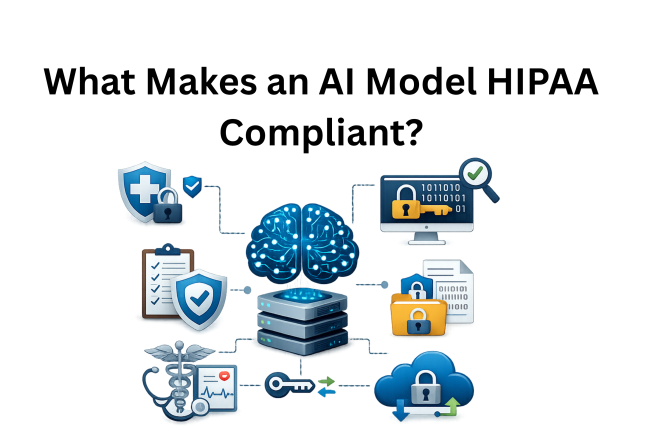
Maintaining compliance with data privacy laws is now crucial as healthcare organisations use AI more and more. CEOs and corporate executives may reduce risk, safeguard patient confidence, and realise the full potential of private AI for healthcare by knowing what makes an AI model HIPAA compliant.


Understanding HIPAA in the Context of AI
Strict guidelines for managing Protected Health Information (PHI) are established under the Health Insurance Portability and Accountability Act (HIPAA). To guarantee patient data availability, confidentiality, and integrity, every AI model utilised in healthcare must comply with these rules.
This is the point at which private AI for healthcare becomes essential. Private AI deployments, in contrast to public ones, are made to function in regulated settings, which facilitates and maintains compliance.
Core Requirements of a HIPAA-Compliant AI Model
1. Secure Data Handling and Storage
All PHI must be encrypted while it's in transit and at rest for an AI model to comply with HIPAA regulations. To stop unwanted access, audit trails and strong access restrictions are crucial. Organisations can successfully apply these precautions thanks to private AI for healthcare.
2. Access Control Authentication
Sensitive information and AI results should only be accessible by authorised persons. Multi-factor authentication (MFA) and role-based access control (RBAC) are essential elements that improve accountability and compliance.
3. Data Minimisation and De-identification
Only the bare minimum of data needed for a task should be processed by AI models. To lower risk, PHI should be de-identified whenever feasible. Organisations can impose stringent data governance standards that are customised to meet their needs with private AI for healthcare.
4. Auditability and Transparency
Organisations must keep thorough records of all data access and processing operations in accordance with HIPAA. AI systems must have transparent audit trails so that companies can monitor who accessed data, when, and why.
5. Business Associate Agreements (BAAs)
A Business Associate Agreement is required if third-party vendors are involved. This guarantees that upholding compliance standards is equally the responsibility of all parties handling PHI.
Learn more about HIPAA AI Compliance
Why Deployment Environment Matters
An AI model's operating environment has a significant impact on compliance. The openness and control necessary for managing PHI are frequently absent from public cloud-based AI solutions.
On the other hand, private AI for healthcare enables businesses to use secure private clouds or on-premise solutions.
The risk of breaches and non-compliance is greatly decreased by this managed architecture, which guarantees that sensitive data never leaves the organisation's ecosystem.
Risks of Non-Compliance
Serious financial penalties, legal repercussions, and reputational harm may result from noncompliance with HIPAA regulations. More significantly, it can undermine patient trust, which is a vital resource in the medical field.
Businesses may proactively address these risks and create a safe basis for AI-driven innovation by implementing private AI for healthcare.
Strategic Takeaways for CEOs
HIPAA compliance is a business necessity for decision-makers, not merely a legal requirement. Purchasing compliant AI models benefits businesses:
-
Safeguard private patient data
-
Establish trust with stakeholders and patients
-
Make sure AI projects are scalable over the long run.
-
Keep up with changing legal requirements
In conclusion
AI HIPAA compliance is about duty, not just technology. Every element, from regulated deployment settings to secure data management, must comply with stringent regulatory requirements. Healthcare companies may confidently innovate while protecting what really matters, patient data, with the help of private AI.
What's Your Reaction?