Private LLM for BFSI Compliance
Learn how private LLMs help BFSI organizations meet compliance, improve data security, and automate regulated workflows safely and efficiently.
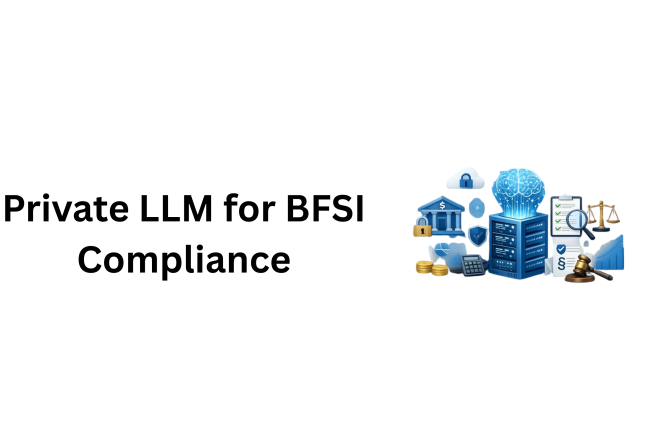
The banking, financial services, and insurance (BFSI) industry operates in one of the world's most regulated environments. Adopting AI is now a compliance decision rather than only a technology one due to stringent regulations regarding data privacy, auditability, and risk management. For this reason, private LLM BFSI solutions are quickly becoming the AI strategy of choice for financial firms.


In this blog, we examine the main use cases, how private LLMs facilitate BFSI compliance, and the reasons CEOs and corporate executives should take them into account for the safe use of AI.
Why Compliance Is Critical in BFSI
BFSI companies have to abide by a number of international and local laws, including GDPR, PCI DSS, SOC 2, ISO 27001, and industry-specific legislation. Any AI system that handles financial records, consumer information, or internal communications needs to be completely auditable, safe, and comprehensible.
Private LLM BFSI implementations are a safer and more compliant option because public or shared AI models frequently fail to meet these standards.
What Is A Private LLM in BFSI?
A private LLM is a language model that is only used by the company in a regulated enterprise setting, either on-site or in a private cloud. Private LLMs do not learn from the input of other users or exchange data externally, in contrast to public models.
This guarantees total control over sensitive financial and customer data for BFSI institutions.
How BFSI Compliance Is Made Possible by Private LLMs
1. Confidentiality and Data Privacy
Financial institutions deal with extremely sensitive data, such as transaction history, KYC records, and private client data. Data never leaves the company's secure infrastructure thanks to a private LLM BFSI arrangement.
This greatly lowers the possibility of data leaks and aids organizations in preserving client confidence.
2. Regulatory Alignment and Audit Readiness
Compliance personnel must be able to see how AI systems generate and handle data. Private LLMs facilitate this by providing:
-
Clear tracking of data flow
-
Thorough recording and observation
-
Simpler compliance reporting and audits
This degree of openness is necessary to pass regulatory audits without interfering with business operations.
3. Consistent and Policy-Aligned Outputs
Inaccurate or inconsistent AI responses in BFSI may result in reputational harm or compliance infractions. To guarantee that outcomes stay in line with internal and regulatory requirements, private LLMs receive training on institution-specific policies, rules, and paperwork.
They are therefore perfect for high-stakes situations where precision is crucial.
Key BFSI Use Cases for Private LLMs
Compliance Monitoring and Reporting
Communications, documents, and transactions can be scanned by private LLM BFSI solutions to identify possible compliance issues. This lessens the need for manual reviews and permits proactive risk management.
KYC and AML Assistance
While maintaining all data confidential and compliant, private LLMs help compliance teams by summarizing KYC paperwork, spotting irregularities, and assisting with AML investigations.
Customer Communication Governance
Private LLMs are used by banks and insurers to examine customer-facing content to make sure communications adhere to legal language requirements and refrain from making false statements.
Internal Policy and Knowledge Access
Using a private LLM, staff members can query operational guidelines, regulatory updates, and internal compliance policies, enhancing decision-making while preserving access control.
Why CEOs Should Prioritize Private LLMs for BFSI
Adopting AI requires leadership teams to weigh risk and innovation. By enabling AI-driven efficiency without sacrificing security or compliance, private LLM BFSI solutions provide a strategic advantage.
Among the advantages for decision-makers are:
-
Reduced legal and regulatory risk
-
AI behaviour that is predictable
-
Increased control and governance
AI deployment at scale that is quicker and safer
BFSI: Private vs. Public LLM
Public LLMs may be more flexible, but they frequently don't provide the control and compliance assurances needed in BFSI. In contrast, private LLMs are better suited for long-term enterprise use because they are specifically designed for regulated contexts.
Conclusion
Adoption of AI in BFSI needs to be reliable, safe, and compliant. Financial institutions can modernize operations while adhering to stringent regulatory requirements with the help of private LLM BFSI solutions.
Private LLMs are not only a safer AI choice for companies and CEOs in the BFSI sector, but they also provide a platform for sustained innovation that prioritizes compliance.
What's Your Reaction?