Auditability and Traceability: Ensuring Full Visibility in Private LLM Systems
Explore how auditability and traceability strengthen private LLM security with full visibility, logging, and compliance controls for enterprise AI environments.
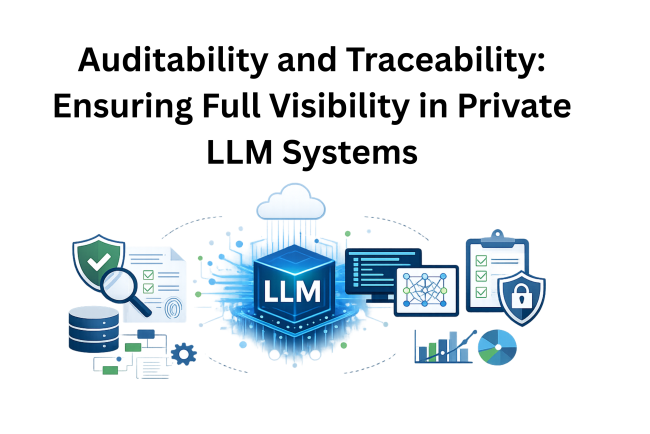
Large language models are currently being quickly integrated by businesses into essential business processes, such as internal knowledge assistants and automation that interacts with customers. These technologies offer efficiency and speed, but they also come with additional risks. Leaders frequently pose the straightforward but crucial query: Is it possible to know precisely what the AI is doing?


Uncertainty in the response leads to security flaws.
At this point, traceability and auditability become crucial. Robust visibility controls are essential to private LLM security because they provide organisations with the assurance that all system interactions, decisions, and modifications can be monitored and validated.
This is operational responsibility, not simply technical hygiene, for CEOs and other corporate executives.
What Are the Meanings of Auditability and Traceability?
The capacity to examine system activity using logs and records is known as auditability. Teams may trace actions back to certain individuals, prompts, or configurations thanks to traceability, which goes one step further.
This implies that in private LLM settings, you can respond to enquiries like as:
-
Who had access to the model?
-
What information was handled?
-
Which prompts were sent in?
-
How did the outputs get created?
-
What system modifications were made?
-
Effective private LLM security is built on these insights.
Without them, it becomes more difficult to show compliance and investigate problems.
Why Businesses Can't Function Without Visibility
Unreported AI activity is a liability in regulated businesses. In order to convince authorities that safeguards are in place, organisations must establish that they have control over sensitive data.
Poor visibility may result in:
-
Undiscovered data abuse
-
Unnoticed inaccurate outputs
-
Violations of compliance
-
Inadequate reaction to incidents
-
Stakeholder trust is lost.
Audit trails offer assurance and clarity. Risks become controllable rather than unpredictable when all actions are documented.
Important Mechanisms for Enabling Private LLM Security
Extensive Logging
Every request, response, and configuration change should be logged automatically. Detailed records create a reliable history of activity.
User-Level Tracking
Tie actions to verified identities using secure authentication. Knowing exactly who did what improves accountability and discourages misuse.
Real-Time Monitoring
Dashboards and alerts help teams detect unusual behavior immediately, such as abnormal data access or high-volume queries.
Retention and Reporting
Store logs securely for defined periods and generate reports for audits, compliance checks, and executive reviews.
Together, these measures strengthen private LLM security while supporting governance and oversight.
Beyond Compliance, Business Value
Auditability offers more advantages even if it sometimes begins as a compliance requirement. Investigative speed, operational efficiency, and troubleshooting are all improved by clear visibility.
It also helps leadership teams make better decisions. You can scale responsibly and manage resources sensibly if you know where risks are and how AI systems are employed.
To put it briefly, openness fosters trust both inside and outside the company.
Conclusion
Compared to public options, private AI systems provide more control; nonetheless, control is only effective when combined with visibility. Traceability and auditability make sure nothing goes unnoticed.
Organisations may improve private LLM security, streamline compliance, and safeguard their most precious asset, their data, by using these principles in routine business activities.
Full visibility is becoming essential as businesses continue to embrace AI. It serves as the cornerstone of safe and ethical innovation.
What's Your Reaction?