Private LLM Build vs Buy: How Enterprises Make the Right Choice
Confused about Private LLM build vs buy? Learn how enterprises compare cost, scalability, and control to choose the right large language model strategy.
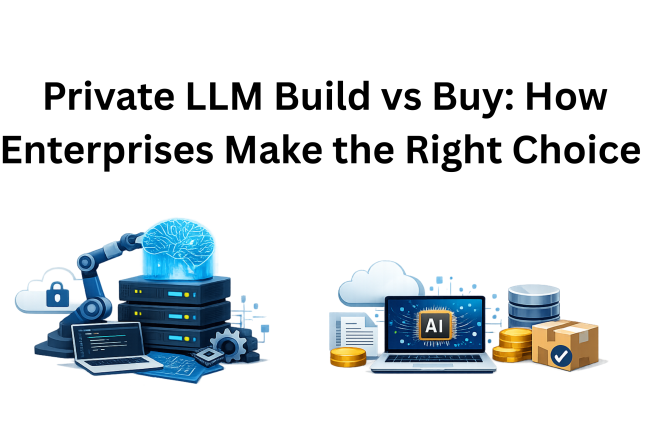
Large language models are fast becoming an essential component of enterprise technology. LLMs are revolutionising teamwork through automated workflows, customer support, internal copilots, and knowledge assistants. However, when acceptance increases, executives must decide whether to purchase an already-existing solution or create a private model from the ground up.


The choice between private LLM build vs buy is not just a technological one. Cost, timeliness, compliance, and long-term flexibility are all impacted. Whether AI turns out to be a costly experiment or a competitive advantage depends on the decision made by CEOs and other company executives.
Why Enterprises Need Private LLMs
Although most businesses manage confidential data, including contracts, financial information, customer records, and intellectual property, public AI tools are helpful for testing ideas. There is danger involved with sending this data to shared systems.
Private LLMs function within secure settings, including on-premises infrastructure or private clouds. This enables teams to tailor models to their own business requirements while maintaining data security. Businesses benefit from increased control and innovation as a result.
Option 1: Building a Private LLM
Building refers to creating or significantly altering an LLM in-house. Teams choose the architecture, use private data to train models, and oversee the whole process.
Benefits
Full control
Organizations decide how the model is trained, updated, and deployed.
Maximum customization
Models can reflect industry language, internal documents, and domain knowledge.
Stronger data ownership
All data and outputs stay within company boundaries.
Challenges
Building requires significant investment. Infrastructure, skilled talent, and ongoing maintenance add complexity. Time to market can also be slower, especially for teams new to AI engineering.
Option 2: Buying a Private LLM Solution
Buying involves partnering with a vendor that provides a pre-built private or dedicated LLM environment. The provider handles much of the setup and maintenance.
Benefits
Faster deployment
Enterprises can launch use cases quickly without long development cycles.
Lower upfront costs
There is less need for specialized hiring or heavy infrastructure.
Vendor knowledge
Reputable suppliers give support, security features, and tried-and-true technologies.
Challenges
In contrast to a totally in-house model, customisation could be restricted. Subscription fees may rise over time, and dependence on suppliers may limit flexibility.
Important Elements to Consider
When weighing Private LLM build vs buy, leaders should consider a few practical factors.
Security and Compliance
If regulations are strict, ensure either option meets internal standards for encryption, access control, and auditing.
Budget and Resources
Building demands higher initial investment. Buying spreads costs over time but may become expensive at scale.
Speed to Value
If AI must deliver results quickly, buying may be more practical. Building often requires patience.
Long-Term Plan
Building can establish long-term ownership and distinction for companies aiming to make AI a fundamental capability.
A Practical Approach
Many businesses choose a hybrid approach. To test use cases and demonstrate ROI, they start by purchasing a solution. They thereafter progressively develop internal capabilities for increased customisation and control. This well-rounded approach lowers risk while fostering expansion.
Conclusion
The Private LLM build vs buy debate has no well accepted solution. Goals, risk tolerance, and available resources all influence the best decision. Aligning the choice with corporate strategy rather than just technological trends is what really counts.
Businesses can select a strategy that promotes safe innovation and long-term success by carefully weighing control, cost, and scalability.
What's Your Reaction?