How to Define a Unique Value Proposition That Actually Converts
Learn how to create a value proposition that converts using brand positioning strategy, brand differentiation, and a clear positioning framework.
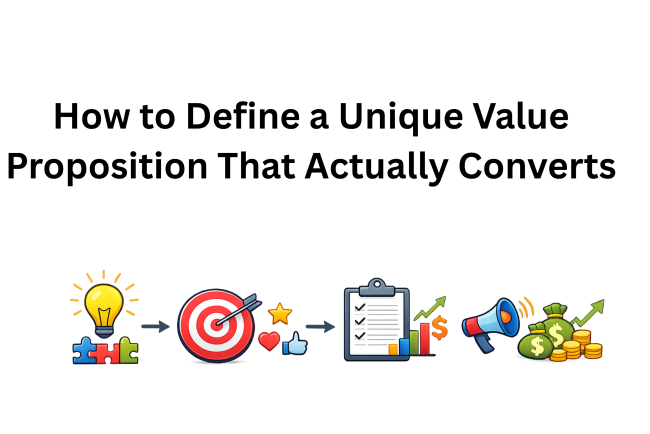
Most companies don’t struggle because they lack a good product. They struggle because they cannot clearly explain why it matters. And when that happens, even strong offerings get ignored.


A weak or generic value proposition doesn’t just affect messaging. It quietly damages your entire brand positioning strategy, reduces conversion rates, and makes sales cycles longer than they should be.
This is where clarity becomes a growth lever. A well-defined value proposition is not a tagline. It’s a decision filter, a positioning anchor, and a conversion driver.
Let’s break down how to define one that actually works in real buying scenarios.
What A Value Proposition Really Means In Practice
A value proposition answers a simple but critical question:
Why should a customer choose you over a credible alternative—right now?
But most businesses answer this poorly. They talk about features, generic benefits, or industry clichés.
A strong value proposition does three things:
-
It defines a clear outcome
-
It shows how that outcome is achieved differently
-
It makes the choice feel obvious
This is where brand differentiation becomes practical, not theoretical. If your message sounds interchangeable, your positioning is already weak.
And that’s why your value proposition must sit at the core of your brand positioning strategy, not as a surface-level statement.
Why Most Value Propositions Fail To Convert
Let’s be direct. Most value propositions fail because they are built from the inside out.
Companies describe what they do. Buyers care about what changes for them.
Here are common failure patterns:
-
Too broad: trying to appeal to everyone
-
Too vague: using words like “innovative” or “cutting-edge”
-
Too feature-heavy: listing capabilities instead of outcomes
-
Too safe: avoiding clear positioning to not exclude anyone
The result? No real brand differentiation.
And without differentiation, there is no reason to choose you.
A strong positioning framework forces you to make trade-offs. It helps you decide what you won’t say, which is often more important than what you will.
Start With The Outcome, Not The Offering
Most teams start with "What do we sell?”
Instead, start with "What changes for the customer after using us?”
That shift alone can transform your messaging.
Ask:
-
What measurable improvement do customers see?
-
What problem disappears or becomes manageable?
-
What risk gets reduced?
-
What opportunity becomes accessible?
Your value proposition should describe a before and after, not a product description.
This is where a strong brand positioning strategy begins to take shape. It aligns your message with real business impact, not internal capabilities.
Define Your Core Audience With Precision
A value proposition cannot work if it tries to speak to everyone.
Specificity increases conversion.
Instead of broad segments, define:
-
Industry context
-
Company stage or size
-
Decision-maker mindset
-
Urgency level of the problem
For example, messaging for an early-stage startup founder is very different from messaging for an enterprise buyer managing risk.
Clear audience definition sharpens brand differentiation. It also ensures your value proposition feels relevant, not generic.
A disciplined positioning framework always starts with who this is for and who it is not for.
Identify Your Real Competitive Context
You are not competing with “the market.” You are competing with:
-
Direct alternatives
-
Internal solutions (doing nothing or building in-house)
-
Status quo habits
Your value proposition must address that real context.
Ask:
-
What are buyers currently using instead of you?
-
Why do they stick with it?
-
What friction prevents them from switching?
This is where many brand positioning strategy efforts fall short. They ignore the actual decision environment.
Strong brand differentiation happens when you position against real alternatives, not abstract categories.
Build A Clear Value Equation
A converting value proposition often follows a simple structure:
Outcome + Differentiator + Proof
Let’s break that down.
Outcome
What result does the customer get?
Differentiator
Why is your approach meaningfully different?
Proof
Why should they believe you?
Example structure:
-
“We help [specific audience] achieve [specific outcome] by [unique approach], proven by [evidence].”
This is not a copywriting trick. It’s a simplified positioning framework that forces clarity.
And clarity is what drives conversion.
Make Your Differentiation Defensible
Not all differentiation is useful.
Saying “better service” or “faster delivery” is easy to copy. It doesn’t create a strong position.
Defensible brand differentiation comes from:
-
Unique methodology or process
-
Proprietary data or insights
-
Strong point of view
-
Clear strategic focus
Your value proposition should reflect something competitors cannot easily replicate.
This is where your brand positioning strategy becomes long-term, not just campaign-driven.
Stress-Test Your Value Proposition
Before you finalize anything, test it against real-world scenarios.
Ask:
-
Would a buyer immediately understand this?
-
Does it clearly explain why you’re different?
-
Can a competitor say the same thing?
-
Does it reduce decision friction?
If the answer is unclear, refine it.
A good positioning framework is iterative. It evolves based on feedback, sales conversations, and market response.
Align Messaging Across Touchpoints
A value proposition is only useful if it is consistently applied.
It should show up in:
-
Website messaging
-
Sales conversations
-
Product positioning
-
Marketing campaigns
Misalignment weakens trust.
Consistency strengthens recall and reinforces brand differentiation.
And over time, this consistency compounds into a stronger brand positioning strategy that buyers recognize and trust.
Keep It Simple, But Not Simplistic
Clarity does not mean oversimplification.
A strong value proposition should be:
-
Easy to understand
-
Specific in outcome
-
Grounded in reality
-
Focused on decision-making
Avoid jargon. But don’t remove substance.
A well-built positioning framework balances simplicity with depth.
Final Takeaway
A value proposition that converts is not written in isolation. It is built through structured thinking.
It forces you to define the following:
-
Who you serve
-
What outcome do you deliver
-
Why are you different
-
Why are you credible
And when done right, it becomes the foundation of your brand positioning strategy, strengthens brand differentiation, and creates a repeatable positioning framework that scales across your business.
If your current messaging feels interchangeable, this is the place to fix it.
FAQs
What is a unique value proposition in simple terms?
A unique value proposition clearly explains what outcome you deliver, who it is for, and why you are different. It helps buyers quickly understand why they should choose you.
How does a value proposition impact conversion rates?
A clear value proposition reduces confusion and decision friction. It makes the benefit obvious, which improves engagement, leads, and overall conversion rates.
How is brand positioning strategy connected to value proposition?
Your value proposition is the core expression of your brand positioning strategy. It translates positioning into a clear, buyer-facing message.
What makes brand differentiation strong and effective?
Strong brand differentiation is specific, defensible, and relevant. It highlights something competitors cannot easily replicate and that customers actually care about.
What's Your Reaction?