How to Build Internal AI Copilots for SaaS
Learn how to build an Internal AI Copilot for SaaS to improve productivity, automate workflows, and deliver smarter user experiences for scalable business growth.
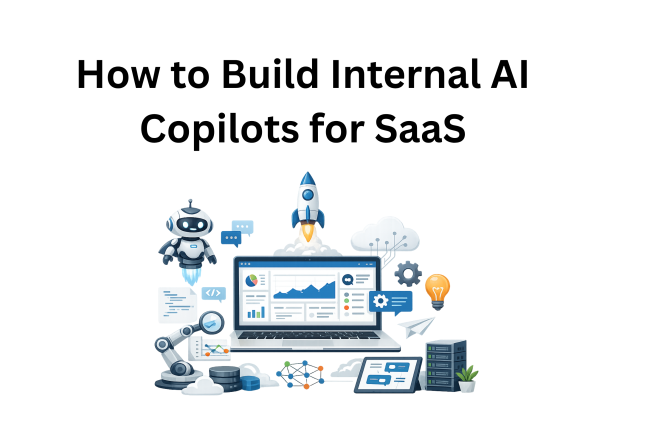
Businesses are increasingly implementing AI-driven solutions to improve user experience and productivity as SaaS platforms develop. The Internal AI Copilot for SaaS, a smart assistant created to aid teams, automate processes, and enable data-driven decision-making, is among the most significant advancements. Developing an internal AI copilot is becoming a strategic requirement for CEOs and company executives.


What Is a SaaS Internal AI Copilot?
An AI-powered assistant built inside your SaaS platform that aids internal teams in completing tasks more quickly is called an Internal AI Copilot for SaaS. These copilots, which support departments like sales, customer success, operations, and product development, are made for staff members, in contrast to customer-facing AI products.
They can produce insights, automate tedious tasks, summarise data, and even help in decision-making.
Why Your SaaS Business Needs an Internal AI Copilot
1. Enhanced Operations Efficiency
By automating repetitive processes like reporting, data entry, and ticket processing, an internal AI copilot for SaaS minimises manual labour. Teams are able to concentrate on high-value tasks as a result.
2. Faster Decision Making
AI copilots assist executives make prompt, well-informed decisions by providing actionable insights through real-time analysis of massive datasets.
3. Enhanced Worker Efficiency
Workers can communicate with the copilot in plain language, which simplifies and expedites complicated operations.
Key Steps to Build an Internal AI Copilot for SaaS
Step 1: Clearly Define the Use Cases
Determine the areas where an Internal AI Copilot for SaaS can be most beneficial. Typical usage cases include:
-
Customer service automation
-
Forecasting and sales insights
-
Management of internal knowledge
-
Workflow automation
Step 2: Select the Appropriate Model Approach
Choose between using a hybrid method, large language models, or small language models. For better control, cost effectiveness, and data protection, many companies favour smaller, more refined models.
Step 3: Integrate Your Data Ecosystem
The quality of your AI copilot depends on the data it uses. To guarantee accurate and pertinent results, integrate it with databases, analytics tools, CRMs, and internal documentation systems.
Step 4: Pay Attention to Compliance and Security
Data security is essential. Make sure your Internal AI Copilot for SaaS runs in safe settings that adhere to industry standards and have role-based access controls.
Step 5: Create an Interface That Is Easy to Use
Usability determines adoption. Provide a conversational interface that makes it easy for staff members to communicate with the copilot.
Step 6: Continue to Train and Improve
Over time, AI copilots get better. To guarantee accuracy and relevance, update models with fresh data on a regular basis, track performance, and improve outputs.
Best Practices for Success
Priority Data Quality
Better results and more trustworthy insights from your Internal AI Copilot for SaaS are guaranteed by high-quality data.
Start Small, Then Grow
Start with a certain use case and progressively broaden it as you observe outcomes.
Align with Business Objectives
Make sure your AI copilot is in line with more general company goals, including increasing revenue, improving customer satisfaction, or streamlining operations.
Challenges to Think About
Data silos, model correctness, and integration complexity are some of the difficulties in developing an internal AI copilot for SaaS. Additionally, appropriate training and change management techniques are needed to guarantee employee acceptance.
Conclusion
Building an Internal AI Copilot for SaaS is a potent strategy for modern SaaS firms to boost productivity, creativity, and competitive advantage. Businesses can fully utilise AI and change the way their teams operate by concentrating on the appropriate use cases, guaranteeing data security, and consistently improving performance.
What's Your Reaction?