Healthcare SEO Services: How to Improve Your Medical Website’s Visibility
Learn how SEO can help healthcare businesses attract the right audience, build trust, improve search rankings, and generate more patient enquiries.
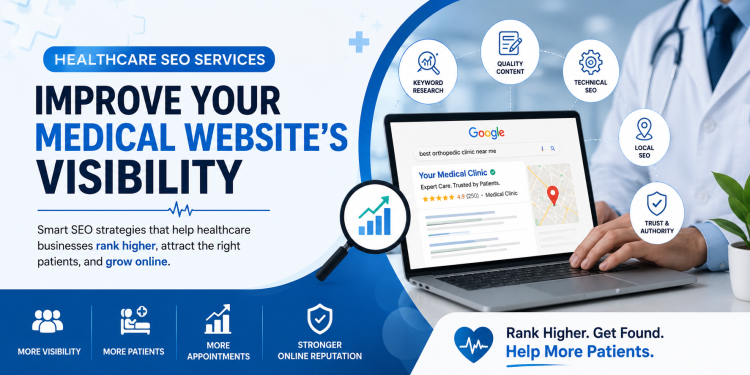


Imagine a patient searching Google for “best cardiologist near me,” “symptoms of diabetes,” or “dental clinic for root canal.” Your medical website offers the right service, but your competitors appear on the first page while your website sits somewhere on page three or four.
That creates a real problem.
Patients cannot contact a healthcare business they cannot find.
As per my research, online search has become an important part of how people find health information. According to the U.S. Centers for Disease Control and Prevention (CDC), 58.5% of U.S. adults used the internet to look for health or medical information during July–December 2022. The same report found that 41.5% used the internet to communicate with a doctor or doctor's office.
This is where healthcare SEO services can make a difference.
Why Medical Websites Struggle to Get Visibility
A healthcare website can have good doctors, useful treatments, and a professional design and still struggle to attract organic traffic.
Why?
In my experience, the problem often starts with content and search intent.
Many medical websites create pages only about their services. They may have pages such as “Our Services,” “About Us,” and “Contact,” but they miss the questions patients actually type into Google.
For example, someone looking for treatment may first search:
- What are the early signs of diabetes?
- How long does physiotherapy take?
- When should I see a dermatologist?
- What causes chronic back pain?
- How much does a dental implant cost?
These searches represent opportunities.
If your website provides clear, useful answers, you can introduce your healthcare brand before the patient makes a final decision.
Google also places extra importance on trust for health-related topics. Google explains that its systems give more weight to experience, expertise, authoritativeness, and trustworthiness for topics that can affect people's health and safety.
So healthcare SEO is not simply about adding keywords to pages. It requires useful content, clear medical expertise, technical SEO, and trust signals.
P — Problem: Your Patients May Not Find You
The biggest problem is simple: low visibility means fewer opportunities to reach potential patients.
A medical practice may invest heavily in doctors, equipment, facilities, and patient care. But if its website does not appear when people search for relevant services, competitors can capture that search demand.
As per data available from the CDC, more than half of U.S. adults searched online for health or medical information during the measured period.
That tells me one thing: healthcare businesses cannot treat Google visibility as an optional marketing activity.
A strong medical website should target both informational and commercial searches.
Informational content can answer patient questions, while service and location pages can help users find the right healthcare provider.
A — Agitation: Publishing More Blogs Is Not Enough
Many businesses think publishing dozens of blogs will automatically improve rankings.
As I found it over research, that approach does not always work.
Google specifically advises website owners to create people-first content, rather than content produced mainly to manipulate search rankings. Google also says there is no preferred word count that automatically helps a page rank.
This matters even more for medical websites.
A healthcare article should provide accurate information, identify its author, use credible sources, and make it clear when a qualified professional reviews the content.
For example, instead of writing a generic 1,000-word article about “back pain,” a healthcare website can create a useful guide covering common causes, warning signs, treatment options, when someone should consult a doctor, and related services offered by the practice.
That approach gives the reader something useful instead of simply giving Google another page to crawl.
S — Solution: Build SEO Around Patient Intent
A good healthcare SEO agency should start by understanding what patients search for and why they search for it.
Here are some practical steps I recommend.
1. Research Healthcare Keywords
Start with keywords related to your treatments, specialties, conditions, locations, and patient questions.
For example:
- Dermatologist in Manchester
- Diabetes treatment clinic
- Physiotherapy for back pain
- Dental implants near me
- Women's health specialist
A medical SEO agency can then map these keywords to the right pages instead of putting every keyword on one page.
2. Create Useful Medical Content
Build content around real patient questions.
Your content calendar can include treatment guides, condition explainers, preparation guides, recovery information, FAQs, and location-based healthcare content.
But accuracy should come first.
Google recommends making it clear who created content and providing information about the author's background where appropriate.
3. Improve Service and Location Pages
Your main treatment pages should explain what the service involves, who it helps, what patients can expect, and how they can contact the practice.
For businesses with multiple locations, create useful location pages rather than copying the same text and changing only the city name.
4. Strengthen Technical SEO
Even good content can struggle if Google cannot properly crawl, understand, or index your website.
A technical SEO review should check page speed, mobile usability, indexing, broken links, redirects, structured data, internal linking, and website architecture.
5. Build Trust
Healthcare websites need stronger trust signals than many ordinary business websites.
Add:
- Doctor or specialist profiles
- Author information
- Medical reviewer information where appropriate
- Credentials and qualifications
- References to reliable medical sources
- Clear contact information
- Updated content
- Patient-focused explanations
Google states that trust is the most important part of E-E-A-T and gives extra weight to these quality concepts for health-related topics.
What Results Can Healthcare SEO Produce?
One existing case study gives a useful example.
Direction.com reported that its SEO work for Craft Body Scan, a preventive healthcare provider, increased monthly organic traffic from 4,851 to 86,460 visitors in about one year—an increase of roughly 1,682%. The campaign included service pages, location pages, blogs, technical SEO, local optimization, digital PR, and conversion-focused work.
I would not treat this result as a promise for every healthcare business. SEO results vary based on competition, website authority, location, content quality, technical condition, and many other factors.
However, the case study shows why healthcare SEO works best as a complete strategy rather than a simple blogging exercise.
Choose the Right Healthcare SEO Consultant
If you plan to invest in SEO, choose a healthcare SEO consultant who understands both search engines and the healthcare industry.
Ask how they handle medical content, keyword research, technical SEO, local search, content reviews, internal linking, and reporting.
A good consultant should also explain what they plan to improve and how they will measure progress.
Do not focus only on rankings.
Look at organic traffic, qualified enquiries, appointment requests, visibility for non-branded searches, engagement, and conversions.
Final Thoughts
As per my experience, healthcare SEO works best when businesses stop thinking only about rankings and start thinking about patients.
People search Google because they want answers, treatment information, specialists, and healthcare providers they can trust.
Your website should be ready when that search happens.
A reliable medical SEO company can help you build that visibility through keyword research, useful content, technical improvements, local SEO, and trust-focused optimization.
The goal is not simply to get more visitors.
The goal is to help the right patients find the right healthcare information—and then make it easy for them to take the next step.
What's Your Reaction?