What Is Enterprise LLM Governance and Why Does It Matter?
Learn what Enterprise LLM Governance is, why it matters for risk, compliance, and how businesses can manage large language models safely and effectively.
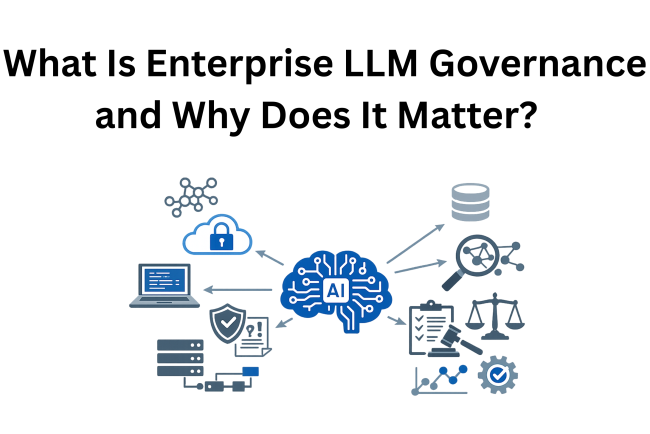
The use of large language models (LLMs) in routine business processes is rapidly expanding. These systems, which range from internal knowledge assistants and decision support tools to automated customer care, are changing the way businesses operate. However, this authority also carries responsibility. LLMs can create security concerns, compliance problems, and expensive errors in the absence of clear controls.


That’s where Enterprise LLM Governance comes in.
Enterprise LLM governance, to put it simply, is the framework that lets businesses oversee, manage, and regulate the creation, implementation, and usage of big language models within the company. It guarantees that AI systems continue to be safe, dependable, compliant, and in line with corporate objectives.
For executives and business leaders, governance isn’t optional, it’s essential.
Understanding Enterprise LLM Governance
The policies, procedures, and resources that direct ethical AI use at scale are referred to as enterprise LLM governance. It includes everything from access control and continuous monitoring to data privacy and model evaluation.
Consider these to be AI's guardrails.
Teams may swiftly implement models without governance, but doing so exposes the business to risks like:
-
Leakage of data
-
Inaccurate or biased results
-
Violations of regulations
-
Loss of client confidence
AI turns into a benefit rather than a liability when governance is in place.
Why Governance Matters for Enterprises
Unpredictable results can be produced by LLMs. Even minor mistakes can have major repercussions in regulated fields like finance, healthcare, or law. Through testing, validation, and supervision, enterprise LLM governance lowers these risks.
Compliance and Data Security
Strict data protection measures are required by modern rules. Governance guarantees that models adhere to industry standards and privacy laws and that sensitive data is handled appropriately.
Reliability and Excellence
The performance of AI tools varies. Governance frameworks establish performance, accuracy, and dependability standards. This enables teams to assess models before to production and sustain steady outcomes throughout time.
Executive Accountability
The decision-making process of AI must be transparent to leadership teams. Leaders can safely stand behind AI-driven results thanks to enterprise LLM governance's openness, reporting, and audit trails.
Key Components of a Strong Governance Framework
A practical governance model often consists of the following essential components:
-
Clear policies: Specified guidelines for the development and application of AI tools
-
Access controls: Restricting who is able to use or train models
-
Assessing the model's accuracy, bias, and safety
-
Monitoring: Following deployment, keeping tabs on behaviour and performance
-
Documentation: Keeping track of compliance data and audit trails
By taking these actions, LLMs are guaranteed to remain in line with company strategy and technological requirements.
How Companies Can Begin
A complicated system is not necessary right away. Scale carefully and start small.
Start by determining the existing applications of LLMs. Next, establish fundamental guidelines for permissions and data processing. Assign ownership to particular teams and establish monitoring procedures. Formalise these procedures into an enterprise LLM governance program over time.
Consistent control, not bureaucracy, is the aim.
The Bottom Line
Unmanaged AI is dangerous, but AI innovation is fascinating. Adopting huge language models responsibly while safeguarding consumers, data, and brand reputation is made possible by enterprise LLM governance.
CEOs and other corporate executives view governance as a strategic advantage rather than a technical detail. The businesses that scale securely and succeed in the future are those who build confidence in their AI systems now.
What's Your Reaction?