AI vs Traditional Learning: Key Differences Enterprises Must Understand
Explore AI vs traditional learning, compare benefits, costs, and scalability, and learn how enterprises can choose smarter, future-ready training strategies.
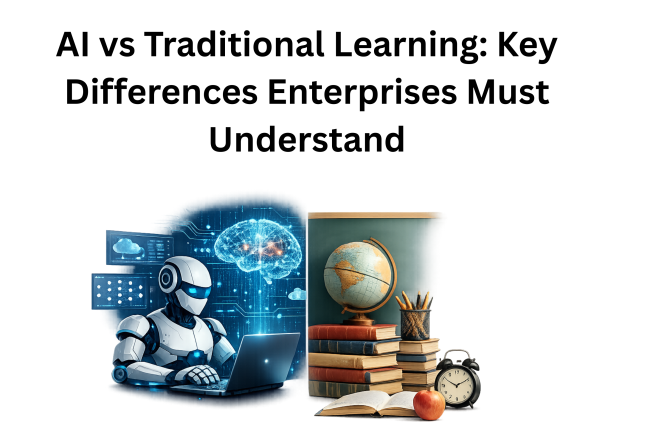
The skills of the workforce are changing more quickly than before. Organisations are being forced to reconsider how their staff learn and develop as a result of new technology, changing client expectations, and digital transformation. Static online courses and classroom sessions were the norm for many years. Intelligent systems are changing the way people study today.


This change has spurred a crucial discussion: which method better equips teams for today's business issues, artificial intelligence or classical learning?
The solution for CEOs and company executives goes beyond training strategies. It has to do with long-term competitiveness, cost effectiveness, and productivity. Businesses can make more informed investments and achieve quantifiable outcomes by being aware of the distinctions.
What Is Traditional Learning?
Traditional learning typically includes instructor-led training, workshops, seminars, and fixed eLearning modules. It follows a structured, one-size-fits-all format where every employee receives the same content at the same pace.
This approach has worked for decades because it’s predictable and easy to organize. Companies can schedule sessions, track attendance, and ensure standardized knowledge delivery.
However, it has limitations.
Content becomes outdated quickly. Employees often forget what they learn after a few weeks. And scaling training across global teams can be slow and expensive.
While reliable, traditional methods often struggle to keep up with today’s rapid change.
What Is AI Powered Learning?
AI powered learning uses intelligent systems to personalize and automate training. Instead of fixed courses, employees receive content tailored to their roles, skill levels, and progress.
These platforms analyze behavior, recommend next steps, and adapt in real time. If someone struggles with a topic, the system provides extra support. If they advance quickly, it skips repetitive material.
In the conversation around AI vs traditional learning, this adaptability is where AI stands out most.
Learning becomes continuous rather than occasional, and employees get help exactly when they need it.
Key Differences Enterprises Should Know
Personalisation
Traditional learning treats everyone the same. AI customizes content for each individual. This leads to faster skill development and higher engagement.
Scalability
Classroom training requires instructors, scheduling, and logistics. AI platforms scale instantly across locations and time zones, making global rollouts easier and more cost-effective.
Speed of Updates
Updating traditional materials can take weeks or months. AI systems can refresh content quickly, keeping training aligned with new tools or policies.
Data and Insights
Traditional programs often rely on completion rates. AI provides deeper analytics, tracking progress, identifying skill gaps, and predicting outcomes. Leaders gain clearer visibility into workforce readiness.
These distinctions highlight why many enterprises are rethinking AI vs traditional learning strategies.
Cost and Efficiency Considerations
At first glance, traditional learning may seem less expensive. But travel, instructor fees, and lost productivity add up.
AI solutions often require upfront investment but reduce long-term costs through automation and scalability. Employees spend less time away from work, and training becomes more targeted.
For executives, this translates into better ROI and measurable performance improvements.
Finding the Right Balance
This isn’t about completely replacing one approach with the other.
Many successful organizations combine both. Complex topics may still benefit from human-led sessions, while AI handles ongoing, personalized development.
A blended strategy allows enterprises to get the best of both worlds.
When evaluating AI vs traditional learning, the goal isn’t choosing sides; it’s choosing what drives results.
The Bottom Line
Learning strategies directly impact business growth. Companies that rely only on outdated methods risk falling behind. Those that embrace intelligent, flexible systems stay agile and competitive.
By understanding the real differences between AI vs traditional learning, leaders can design programs that empower employees, reduce costs, and future-proof their workforce.
In today’s market, smarter learning isn’t just an advantage, it’s a necessity.
What's Your Reaction?